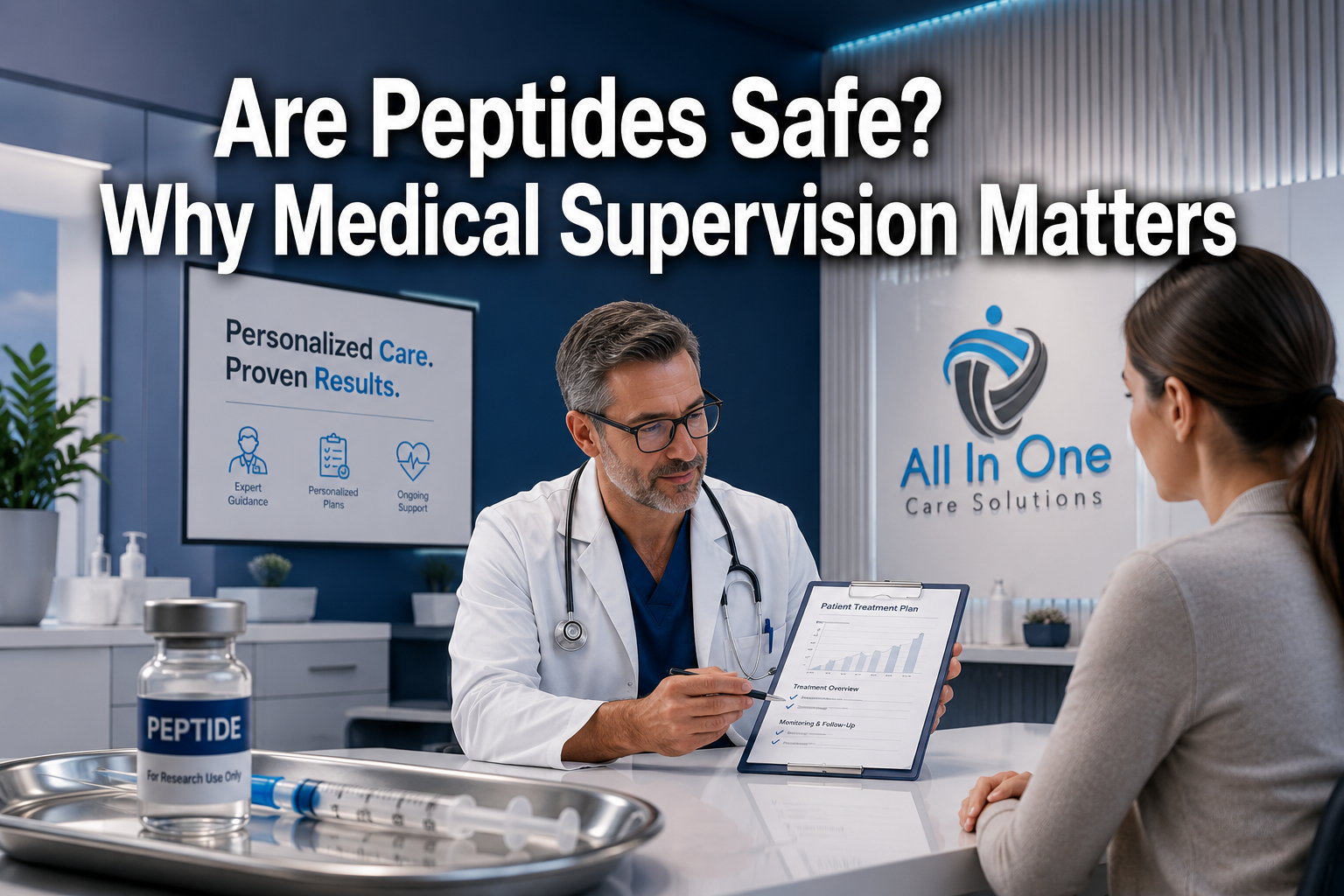
Are Peptides Safe? Why Medical Supervision Matters
Last updated: June 10, 2026
Quick Answer: Peptides are generally considered safe when prescribed and monitored by a licensed physician using pharmaceutical-grade formulations from an accredited compounding pharmacy. The key risk is not the peptide molecule itself but the source, dosage, and lack of professional oversight. Buying peptides online without a prescription or using unregulated “research-grade” products carries serious health risks that medically supervised therapy avoids.
Key Takeaways
- Peptides are short chains of amino acids that signal specific biological processes in the body, such as tissue repair, hormone release, and metabolism.
- FDA-approved peptide drugs exist, but many peptides used in wellness clinics are compounded medications, which are not individually FDA-approved.
- Medical supervision matters because dosing errors, contaminated products, and drug interactions can cause real harm.
- U.S. state medical boards, including Alabama’s, have issued formal warnings about physicians prescribing non-FDA-approved “research-grade” peptides [10].
- Common side effects of peptide injections include injection-site reactions, water retention, and fatigue, most of which are manageable under physician care.
- Lab testing before starting therapy helps identify contraindications such as active cancer, hormonal imbalances, or kidney disease.
- Most peptide therapies are not covered by insurance and are paid out of pocket, with costs ranging from roughly $150 to $500 or more per month depending on the protocol.
- Results typically appear within four to twelve weeks, depending on the peptide and the individual’s health baseline.
- Buying peptides online without a prescription is legal in a gray area but carries significant contamination and dosing risks.
- Working with a primary care physician in Miami who can order baseline labs and monitor your response is the safest path to peptide therapy.
What Exactly Are Peptides and How Do They Work in the Body
Peptides are short chains of amino acids, the same building blocks that make up proteins. They act as biological messengers, telling cells to perform specific tasks such as releasing growth hormone, repairing tissue, reducing inflammation, or regulating metabolism [1].
Your body already produces hundreds of peptides naturally. The ones used in medical therapy are either synthesized versions of those naturally occurring molecules or modified analogs designed to produce a more targeted effect. For example:
- BPC-157 is a synthetic peptide studied for its role in tissue healing and gut repair.
- CJC-1295 / Ipamorelin is a combination that stimulates growth hormone release from the pituitary gland.
- Semaglutide and tirzepatide are GLP-1 receptor agonist peptides approved by the FDA for type 2 diabetes and weight management. You can learn more about how these compare in our tirzepatide vs. semaglutide breakdown.
Because peptides are relatively small molecules, many can be injected subcutaneously (just under the skin) and absorbed quickly. Some are available as nasal sprays or oral formulations, though injectable forms tend to have higher bioavailability [2].
Are Peptides Safe? Understanding the Real Risks
Peptides used in supervised clinical settings have a generally favorable safety profile, but the question “Are Peptides Safe? Why Medical Supervision Matters” cannot be answered without separating two very different scenarios: physician-supervised therapy versus self-administration of unregulated products [5].
Under medical supervision, risks are manageable. Physicians screen patients for contraindications, select appropriate peptides, prescribe accurate doses, and monitor for adverse effects through follow-up labs and consultations.
Without supervision, risks multiply. Research-grade peptides sold online are not manufactured under the same quality standards as pharmaceutical-grade compounds. They may contain impurities, incorrect concentrations, or microbial contamination [4]. In April 2026, regulators issued fresh safety warnings about unapproved peptide products circulating in consumer markets, underscoring how quickly this risk landscape is changing [4].
Key risk factors when peptides are used without medical oversight:
- Contaminated or mislabeled products from unverified online sources
- Incorrect dosing leading to hormonal imbalances or unwanted side effects
- Drug interactions with existing medications (blood thinners, diabetes drugs, hormone therapies)
- Delayed diagnosis of an underlying condition that peptides may worsen, such as a hormone-sensitive tumor [9]
Decision rule: If you are considering peptide therapy and have any chronic condition, current medication regimen, or personal or family history of cancer, physician evaluation is not optional. It is the minimum standard of care.
What Medical Conditions Can Peptides Help Treat
Peptides are used in supervised clinical settings to address a range of conditions, though the evidence base varies by peptide and indication [3].
Well-supported uses include:
| Condition or Goal | Relevant Peptide(s) | Evidence Level |
|---|---|---|
| Growth hormone deficiency | Sermorelin, CJC-1295/Ipamorelin | Moderate to strong |
| Obesity and metabolic syndrome | Semaglutide, tirzepatide | Strong (FDA-approved) |
| Tissue and joint repair | BPC-157 | Preliminary (animal + early human) |
| Sexual dysfunction | PT-141 (Bremelanotide) | Moderate (FDA-approved for women) |
| Immune modulation | Thymosin Alpha-1 | Moderate |
| Anti-aging and cellular energy | NAD+ (a related coenzyme, not a peptide) | Emerging |
Our medical weight loss programs in Miami Gardens incorporate GLP-1 peptide protocols as part of a comprehensive, physician-supervised plan that includes nutrition guidance and lab monitoring.
Who Should Not Use Peptide Treatments
Certain individuals should avoid peptide therapy or proceed only with very close physician monitoring. This is one of the most important reasons why medical supervision matters.
Absolute or strong contraindications include:
- Active or history of hormone-sensitive cancers (breast, prostate, ovarian)
- Pregnancy or breastfeeding
- Uncontrolled diabetes or thyroid disease
- Active autoimmune conditions (some peptides modulate immune response)
- Severe kidney or liver impairment, which affects peptide clearance [6]
Relative contraindications (requires physician judgment):
- Patients on anticoagulants or immunosuppressants
- Those with a history of pituitary tumors
- Adolescents and children, whose hormonal axes are still developing
Common mistake: Patients sometimes assume that because peptides are “natural” or amino acid-based, they carry no risk. That reasoning is incorrect. Insulin is also a peptide, and incorrect dosing is life-threatening. The molecular origin of a compound does not determine its safety margin.
What Side Effects Might Happen With Peptide Injections
Most side effects from medically supervised peptide injections are mild and temporary [6]. Knowing what to expect helps patients report problems early.
Common side effects:
- Redness, swelling, or bruising at the injection site
- Mild water retention, especially with growth hormone-stimulating peptides
- Fatigue or mild headache during the first one to two weeks
- Increased hunger (common with CJC-1295/Ipamorelin)
- Flushing or temporary skin changes
Less common but more serious:
- Elevated blood glucose (particularly with growth hormone secretagogues in pre-diabetic patients)
- Joint pain or carpal tunnel symptoms at high doses
- Hormonal shifts that require dose adjustment
- Allergic reactions, which are rare but possible with any injectable compound [5]
Physicians at a primary care clinic in Miami Gardens can monitor these effects through follow-up appointments and periodic lab work, adjusting protocols before minor issues become serious ones.
What Tests Do Doctors Run Before Prescribing Peptides
A responsible prescriber will not start peptide therapy without baseline testing. This is a core reason why the question “Are Peptides Safe? Why Medical Supervision Matters” keeps coming back to the clinical setting.
Standard pre-treatment labs typically include:
- Complete metabolic panel (kidney and liver function, blood glucose)
- Complete blood count (CBC)
- Hormone panel: IGF-1, testosterone, estradiol, thyroid (TSH, free T3/T4)
- Fasting insulin and HbA1c if metabolic risk is present
- PSA for men over 40 considering growth hormone protocols
- Lipid panel
These labs establish your baseline, identify contraindications, and give the physician a reference point for monitoring your response over time. Our medical laboratory services in Miami Gardens are available in-clinic, so patients can complete bloodwork and their consultation in a single visit.
How Peptide Treatments Compare to Traditional Medications
Peptides occupy a middle ground between conventional pharmaceuticals and natural supplements. Understanding that distinction helps patients make informed decisions.
Compared to traditional small-molecule drugs:
- Peptides tend to have higher target specificity, meaning they interact with fewer unintended receptors.
- They are generally metabolized into amino acids, which the body handles naturally.
- However, they often require injection because oral bioavailability is low for larger peptide molecules [7].
- Their regulatory status varies widely: some are FDA-approved drugs; others are compounded medications; still others are sold only as “research chemicals” with no human-use approval.
Compared to supplements:
- Peptides used in clinical settings are pharmaceutical-grade compounds, not over-the-counter products.
- They require a prescription and physician oversight in a legitimate clinical context.
- Their effects are more potent and more targeted than most dietary supplements.
The FDA has issued guidance on clinical pharmacology considerations for peptide drug products, reflecting the growing medical and regulatory attention this category is receiving [7].
Can I Buy Peptides Online Without a Prescription
Technically, some peptides are sold online labeled as “research chemicals” or “not for human use,” which places them in a legal gray zone. However, purchasing and self-administering these products carries significant risks that supervised therapy avoids [10].
Why this matters in 2026:
- U.S. state medical boards are now formally warning physicians against prescribing non-FDA-approved “research-grade” peptides, signaling increased regulatory scrutiny across the board [10].
- Products sold as research chemicals are not manufactured under pharmaceutical quality controls. Contamination, incorrect concentration, and sterility failures are documented problems [4].
- Self-injection without clinical guidance increases the risk of infection, incorrect dosing, and missing a contraindication that a physician would have caught.
The practical recommendation: If a vendor is selling you peptides without requiring a prescription or a medical consultation, that is a red flag, not a convenience. Seek a licensed provider who can conduct a proper evaluation, prescribe pharmaceutical-grade compounded formulations from an accredited pharmacy, and monitor your progress.
How Much Do Peptide Therapies Typically Cost
Peptide therapy is almost always a self-pay expense. Most health insurance plans do not cover compounded peptide protocols, though FDA-approved peptide drugs like semaglutide may be covered depending on your plan and diagnosis.
Typical cost ranges (estimates for 2026, Miami market):
| Protocol | Estimated Monthly Cost |
|---|---|
| CJC-1295 / Ipamorelin | $150 – $300 |
| BPC-157 | $100 – $250 |
| Sermorelin | $150 – $350 |
| Thymosin Alpha-1 | $200 – $500+ |
| GLP-1 peptides (compounded) | $200 – $400 |
These figures include the compounded medication but may not include the initial consultation, lab work, or follow-up visits. Ask your provider for a full cost breakdown before starting.
If cost is a concern, our clinic offers flexible medical payment plans so that supervised care remains accessible for self-pay patients in Miami, Hialeah, and Miami Lakes.
Are Peptide Treatments Covered by Insurance
Most compounded peptide protocols are not covered by insurance because they are not individually FDA-approved drugs. However, there are exceptions.
- FDA-approved peptide drugs (semaglutide, tirzepatide, bremelanotide) may be covered when prescribed for an approved indication and when medical necessity is documented.
- Lab work ordered as part of a comprehensive physical exam may be covered under preventive care benefits.
- Consultation visits with a primary care physician may be billed to insurance even if the peptide itself is not covered.
Patients with Oscar Health or other plans that include wellness benefits should ask their provider to verify coverage before their first appointment. Our team can help clarify what portions of your care plan may be billable.
What Are the Most Common Mistakes People Make With Peptides
Even patients who start with good intentions make avoidable errors. These are the most frequent ones seen in clinical practice.
- Skipping the consultation. Starting a peptide protocol without baseline labs means there is no way to measure progress or catch early problems.
- Buying from unverified online sources. Research-grade products lack pharmaceutical quality controls.
- Stacking multiple peptides without guidance. Combining growth hormone secretagogues with other hormonal therapies can produce unpredictable interactions.
- Stopping abruptly. Some peptide protocols require a gradual taper, particularly those affecting the hypothalamic-pituitary axis.
- Ignoring side effects. Mild water retention or fatigue in week one may be normal. Persistent joint pain or elevated blood glucose is not. Patients who do not report symptoms delay necessary dose adjustments.
- Expecting immediate results. Peptide therapy is not a quick fix. Tissue repair and hormonal optimization take weeks to months.
How Long Does It Take to See Results From Peptide Therapy
Most patients begin noticing initial changes within four to eight weeks, though meaningful, measurable outcomes often require three to six months of consistent therapy [9].
General timeline by goal:
- Sleep quality and energy: Two to four weeks
- Body composition changes: Eight to twelve weeks
- Tissue repair (BPC-157): Four to eight weeks for soft tissue; longer for complex injuries
- Hormonal optimization: Three to six months for full effect
- Immune modulation (Thymosin Alpha-1): Variable; depends on baseline immune status
Results vary based on age, baseline health, adherence to the protocol, lifestyle factors (sleep, nutrition, exercise), and whether the peptide is pharmaceutical-grade. A physician who monitors IGF-1 levels, body composition, and symptom scores can give you a much clearer picture of your individual trajectory than any general estimate.
What Are the Differences Between Synthetic and Natural Peptides
“Natural” and “synthetic” peptides are often discussed as if one is inherently safer than the other. The distinction is more nuanced.
Natural peptides are produced by the body or derived from food sources (collagen peptides in bone broth, for example). They are generally safe but have limited clinical potency.
Synthetic peptides are manufactured in a laboratory to replicate or modify naturally occurring sequences. The word “synthetic” does not mean inferior or unsafe. FDA-approved drugs like insulin and semaglutide are synthetic peptides produced under strict pharmaceutical standards [1].
The quality of manufacturing matters more than the origin. A synthetic peptide produced in an FDA-registered compounding pharmacy under USP standards is far safer than a “natural” peptide extract from an unverified source. When evaluating any peptide product, ask:
- Was it compounded by an accredited pharmacy?
- Does it have a certificate of analysis from an independent lab?
- Was it prescribed by a licensed physician after a medical evaluation?
If the answer to any of those questions is no, the product does not meet the standard of care expected in a supervised clinical setting.
Conclusion: Are Peptides Safe? The Answer Depends on How You Use Them
Peptides are not inherently dangerous, but they are not consequence-free either. The evidence shows that pharmaceutical-grade peptides, prescribed by a licensed physician after proper evaluation, carry a manageable risk profile for most healthy adults [3][5]. The danger comes from unregulated products, self-administration without clinical oversight, and the growing market of online vendors selling research-grade compounds directly to consumers.
In Miami, Miami Gardens, Hialeah, and Miami Lakes, adults seeking peptide therapy have access to medically supervised programs that include baseline lab work, physician consultations, pharmaceutical-grade compounding, and ongoing monitoring. That is the standard that protects your health and maximizes the clinical benefit of these treatments.
Your next steps:
- Schedule a comprehensive medical exam in Miami Gardens to establish your health baseline before any new therapy.
- Ask your provider to order the appropriate hormone and metabolic labs through our in-clinic lab testing services.
- Discuss your goals with a primary care doctor in Miami Gardens who can evaluate whether peptide therapy is appropriate for you.
- If cost is a barrier, review our flexible payment plan options before your visit.
Supervised care is not a formality. It is the difference between a treatment that works and one that causes harm. Call All In One Care Solutions today to schedule your consultation.
Frequently Asked Questions
Q: Are peptides legal in the United States?
A: FDA-approved peptide drugs are fully legal. Compounded peptides prescribed by a licensed physician are legal under federal compounding regulations. Peptides sold as “research chemicals” for human use exist in a legal gray area and are subject to increasing regulatory scrutiny as of 2026 [10].
Q: Can peptides cause cancer?
A: There is no established causal link between therapeutic peptides and cancer in healthy individuals. However, growth hormone-stimulating peptides are contraindicated in patients with active or history of hormone-sensitive cancers because they may accelerate tumor growth [9]. This is why physician screening before starting therapy is essential.
Q: How are peptides different from steroids?
A: Peptides and anabolic steroids work through completely different mechanisms. Peptides signal the body’s own hormonal systems (for example, stimulating natural growth hormone release), while anabolic steroids introduce synthetic hormones directly. Peptides generally carry a lower risk profile than anabolic steroids when used appropriately [2].
Q: Do I need a prescription for peptide therapy in Miami?
A: Yes, for any compounded peptide intended for human use, a prescription from a licensed physician is required. Clinics offering peptide therapy without a medical consultation and prescription are not operating within the standard of care.
Q: Can peptide therapy help with weight loss?
A: GLP-1 peptides such as semaglutide and tirzepatide have strong clinical evidence supporting weight loss in adults with obesity or metabolic syndrome. Other peptides marketed for fat loss have weaker evidence. Our medical weight loss programs in Hialeah use evidence-based peptide protocols under physician supervision.
Q: How often do I need to inject peptides?
A: Frequency depends on the specific peptide and protocol. Some are injected once daily, others two to three times per week. Your prescribing physician will provide a specific schedule based on your goals and the half-life of the compound.
Q: What happens if I stop peptide therapy?
A: Most peptide effects are not permanent. Stopping therapy typically leads to a gradual return to baseline over weeks to months. Abrupt discontinuation of growth hormone secretagogues does not cause withdrawal in the way that anabolic steroids can, but your physician should guide any tapering plan.
Q: Are there peptide therapies available in Spanish at your clinic?
A: Yes. All In One Care Solutions provides bilingual care in English and Spanish. Our team serves the Miami Gardens, Hialeah, and Miami Lakes communities with culturally competent, patient-centered care.
References
[1] What Are Peptides And Are They Safe Heres What To Know – https://www.pbs.org/newshour/health/what-are-peptides-and-are-they-safe-heres-what-to-know
[2] Are Peptides Safe – https://www.peptideeffect.com/articles/are-peptides-safe
[3] Peptide Safety Evidence – https://peptidesclinic.org/articles/peptide-safety-evidence/
[4] drugoffice.gov.hk – https://www.drugoffice.gov.hk/eps/news/showNews/newsTitle/consumer/2026-04-13/en/57193.html
[5] What Doctors Want Patients Know About Injectable Peptides – https://www.ama-assn.org/public-health/prevention-wellness/what-doctors-want-patients-know-about-injectable-peptides
[6] Peptide Therapy Safety Guide – https://sanctuarywellnessinstitute.com/peptide-therapy/peptide-therapy-safety-guide.php
[7] Clinical Pharmacology Considerations Peptide Drug Products – https://www.fda.gov/regulatory-information/search-fda-guidance-documents/clinical-pharmacology-considerations-peptide-drug-products
[9] Are Peptides Safe What You Need To Know Before Starting Peptide Therapy – https://drbnaples.com/are-peptides-safe-what-you-need-to-know-before-starting-peptide-therapy/
[10] Board Issues Official Notice Concerning The Prescribing Of Non Fda Approved Research Grade Peptides – https://www.albme.gov/press-release/board-issues-official-notice-concerning-the-prescribing-of-non-fda-approved-research-grade-peptides
Tags: peptide therapy Miami, are peptides safe, medical supervision peptides, peptide injections Miami Gardens, BPC-157 Miami, CJC-1295 Ipamorelin, compounded peptides, peptide side effects, medically supervised therapy, primary care Miami, peptide therapy safety, anti-aging clinic Miami