
How Often Should You Get a B12 Shot in Miami? A Medical Guide
Last updated: March 13, 2026
Quick Answer
For most healthy adults in Miami, B12 injections are typically given once per week during an initial loading phase (usually 4 weeks), then reduced to once monthly for maintenance. The exact frequency depends on your B12 levels, underlying health conditions, age, diet, and how your body responds to treatment. A licensed medical provider should determine your schedule — not a general wellness estimate.
Key Takeaways
- Loading phase: Most patients start with weekly B12 shots for 4 consecutive weeks to restore depleted levels.
- Maintenance phase: After loading, one injection per month is typical for ongoing support in otherwise healthy adults.
- Higher-need patients (diabetics on Metformin, adults over 50, vegans, or those with absorption issues) may need injections every 1–2 weeks long-term.
- Injections absorb at nearly 100% — bypassing the digestive system entirely, unlike oral supplements.
- Results vary by individual. Frequency should be guided by lab work and clinical evaluation, not self-diagnosis.
- All In One Care Solutions in Miami Gardens offers our B12 injection service in Miami Gardens with licensed medical professionals on-site.
- Walk-ins are welcome. Same-day appointments are available at 16191 NW 57 Ave, Miami Gardens, FL 33014.
- The current promotional package offers 4 professional B12 injections for just $60 — a significant savings for patients starting a loading phase.
- B12 injections are not a cure for any condition; they are a supportive wellness tool administered under medical supervision.
- Getting baseline labs before starting is strongly recommended to establish your actual B12 status.
What Is a B12 Injection and Why Does Frequency Matter?
A B12 injection delivers cyanocobalamin or methylcobalamin — two forms of vitamin B12 — directly into muscle tissue, typically the deltoid or gluteal muscle. Because the nutrient enters the bloodstream without passing through the gastrointestinal tract, absorption is essentially complete, regardless of gut health or intrinsic factor levels.
Frequency matters because B12 is a water-soluble vitamin the body does not produce on its own. It must come from food or supplementation. When stores are depleted, a single injection restores levels temporarily — but without a structured schedule, levels can drop again before the next dose. The goal of any B12 injection protocol is to first replenish, then maintain.
Why this is clinically important: B12 plays a direct role in red blood cell formation, nerve function, DNA synthesis, and energy metabolism. Irregular or infrequent dosing during a deficiency period may not provide consistent enough support to see meaningful improvement in symptoms like fatigue, brain fog, or low mood.
How Often Should You Get a B12 Shot in Miami? The Standard Protocol Explained
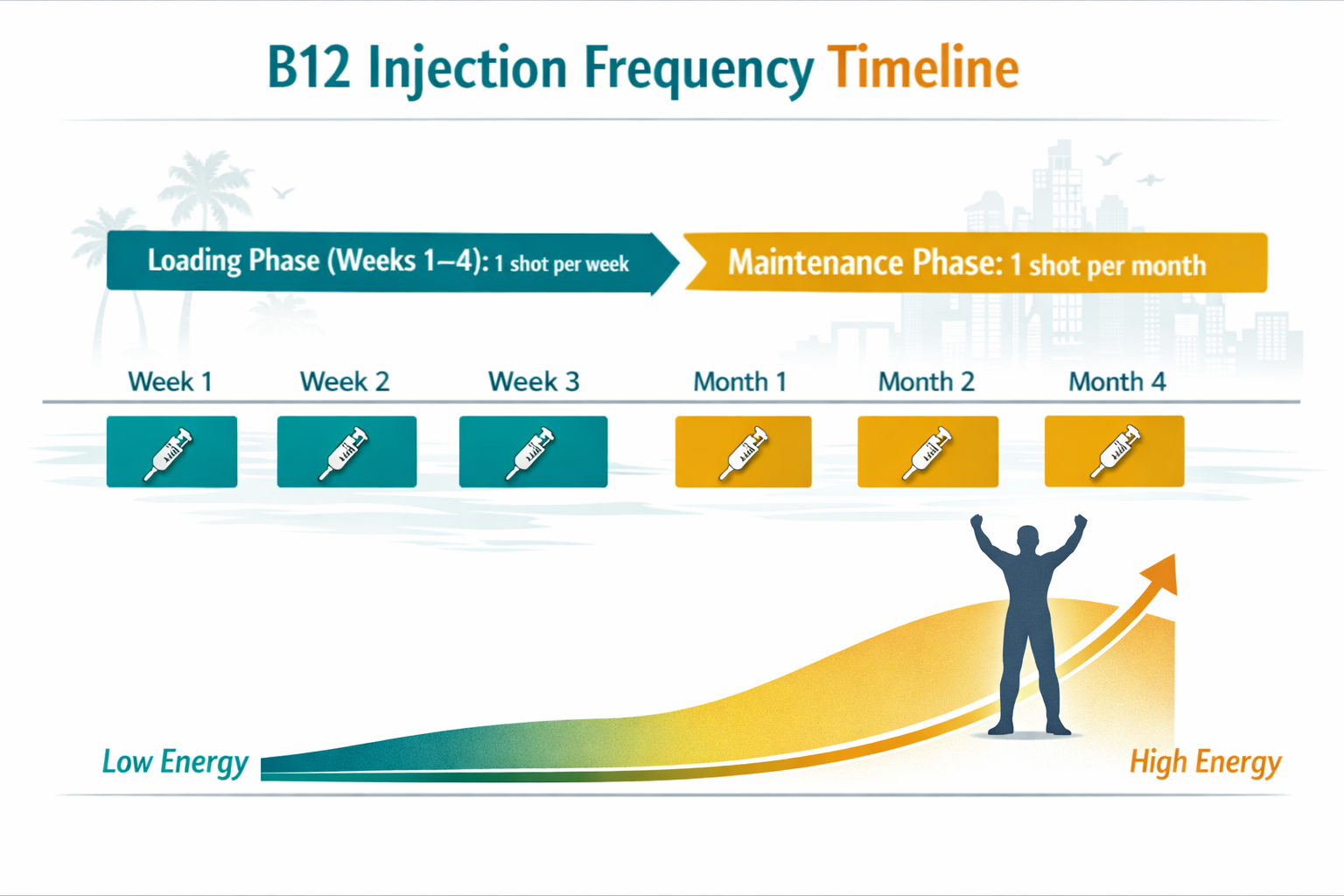
The answer to how often you should get a B12 shot in Miami depends on two distinct phases: the loading phase and the maintenance phase. Understanding both helps patients set realistic expectations and stay consistent.
The Loading Phase (Weeks 1–4)
For patients presenting with confirmed or suspected B12 deficiency, most clinical protocols recommend one injection per week for four consecutive weeks. This accelerated schedule is designed to rapidly replenish tissue stores that have been depleted — sometimes over months or years.
During this phase, patients often begin noticing improvements in energy, mental clarity, and mood within the first 2–3 weeks. However, individual responses vary, and some patients require a longer loading period based on lab results and symptom severity.
Clinical note: The National Institutes of Health (NIH) and clinical guidelines from the American Academy of Family Physicians recognize intramuscular B12 as an effective approach for patients with malabsorption or confirmed deficiency. Protocols vary by provider and clinical presentation.
The Maintenance Phase (Monthly Ongoing)
Once B12 levels are restored through the loading phase, most healthy adults transition to one injection per month. This schedule is sufficient to maintain adequate serum B12 levels in individuals with a functioning digestive system and a reasonably balanced diet.
For patients in Miami who are otherwise healthy and using B12 shots primarily for general wellness support — rather than treating a clinical deficiency — monthly injections are typically the standard recommendation.
When More Frequent Injections May Be Appropriate
Certain patient populations may benefit from injections every 1–2 weeks on an ongoing basis rather than monthly. These include:
- Adults over 50 whose gastric acid production has declined, reducing natural B12 absorption
- Patients taking Metformin for diabetes, which is well-documented to interfere with B12 absorption over time
- Vegans and strict vegetarians who have no dietary source of B12
- Patients with pernicious anemia or other conditions affecting intrinsic factor production
- Individuals with gastrointestinal conditions such as Crohn’s disease or post-bariatric surgery anatomy
A comprehensive medical exam and baseline lab work are the most reliable way to determine which schedule applies to you.
Why Miami Residents Have Specific B12 Needs
Miami’s population is diverse, active, and increasingly health-conscious — but several local lifestyle factors make B12 deficiency more common than many residents realize.
Diet patterns: South Florida has a large and growing vegan and plant-based community, particularly in Miami Gardens, Hialeah, and Miami Lakes. Plant-based diets contain little to no naturally occurring B12, making supplementation essential rather than optional.
Chronic condition prevalence: Miami-Dade County has a significant population of adults managing type 2 diabetes. Long-term Metformin use — one of the most prescribed diabetes medications in the country — is associated with measurable reductions in serum B12 over time. If you are a diabetic patient in Miami, discussing B12 status with your provider is worth prioritizing. Our primary care services in Miami Gardens include diabetes management alongside nutritional support.
Active lifestyle demands: Miami athletes, gym-goers, and outdoor workers place higher metabolic demands on their bodies. B12 is involved in red blood cell production and oxygen delivery to muscles — making adequate levels relevant to anyone training consistently.
Stress and sleep disruption: Working professionals and parents in Miami Gardens and surrounding communities often deal with chronic stress and irregular sleep, both of which can amplify the symptoms of low B12 — fatigue, irritability, and poor concentration — even when deficiency is mild.
How B12 Injections Work: Absorption vs. Oral Supplements
One of the most common questions patients ask is whether they can simply take a B12 pill instead of getting an injection. The clinical answer depends on why B12 levels are low in the first place.
Oral B12 supplements rely on a protein called intrinsic factor, produced in the stomach lining, to be absorbed through the intestinal wall. If a patient has reduced intrinsic factor production — which becomes more common after age 40 — or any gastrointestinal condition affecting absorption, oral supplements may not raise blood levels effectively, regardless of the dose on the label.
Injections bypass this entirely. The B12 goes directly into muscle tissue, enters the bloodstream, and is available for cellular use without any digestive processing. This is why injection protocols are considered the gold standard for correcting deficiency in patients with absorption challenges.
For patients who absorb B12 normally and are using injections for wellness support, the advantage is still meaningful: injections deliver a precise, controlled dose with confirmed bioavailability, while oral supplement absorption can vary significantly based on gut health, stomach acid levels, and the specific supplement formulation.
Patients interested in a broader nutritional approach may also benefit from exploring IV therapy options in Miami Gardens, which can combine B12 with other supportive nutrients in a single session.
What the Experience Is Like at All In One Care Solutions
Getting a B12 injection at All In One Care Solutions in Miami Gardens is straightforward, quick, and administered by licensed medical professionals in a clean clinical setting — not a spa or unregulated wellness pop-up.
Here is what patients can expect:
- Check-in: Walk-ins are welcome, or patients can book a same-day appointment by calling 786-446-9414.
- Brief intake: A staff member reviews your health history and any relevant symptoms or medications.
- Lab option: Patients who want to confirm their B12 status before starting can access in-house lab services at the same location.
- Injection: The B12 shot is administered intramuscularly — typically in the upper arm — in under two minutes. Most patients describe minimal discomfort.
- Follow-up schedule: The clinical team will recommend a frequency schedule based on your health profile and goals.
The entire visit, including intake, typically takes 15–20 minutes. There is no lengthy wait, no referral required, and no pressure to purchase additional services.
Patients who want to combine B12 support with a broader wellness approach can also ask about the Skinny Shot package or IV drip therapy, both available at the same clinic.
Who Benefits Most From a Structured B12 Injection Schedule?
Understanding how often to get a B12 shot in Miami means understanding who actually needs a structured protocol versus occasional supplementation. Three patient profiles stand out consistently.
Profile 1 — The working professional over 40 in Miami Gardens or Hialeah This patient has been feeling tired despite adequate sleep, notices slower thinking at work, and has been told their bloodwork is “normal” — but B12 was never specifically tested. After 40, gastric acid production declines gradually, reducing B12 absorption from food. A monthly maintenance injection after a 4-week loading phase may help support energy and cognitive function. Results vary by individual.
Profile 2 — The vegan or plant-based resident in Miami Lakes This patient eats a clean, whole-food diet but has eliminated all animal products. Since B12 occurs almost exclusively in animal-derived foods, dietary intake is effectively zero. Weekly injections during the loading phase, followed by bi-weekly or monthly maintenance, may be appropriate depending on lab results and how long the diet has been in place.
Profile 3 — The diabetic patient managing long-term Metformin use Research published in peer-reviewed journals has documented that long-term Metformin use is associated with reduced B12 absorption in a meaningful percentage of patients. This patient may benefit from more frequent injections — every 2–4 weeks — under the guidance of their primary care provider. The clinic’s primary care team can coordinate B12 support alongside existing diabetes management.
Common Mistakes to Avoid When Scheduling B12 Shots
Even well-intentioned patients sometimes approach B12 injections in ways that reduce their effectiveness. A few patterns worth avoiding:
- Skipping the loading phase. Starting with monthly injections when levels are already depleted means the body never fully replenishes its stores. The loading phase exists for a reason.
- Self-diagnosing frequency without labs. Guessing at a schedule based on how you feel is less reliable than basing it on actual serum B12 measurements. Lab testing is affordable and available on-site.
- Stopping too soon. Some patients feel better after one or two injections and discontinue. B12 stores take time to stabilize, and stopping early may result in a return of symptoms.
- Choosing unregulated providers. In Miami, B12 shots are offered in a range of settings — some medical, some not. Choosing a licensed clinic ensures proper screening, correct injection technique, and appropriate follow-up.
Frequently Asked Questions
Q: How often should I get a B12 shot if I have no diagnosed deficiency? For general wellness support in otherwise healthy adults, one B12 injection per month is a common recommendation after an initial loading phase. Confirm with a licensed provider based on your health history.
Q: Can I get a B12 shot every week indefinitely? Weekly injections are typically reserved for the loading phase or for patients with significant absorption issues. Long-term weekly dosing in healthy individuals is generally not necessary, though it is not harmful given B12’s safety profile. Your provider will guide the appropriate schedule.
Q: How long before I notice a difference? Some patients report improved energy within 48–72 hours of the first injection. Others notice gradual improvement over 2–4 weeks as levels stabilize. Results vary significantly by individual, starting B12 status, and overall health.
Q: Is there a risk of getting too much B12 from injections? B12 is water-soluble, meaning excess amounts are excreted through urine rather than stored to toxic levels. Serious adverse effects from B12 injections are rare. However, all injections should be administered by licensed professionals following proper clinical protocols.
Q: Do I need a prescription for a B12 injection in Miami? In Florida, B12 injections are administered under medical supervision at licensed clinics. No external prescription is required when visiting a clinic like All In One Care Solutions — the medical team handles the clinical assessment on-site.
Q: What is the difference between cyanocobalamin and methylcobalamin B12? Both are effective forms of B12. Methylcobalamin is the active form the body uses directly and may be preferred for patients with certain metabolic variations. Cyanocobalamin is widely used in clinical settings and converts to active B12 after absorption. Ask the clinical team which form is used and whether an alternative is appropriate for you.
Q: Can I combine B12 injections with IV therapy? Yes. Many patients at All In One Care Solutions combine B12 shots with IV therapy sessions for a more comprehensive nutritional support approach. The clinical team can help design a protocol that fits your goals and schedule.
Q: Is the $60 for 4 injections offer available for walk-ins? Yes. The current promotional package — 4 professional B12 injections for $60 — is available to walk-in patients and those with same-day appointments. Availability may vary; calling ahead is recommended.
Conclusion
The question of how often you should get a B12 shot in Miami does not have a single universal answer — but it does have a clear clinical framework. Start with a loading phase of weekly injections for four weeks, then transition to monthly maintenance. Adjust frequency upward if you are over 50, vegan, diabetic, or have absorption challenges. Always base your schedule on lab results and guidance from a licensed provider, not guesswork.
Miami residents in Miami Gardens, Hialeah, Miami Lakes, and surrounding Miami-Dade communities have access to professional, supervised B12 injection services without the long waits or high costs of traditional medical settings. The most important step is simply starting with the right information — and the right clinic.
Actionable next steps:
- Schedule a same-day appointment or walk in to All In One Care Solutions
- Ask about baseline B12 lab testing to confirm your current levels
- Start a 4-shot loading phase and discuss a maintenance schedule with the clinical team
- Explore complementary services like IV therapy or primary care if you have underlying conditions affecting B12 absorption
Ready to Start Your B12 Protocol?
All In One Care Solutions in Miami Gardens is currently offering our B12 injection service in Miami Gardens — 4 professional B12 injections for just $60, a 70% savings off the regular rate. Walk-ins are welcome, and same-day appointments are available.
Visit our B12 injection page, call 786-446-9414, or stop by at 16191 NW 57 Ave, Miami Gardens, FL 33014.
Results may vary. All injections are administered by licensed medical professionals.
References
- National Institutes of Health, Office of Dietary Supplements. Vitamin B12 Fact Sheet for Health Professionals. Updated 2023. https://ods.od.nih.gov/factsheets/VitaminB12-HealthProfessional/
- Langan, R.C., & Goodbred, A.J. Vitamin B12 Deficiency: Recognition and Management. American Family Physician. 2017;96(6):384–389.
- Aroda, V.R., et al. Long-term Metformin Use and Vitamin B12 Deficiency in the Diabetes Prevention Program Outcomes Study. Journal of Clinical Endocrinology & Metabolism. 2016;101(4):1754–1761.
- Stabler, S.P. Vitamin B12 Deficiency. New England Journal of Medicine. 2013;368(2):149–160.
- Pawlak, R., et al. How prevalent is vitamin B12 deficiency among vegetarians? Nutrition Reviews. 2013;71(2):110–117.
Tags: B12 injections Miami, B12 shot frequency, how often B12 shot, vitamin B12 Miami Gardens, B12 loading phase, B12 maintenance schedule, B12 injection Miami-Dade, B12 deficiency Miami, B12 shot near me, wellness clinic Miami Gardens, IV therapy Miami, B12 injection schedule