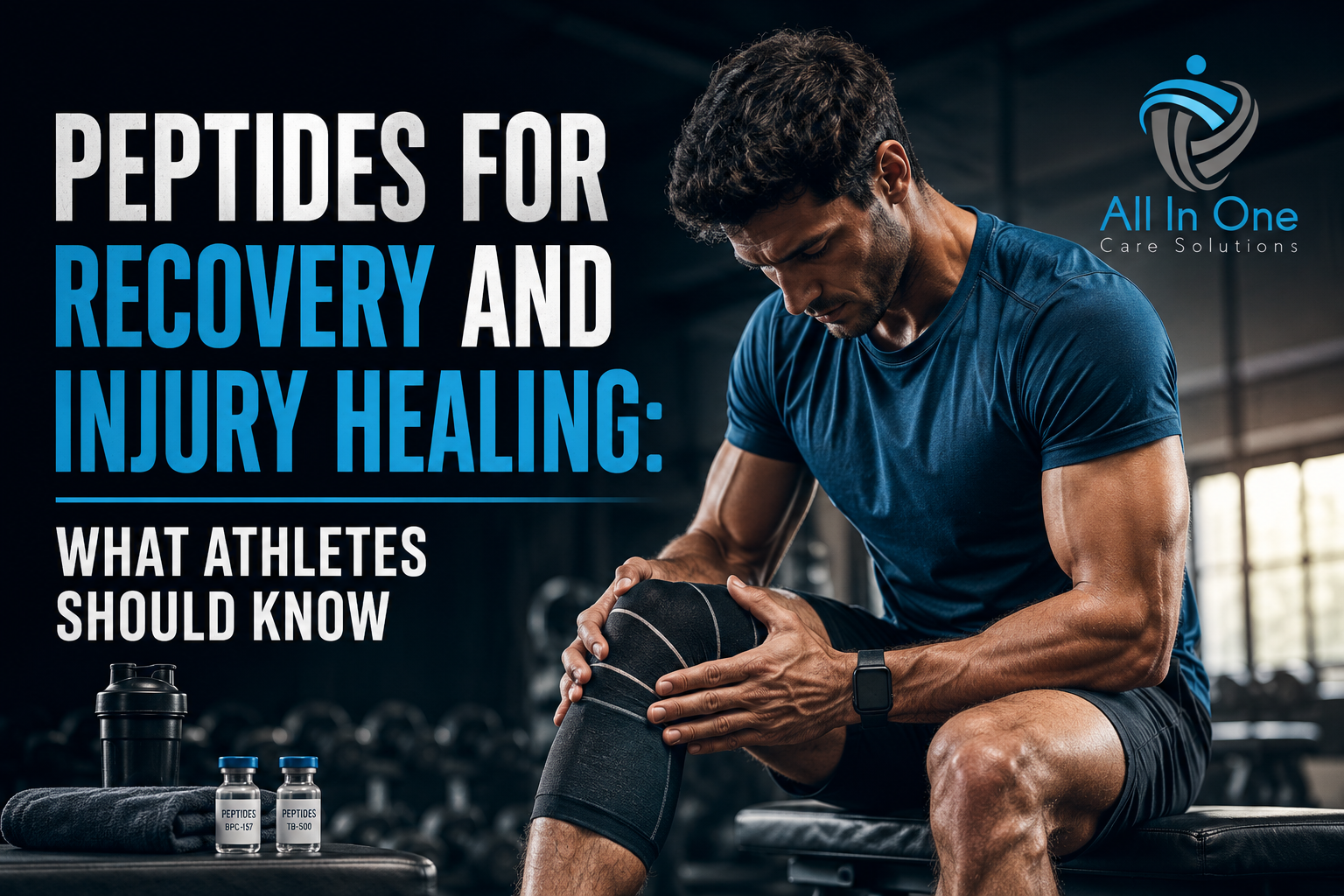
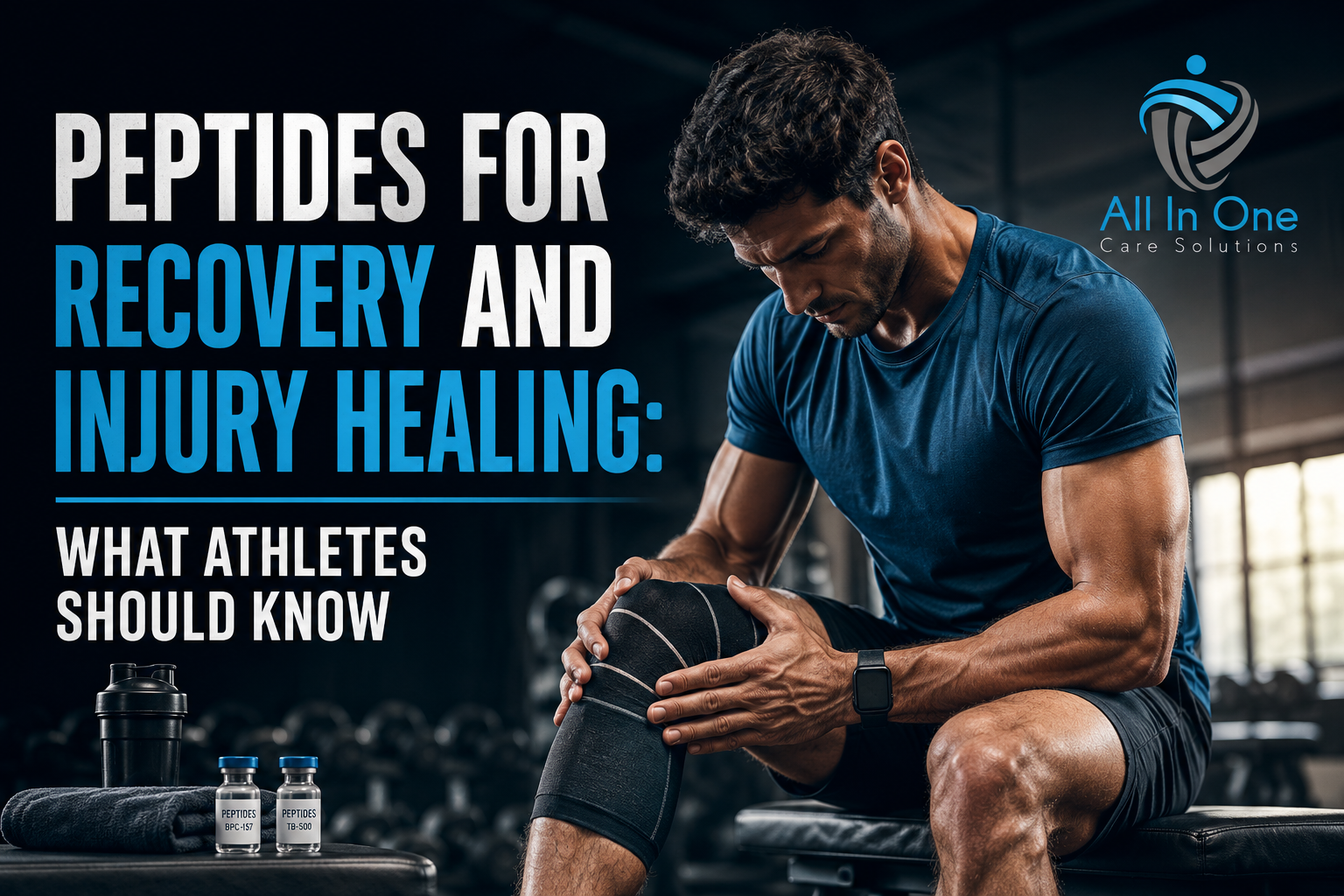
Peptides for Recovery and Injury Healing: What Athletes Should Know
Last updated: June 10, 2026
Quick Answer: Peptides are short chains of amino acids that signal the body to accelerate tissue repair, reduce inflammation, and support muscle and ligament healing. For athletes dealing with sports injuries, certain peptides — particularly BPC-157 and TB-500 — have shown meaningful recovery benefits in research settings. However, their legal status in competitive sports varies, and they are not FDA-approved for human therapeutic use. Any peptide protocol should be started under physician supervision.
Key Takeaways
- Peptides are naturally occurring signaling molecules that can be used therapeutically to support faster recovery from muscle, tendon, and ligament injuries.
- BPC-157 and TB-500 are the most studied peptides for sports injury recovery, with research suggesting they may accelerate healing by 20–50% compared to natural healing timelines [1].
- Neither BPC-157 nor TB-500 is FDA-approved for human use as of 2026; both are classified as prohibited substances by several major sports organizations [2].
- Peptide therapy is available through medically supervised clinics, including peptide therapy providers in Miami, where compounded formulations are prepared by accredited pharmacies.
- Age, injury severity, sleep, nutrition, and stress levels all affect how well peptides work — they are not a standalone fix [1].
- Athletes in professional or sanctioned sports should verify peptide status with their governing body before starting any protocol.
- A physician consultation and lab testing are essential first steps before beginning peptide therapy for any injury.
What Exactly Are Peptides and How Do They Help Muscle Recovery
Peptides are short chains of two or more amino acids linked together. Unlike full proteins, they are small enough to act as direct biological messengers, telling cells to repair tissue, produce collagen, or reduce inflammation.
When you sustain a sports injury — a muscle strain, a torn tendon, or ligament damage — your body launches a natural repair process. That process can be slow, especially with significant tissue damage. Certain therapeutic peptides work by amplifying the signals your body already sends during healing. For example:
- BPC-157 (Body Protection Compound-157) promotes the formation of new blood vessels (angiogenesis), reduces local inflammation, and activates growth hormone receptors in tendon fibroblasts [2].
- TB-500 (Thymosin Beta-4) enhances cell migration to the injury site, reduces scar tissue (fibrosis), and has systemic anti-inflammatory effects [3].
- GHK-Cu (Copper Peptide) stimulates collagen synthesis and supports wound remodeling [4].
These mechanisms make peptides particularly relevant for athletes whose livelihoods depend on how quickly and completely they recover from injury.
What Is the Difference Between BPC-157 and TB-500 for Healing
BPC-157 works locally — it targets the specific site of injury and is most effective for tendon, ligament, and muscle damage at a defined location. TB-500 works systemically, meaning it circulates throughout the body and supports broader tissue repair and inflammation control [3].
| Feature | BPC-157 | TB-500 |
|---|---|---|
| Mechanism | Local angiogenesis, tendon repair | Systemic cell migration, anti-fibrotic |
| Best for | Tendons, ligaments, muscle tears | Full-body inflammation, systemic recovery |
| Typical dose | 250–500 mcg, 1–2x daily [5] | 2–5 mg, twice weekly (loading phase) [5] |
| Administration | Subcutaneous injection or oral | Subcutaneous injection |
| Research status | Preclinical and early human data | Preclinical and early human data |
Many clinicians combine BPC-157 and TB-500 in what is sometimes called the “Wolverine Stack” — a protocol designed to address both local tissue damage and systemic inflammation at the same time [6]. Research suggests this combination may produce recovery outcomes 40–60% faster than natural healing alone, though these figures come from early-stage studies and individual results vary [1].
Can Peptides Help Me Recover Faster From a Torn Muscle or Ligament
Yes, the evidence suggests peptides can meaningfully support recovery from muscle tears and ligament injuries, though the degree of benefit depends on injury severity and the individual’s overall health status.
BPC-157 has been shown in preclinical studies to accelerate muscle strain recovery by an estimated 20–40% and tendon or ligament healing by 20–50% [1]. The mechanism involves increasing blood flow to the damaged area and activating the fibroblasts responsible for rebuilding connective tissue.
Choose peptide therapy if:
- You have a soft tissue injury (muscle, tendon, ligament) that is not responding well to standard physical therapy timelines.
- You are a recreational or non-sanctioned athlete without competitive doping restrictions.
- You are working with a physician who can monitor your progress and adjust the protocol.
Peptide therapy is less appropriate if:
- You compete in a sport governed by WADA or USADA (see the legality section below).
- You have a complete rupture requiring surgical repair — peptides support healing but do not replace surgical intervention.
- You have uncontrolled chronic conditions that have not been evaluated by a primary care physician.
If you are in Miami and dealing with a sports injury, a visit to a primary care clinic in Miami Gardens is a sensible first step to get a proper diagnosis before starting any peptide protocol.
How Quickly Can Peptides Reduce Inflammation After a Sports Injury
Most patients using BPC-157 or TB-500 under medical supervision report noticeable reductions in swelling and pain within the first one to two weeks of treatment [7]. Systemic anti-inflammatory effects from TB-500 can begin within days of the first injection, while BPC-157’s local tissue effects build over the first two to four weeks [3].
That said, “faster” does not mean “immediate.” Peptides work with your body’s natural biology — they do not override it. The full course of a peptide protocol for a moderate sports injury typically runs four to eight weeks, with some athletes continuing a maintenance phase afterward.
Factors that can slow results even with peptide therapy:
- Poor sleep (under 7 hours per night)
- High stress levels (elevated cortisol suppresses tissue repair)
- Inadequate protein intake
- Continuing to train through the injury without modification [1]
Pairing peptide therapy with IV therapy for recovery support and proper nutritional management can improve outcomes.
Are Peptides Legal for Athletes to Use in Professional Sports
This depends entirely on the sport and governing body. As of 2026, BPC-157 and TB-500 are not FDA-approved for human therapeutic use, and their regulatory status in competitive sports is inconsistent [2].
Key facts on legality:
- The World Anti-Doping Agency (WADA) has listed TB-500 (Thymosin Beta-4) on its Prohibited List under peptide hormones and growth factors.
- BPC-157 is not currently on the WADA Prohibited List as of 2026, but its status can change annually — athletes must verify current status before use.
- The United States Anti-Doping Agency (USADA) follows WADA guidelines for Olympic and Paralympic sports.
- Professional leagues (NFL, MLB, NBA) have their own substance policies that may differ from WADA.
What peptides should professional athletes avoid to prevent doping violations?
Any peptide that falls under the WADA category of “Peptide Hormones, Growth Factors, Related Substances and Mimetics” carries violation risk. This includes TB-500, certain growth hormone-releasing peptides (GHRPs), and CJC-1295. Athletes in sanctioned sports should consult with a sports medicine physician and review the current WADA Prohibited List before using any peptide.
Are Peptide Treatments Safe or Do They Have Dangerous Side Effects
When administered under physician supervision using pharmaceutical-grade compounded formulations, peptide therapy carries a relatively low risk profile. The most common side effects are mild and injection-site related: temporary redness, minor swelling, or brief discomfort [7].
More serious concerns arise when peptides are sourced from unregulated suppliers or self-administered without medical oversight. Contaminated or incorrectly dosed peptides can cause infections, hormonal disruption, or unpredictable systemic effects.
Safety checklist for peptide therapy:
- Source peptides only through a licensed medical clinic using accredited compounding pharmacies.
- Undergo a baseline physical exam and lab work before starting [see lab testing services in Miami].
- Disclose all current medications and health conditions to your physician.
- Follow the prescribed dosing protocol — more is not better with peptides.
- Schedule follow-up appointments to monitor response and adjust as needed.
Compounded peptides are not FDA-approved drugs. Results vary between individuals, and no peptide protocol should be treated as a guaranteed outcome.
Which Peptides Work Best for Runners and Endurance Athletes
Runners and endurance athletes tend to deal with repetitive stress injuries: plantar fasciitis, IT band syndrome, stress fractures, and Achilles tendinopathy. For these injury patterns, BPC-157 is the most commonly recommended peptide because of its strong effects on tendon and connective tissue repair [2].
Recommended peptide considerations for endurance athletes:
- BPC-157 — for tendon and ligament overuse injuries, particularly in the lower extremities
- GHK-Cu — for collagen support and joint tissue maintenance during high training volume [4]
- TB-500 — for systemic inflammation management during heavy training blocks or after acute injury [3]
Endurance athletes also benefit from complementary support. NAD+ IV therapy has shown value for cellular energy recovery, and B12 injections can help maintain energy metabolism during intense training cycles.
Do Peptide Treatments Work for Older Athletes or Just Younger Ones
Peptide therapy is relevant for athletes of all ages, and in some ways the benefits are more pronounced in older athletes. Natural peptide production and tissue repair capacity decline with age, meaning older athletes have more to gain from therapeutic supplementation [6].
Athletes over 40 typically experience slower tendon healing, reduced collagen synthesis, and longer inflammation cycles after injury. BPC-157 and GHK-Cu both directly address these age-related deficits by stimulating collagen production and improving vascular supply to healing tissue [4].
That said, older athletes require more thorough medical evaluation before starting peptide therapy. Comorbidities such as hypertension, diabetes, or cardiovascular conditions can affect both the safety and the dosing of any injectable protocol. A comprehensive annual physical exam in Miami is a practical starting point for any athlete over 40 considering peptide therapy.
How Do I Know If Peptide Therapy Is Right for My Specific Injury
Peptide therapy is most appropriate for soft tissue injuries — muscles, tendons, ligaments, and fascia — where the healing process is delayed or incomplete. It is not a first-line treatment for fractures, nerve injuries, or conditions requiring surgical intervention.
A simple decision framework:
- Has the injury been properly diagnosed by a physician or sports medicine specialist?
- Has standard treatment (rest, physical therapy, anti-inflammatory management) been attempted for at least four to six weeks without adequate progress?
- Is the injury a soft tissue type (tendon, ligament, muscle) rather than structural (fracture, surgical repair)?
- Are you free from competitive doping restrictions, or has your governing body cleared the specific peptide?
- Are you willing to commit to a full protocol with physician follow-up?
If you answer yes to all five, peptide therapy is worth a formal consultation. Our family medicine team in Miami Gardens can evaluate your injury history, review your labs, and build a supervised protocol appropriate for your situation.
What Are the Most Common Mistakes Athletes Make When Using Peptides
The biggest mistake is sourcing peptides outside of a licensed medical clinic. Research-grade peptides sold online are not manufactured for human use, carry contamination risks, and have no quality controls. A second common error is skipping the diagnostic phase — starting a peptide protocol without confirming the injury type means you may be using the wrong peptide for your condition.
Other frequent mistakes include:
- Underdosing or inconsistent dosing — peptides require consistent administration to maintain therapeutic tissue levels.
- Expecting peptides to replace rehabilitation — peptides accelerate healing but do not rebuild strength or correct movement patterns. Physical therapy remains essential.
- Ignoring lifestyle factors — poor sleep, high stress, and inadequate nutrition blunt peptide effectiveness significantly [1].
- Not disclosing peptide use to your physician — this creates gaps in your medical record and can lead to dangerous drug interactions.
- Stopping too early — most protocols require four to eight weeks for meaningful tissue-level changes. Stopping after two weeks because pain has decreased often leads to re-injury.
Frequently Asked Questions
What is the difference between peptide therapy and steroid use for injury recovery?
Peptides work by signaling the body’s own repair processes — they do not suppress the immune system or carry the hormonal side effects associated with corticosteroids. Steroids reduce inflammation quickly but can impair long-term tendon integrity with repeated use. Peptides are generally considered a lower-risk, longer-term support option.
How much do peptide treatments cost for sports injuries in Miami?
Costs vary depending on the peptide, protocol length, and clinic. In Miami, a supervised peptide therapy consultation typically starts around $150–$250, with monthly treatment costs ranging from $200–$600 depending on the compounds used. Compounded peptides are rarely covered by insurance since they are not FDA-approved drugs.
Can I use peptides while continuing to train?
In most cases, yes — with modifications. Peptides support healing during active recovery, but continuing to train at full intensity through an injury can counteract the repair process. Your physician should guide training load adjustments as part of the protocol.
How is peptide therapy administered?
Most therapeutic peptides are given as subcutaneous injections, typically in the abdomen or near the injury site. Some, like BPC-157, can also be taken orally, though injectable forms generally produce more consistent results [5].
Is peptide therapy available in Spanish in Miami?
Yes. Clinics offering bilingual care in Miami Gardens, including All In One Care Solutions, provide peptide consultations in both English and Spanish. Terapia de péptidos está disponible bajo supervisión médica en Miami Gardens.
Are there peptides specifically for joint pain rather than muscle injuries?
GHK-Cu and BPC-157 both have documented effects on joint tissue and cartilage support. For athletes with chronic joint pain, a physician may recommend these alongside physical therapy and anti-inflammatory management.
How long before I see results from peptide therapy?
Most patients notice reduced inflammation and improved range of motion within two to four weeks. Full tissue repair benefits typically emerge over a six to twelve week protocol [7].
Can peptide therapy be combined with IV therapy for recovery?
Yes. Many athletes in Miami combine peptide injections with IV nutrient therapy for comprehensive recovery support. NAD+ and glutathione IV drips complement peptide protocols by supporting cellular energy and reducing oxidative stress.
Do I need a prescription for peptide therapy in Miami?
Compounded peptides require a physician’s order. You cannot legally obtain them through a licensed compounding pharmacy without a valid prescription from a licensed provider.
What should I bring to my first peptide therapy consultation?
Bring any imaging (MRI, X-ray) related to your injury, a list of current medications and supplements, and any prior treatment records. Recent lab work is helpful but can also be ordered at the clinic.
Conclusion
Peptides for recovery and injury healing represent a clinically meaningful option for athletes who want to support their body’s natural repair capacity beyond what standard rest and physical therapy alone can achieve. The evidence for BPC-157, TB-500, and GHK-Cu is promising — particularly for soft tissue injuries in the tendons, ligaments, and muscles that athletes commonly face.
The key is medical supervision. Sourcing peptides without physician oversight, skipping baseline lab work, or ignoring the legal status of specific compounds in your sport can create serious risks. Done correctly, peptide therapy is a structured, evidence-informed protocol — not a shortcut.
Your next steps if you are in Miami:
- Schedule a consultation with a primary care physician who offers medically supervised peptide therapy.
- Complete a physical exam and baseline lab panel to establish your health status.
- Bring your injury history and any imaging to the consultation.
- Ask specifically about compounded peptide options, protocol length, and what outcomes are realistic for your injury type.
At All In One Care Solutions in Miami Gardens, we offer physician-supervised peptide therapy consultations for athletes and active adults across Miami, Miami Lakes, Hialeah, and surrounding communities. Every protocol starts with a personalized medical evaluation. Compounded peptides are not FDA-approved drugs and results vary. Contact our clinic to schedule your consultation — same-week appointments are available.
References
[1] Best Peptides For Injury Recovery – https://www.peptidemark.com/news/best-peptides-for-injury-recovery
[2] Best Peptides For Recovery – https://peptidepedia.org/guides/best-peptides-for-recovery
[3] Peptides For Recovery – https://www.thebiologicaledge.com/peptides/peptides-for-recovery
[4] Best Peptides Healing – https://greypeptides.com/articles/best-peptides-healing/
[5] Best Peptides For Healing – https://www.disclosedlabs.com/guides/best-peptides-for-healing
[6] Best Peptides For Recovery – https://knowyourpeptide.com/guides/best-peptides-for-recovery
[7] Recovery – https://whatpeptide.health/goals/recovery/
Tags: peptide therapy Miami, BPC-157 recovery, TB-500 healing, sports injury recovery, peptide injections Miami, peptide clinic Miami Gardens, injury healing peptides, athlete recovery therapy, compounded peptides Miami, medically supervised peptide therapy, anti-inflammatory peptides, tendon and ligament healing