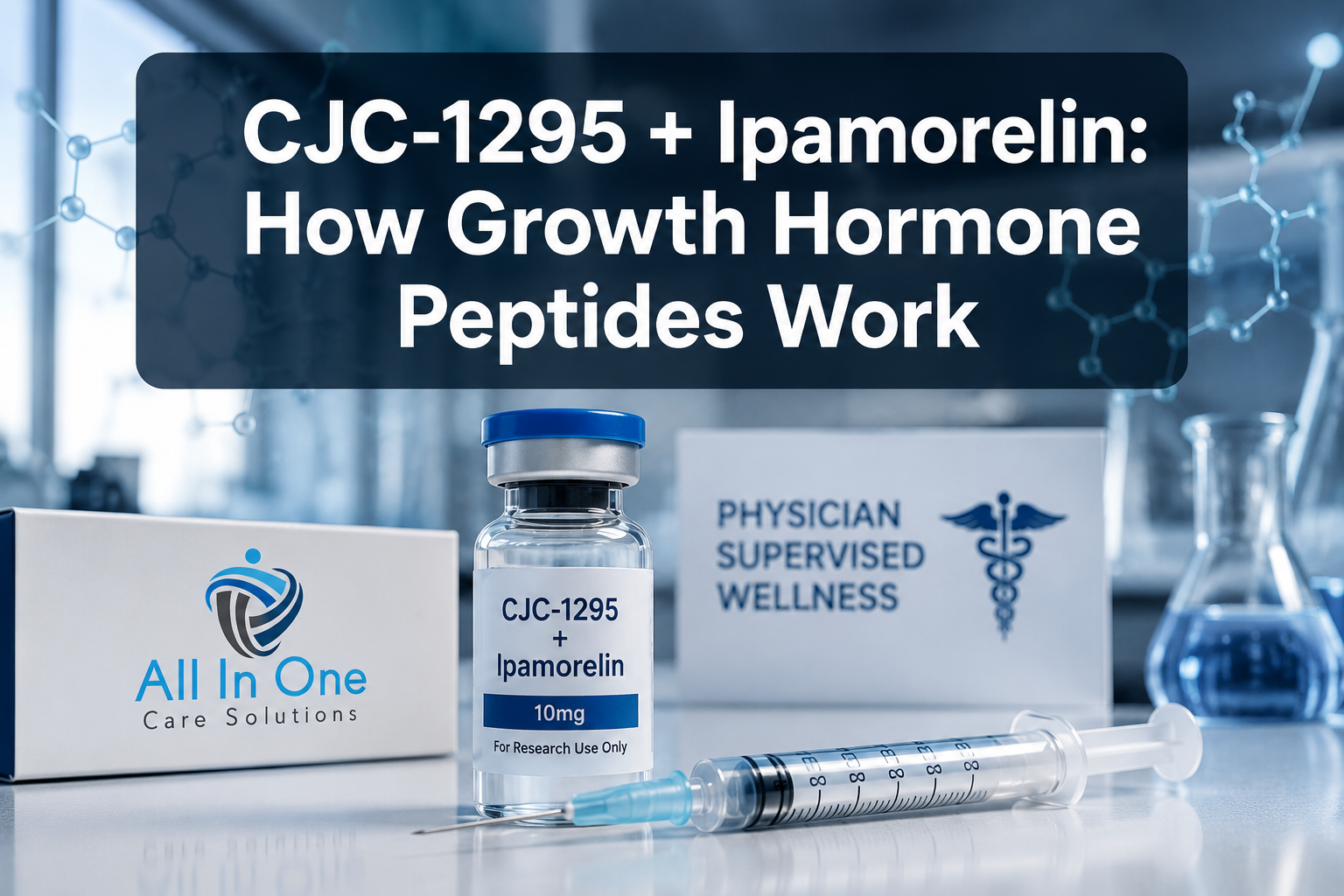
CJC-1295 + Ipamorelin: How Growth Hormone Peptides Work
Last updated: June 10, 2026
Quick Answer: CJC-1295 and Ipamorelin are two synthetic peptides that work together to stimulate your body’s own growth hormone production. CJC-1295 acts on the GHRH receptor, while Ipamorelin targets the ghrelin receptor — and when combined, they produce a significantly stronger growth hormone pulse than either peptide alone. This combination is used under medical supervision for goals including muscle recovery, body composition, and age-related hormone decline.
Key Takeaways
- CJC-1295 + Ipamorelin: How Growth Hormone Peptides Work relies on a dual-receptor mechanism that amplifies natural GH release without suppressing the body’s own feedback system.
- The combination may produce GH peaks estimated to be substantially higher than either peptide used alone, based on current research models [2][7].
- Neither peptide is FDA-approved for human use; both exist in a regulatory grey zone as compounded research peptides in 2026 [5][9].
- Common protocols involve subcutaneous injections, typically 5 nights per week, timed before sleep or exercise.
- Results generally begin to appear between 4 and 12 weeks, with more significant changes in body composition reported at 3 to 6 months [1][10].
- Side effects are generally mild but include water retention, tingling, and temporary injection-site reactions.
- These peptides are not appropriate for people with active cancer, pregnancy, or uncontrolled thyroid disease.
- Medically supervised peptide therapy in Miami is available through licensed clinics offering personalized protocols and pharmaceutical-grade compounded formulations.
- Women can use this combination safely under medical supervision; the protocol is not gender-exclusive.
- Natural alternatives exist but produce significantly smaller GH increases compared to peptide therapy.
What Exactly Are CJC-1295 and Ipamorelin, and How Do They Boost Growth Hormone
CJC-1295 is a synthetic analogue of growth hormone-releasing hormone (GHRH), and Ipamorelin is a selective growth hormone secretagogue that mimics ghrelin. Together, they stimulate the pituitary gland through two separate receptor pathways, producing a stronger and more sustained GH pulse than either compound achieves on its own [6][7].
How each peptide works:
- CJC-1295 binds to GHRH receptors on the anterior pituitary gland. This signals the pituitary to produce and release more growth hormone. The no-DAC version (also called Mod GRF 1-29) has a shorter half-life of roughly 30 minutes, producing a pulse that mirrors natural GH release patterns [8].
- Ipamorelin binds to the ghrelin receptor (GHS-R1a). It triggers a separate GH release signal and is considered highly selective — meaning it does not significantly raise cortisol or prolactin levels the way older secretagogues did [3][5].
Why the combination matters:
When both receptors are activated at the same time, the GH response is amplified through a synergistic effect. Research models in 2026 suggest the CJC-1295 (no-DAC) + Ipamorelin stack may produce GH peaks estimated to be around 340% higher than baseline, though this figure comes from research-setting models and individual results vary [2]. A landmark clinical study published in 2006 found that CJC-1295 alone produced mean GH increases of 2- to 10-fold and elevated IGF-1 levels by 1.5- to 3-fold over several days [6].
This dual-pathway activation is the core reason practitioners in sports medicine and anti-aging medicine favor this combination over single-peptide protocols.
How CJC-1295 + Ipamorelin Compare to Traditional Growth Hormone Injections
The combination of CJC-1295 + Ipamorelin works differently from synthetic human growth hormone (HGH) injections, and for many patients, the distinction matters clinically.
| Feature | CJC-1295 + Ipamorelin | Synthetic HGH Injections |
|---|---|---|
| Mechanism | Stimulates your own pituitary | Replaces GH directly |
| Pituitary feedback preserved | Yes | No |
| Risk of GH suppression | Low | Higher with long-term use |
| Cortisol/prolactin spike | Minimal (with Ipamorelin) | Variable |
| Regulatory status (2026) | Compounded, not FDA-approved | FDA-approved (specific diagnoses) |
| Estimated monthly cost | $150–$400 | $500–$2,000+ |
| Prescription required | Yes (in supervised clinic) | Yes |
Key distinction: Synthetic HGH bypasses the pituitary entirely and can suppress natural GH production over time. CJC-1295 + Ipamorelin preserve the body’s own feedback loop, which many clinicians consider a safer long-term approach [5][8]. However, synthetic HGH is FDA-approved for specific diagnosed deficiencies, while peptide combinations are not.
What Is the Recommended Dosage for Muscle Growth and Recovery
Standard clinical practice protocols for the CJC-1295 + Ipamorelin combination typically use 100–300 mcg of each peptide per injection, administered subcutaneously [1][10]. Most supervised protocols involve injections 5 nights per week, timed 30–60 minutes before sleep, when natural GH release is highest.
Common dosing framework (under medical supervision):
- CJC-1295 no-DAC: 100–200 mcg per injection
- Ipamorelin: 100–300 mcg per injection
- Frequency: 5 days per week, typically at bedtime
- Cycle length: 3 to 6 months, followed by a reassessment
Some protocols add a second injection before morning workouts for athletes focused on muscle recovery and performance. Dosing should always be individualized based on lab values, age, body weight, and treatment goals. Self-dosing without medical oversight increases the risk of side effects and reduces the accuracy of results.
If you are exploring medical weight loss alongside peptide therapy, our team at All In One Care Solutions offers personalized protocols that may combine peptide therapy with other evidence-based approaches.
How Long Does It Take to See Results from CJC-1295 and Ipamorelin
Most patients begin noticing early changes within 4 to 6 weeks, with more significant results appearing between 3 and 6 months of consistent use [1][10].
General timeline:
- Weeks 1–2: Improved sleep quality, mild increase in energy
- Weeks 3–6: Reduced recovery time after exercise, early fat metabolism changes
- Months 2–3: Noticeable changes in body composition (lean mass increase, fat reduction)
- Months 4–6: More sustained improvements in muscle tone, skin quality, and energy levels
Results depend on consistency of dosing, diet, exercise habits, sleep quality, and baseline hormone levels. Patients who undergo in-house lab testing before starting a peptide protocol have a clearer baseline for tracking progress and adjusting dosing appropriately.
What Are the Potential Side Effects of Using These Peptides
CJC-1295 + Ipamorelin are generally considered well-tolerated in supervised settings, but side effects do occur and should be monitored [3][5][9].
Most commonly reported side effects:
- Water retention, particularly in the hands and feet
- Tingling or numbness (paresthesia), especially in extremities
- Mild injection-site redness or irritation
- Temporary flushing or warmth after injection
- Headache, usually mild and short-lived
- Fatigue or drowsiness when injected at night (often considered a benefit)
Less common but worth monitoring:
- Elevated fasting glucose (GH can reduce insulin sensitivity at higher doses)
- Cortisol fluctuations if dosing is excessive
- Nausea, particularly in the first week of use
Important: These side effects are dose-dependent. Working with a licensed provider who monitors your labs reduces the likelihood of persistent or serious reactions. Our primary care clinic in Miami Gardens conducts baseline and follow-up lab work as part of any supervised peptide protocol.
Who Should Not Take CJC-1295 and Ipamorelin
Certain populations should avoid this combination entirely, and others require careful evaluation before starting [5][9][10].
Absolute contraindications:
- Active or history of hormone-sensitive cancers (GH can stimulate tumor growth)
- Pregnancy or breastfeeding
- Uncontrolled hypothyroidism or hyperthyroidism
- Active acromegaly or pituitary tumors
Relative contraindications (require physician evaluation):
- Type 1 or Type 2 diabetes with poor glucose control
- Severe cardiovascular disease
- Children and adolescents (growth plates still open)
- Patients on immunosuppressant therapy
Anyone with a chronic condition such as diabetes should have a thorough medical evaluation before starting peptide therapy. Our chronic disease management services in Miami include the baseline assessments needed to determine whether peptide therapy is appropriate.
Are CJC-1295 and Ipamorelin Safe for Bodybuilders and Athletes
For healthy adults using medically supervised protocols, the safety profile of CJC-1295 + Ipamorelin is considered favorable compared to synthetic HGH or anabolic steroids [3][8]. Animal studies have shown muscle preservation and strength benefits with the combination, and the human safety data from clinical use supports short-to-medium-term use without significant adverse events in healthy subjects [4][7].
Key safety considerations for athletes:
- Ipamorelin’s selectivity means it does not significantly raise cortisol or prolactin, which is an advantage over older GH secretagogues
- The combination preserves natural pituitary feedback, reducing the risk of long-term GH suppression
- These peptides are banned by the World Anti-Doping Agency (WADA) in competitive sports — athletes subject to drug testing should be aware of this before use [5]
- Long-term human safety data beyond 12 months remains limited; most clinical observations are from shorter study periods
Can Women Use These Peptides, or Are They Just for Men
Women can use CJC-1295 + Ipamorelin safely under medical supervision. These peptides are not gender-specific, and women may actually benefit more noticeably from GH optimization due to the steeper age-related decline in GH secretion that occurs after menopause [5][10].
Women commonly report benefits including:
- Improved skin texture and elasticity
- Reduced visceral fat, particularly around the abdomen
- Better sleep quality and recovery
- Increased lean muscle tone without masculinizing effects
Dosing for women is typically at the lower end of the range (100–200 mcg per peptide per injection), and protocols are adjusted based on individual hormone panels. Our women’s health services in Miami Gardens include hormone evaluation as part of a complete wellness assessment.
How Much Do Growth Hormone Peptides Like These Cost
The cost of CJC-1295 + Ipamorelin therapy varies depending on the clinic, dosing protocol, and whether the cost includes medical consultations and lab work [1][5].
Estimated monthly costs in 2026 (Miami market):
- Peptide vials (CJC-1295 + Ipamorelin combined): $150–$350 per month
- Initial medical consultation: $75–$200 (one-time or annual)
- Lab work (baseline hormone panel): $100–$300 depending on coverage
- Follow-up visits: $50–$150 per visit
Most insurance plans do not cover compounded peptide therapy since these compounds are not FDA-approved for these indications. Self-pay wellness clients should ask about package pricing. Financing options such as CareCredit may be available to help manage costs.
Where Can I Legally Purchase These Peptides
In 2026, CJC-1295 and Ipamorelin exist in a regulatory grey zone in the United States. They are not FDA-approved drugs for human use, but they can be legally compounded by licensed 503A or 503B compounding pharmacies when prescribed by a licensed physician [5][9].
What this means practically:
- You cannot legally purchase these peptides over the counter or from unregulated online sources for human use
- A valid prescription from a licensed provider is required for compounded human-use formulations
- “Research chemical” vendors sell peptides without a prescription, but these products are not intended for human use and carry significant quality and safety risks
- Pharmaceutical-grade compounded peptides from accredited pharmacies are the only appropriate source for supervised clinical use
At All In One Care Solutions, every peptide protocol begins with a medical consultation, appropriate lab work, and a prescription sent to an accredited compounding pharmacy. This is what separates medically supervised peptide therapy from unregulated self-dosing.
What Medical Conditions Might Benefit from These Growth Hormone Peptides
Beyond athletic performance, CJC-1295 + Ipamorelin are being studied and used clinically for several conditions associated with GH deficiency or age-related decline [3][4][8].
Conditions with potential clinical relevance:
- Adult GH deficiency: Reduced muscle mass, increased fat, fatigue, and poor bone density
- Metabolic syndrome: Emerging research suggests GH optimization may support insulin sensitivity and fat metabolism
- Post-surgical recovery: Animal data supports muscle preservation and tissue repair benefits [4]
- Age-related sarcopenia: Loss of muscle mass in adults over 50 is a primary target for GH secretagogue research
- Sleep disorders: GH is released primarily during deep sleep; optimizing GH may improve sleep architecture
These applications are investigational. None are FDA-approved indications for these specific peptides. A thorough medical evaluation, including comprehensive lab testing in Miami, is the appropriate starting point for any patient considering peptide therapy for a medical condition.
Are There Any Natural Alternatives to CJC-1295 and Ipamorelin
Natural strategies can support GH production, but they produce significantly smaller increases compared to peptide therapy. For patients who are not candidates for peptide injections, or who want to maximize results alongside a peptide protocol, these approaches are evidence-supported [5][10].
Evidence-supported natural GH boosters:
- High-intensity interval training (HIIT): One of the strongest natural stimulators of GH release
- Deep, consistent sleep: GH is primarily released during slow-wave sleep; 7–9 hours per night is essential
- Intermittent fasting: Short fasting periods can increase GH pulses
- Protein-rich diet: Adequate amino acid availability supports GH signaling
- Reducing sugar intake: High insulin levels suppress GH release
- Supplements: Arginine, glutamine, and GABA have modest supporting evidence for GH release, though effects are far smaller than peptide therapy
Natural approaches work best as a foundation. For adults with significant GH decline, they are rarely sufficient on their own to produce clinically meaningful changes in body composition or recovery.
Frequently Asked Questions
Q: Do I need a prescription for CJC-1295 + Ipamorelin in Miami?
Yes. For compounded human-use formulations from an accredited pharmacy, a valid prescription from a licensed physician is required. Any source that sells these peptides without a prescription is not operating within legal and safety standards for human use.
Q: Can I combine these peptides with IV therapy or other wellness treatments?
Yes, many patients combine peptide therapy with IV vitamin therapy in Miami Gardens or other wellness protocols. Your provider should review all treatments together to avoid interactions and optimize your overall plan.
Q: How do I know if my GH levels are low enough to benefit from peptide therapy?
A serum IGF-1 test is the standard screening tool for GH status in adults. A morning GH level or stimulation test may also be ordered. These are available through in-house lab testing at our clinic.
Q: Will these peptides cause me to fail a drug test?
WADA prohibits GH secretagogues including Ipamorelin and CJC-1295. If you are a competitive athlete subject to drug testing, you should not use these peptides.
Q: How is the no-DAC version of CJC-1295 different from the DAC version?
CJC-1295 with DAC (Drug Affinity Complex) has a half-life of approximately 8 days, producing a sustained GH elevation. The no-DAC version (Mod GRF 1-29) has a 30-minute half-life and produces a more natural pulsatile GH release. Most current protocols favor the no-DAC version when combined with Ipamorelin [7][8].
Q: Is peptide therapy covered by insurance?
Generally no. Compounded peptides are not FDA-approved for these indications, so most insurance plans do not cover them. Self-pay options and financing through programs like CareCredit are available.
Q: How often do I need to come in for follow-up appointments?
Most supervised protocols include a follow-up at 4–6 weeks and then every 3 months. Lab work is typically repeated at 3 and 6 months to assess IGF-1 levels and metabolic markers.
Q: Can peptide therapy help with weight loss?
GH optimization can support fat metabolism and lean muscle preservation, which contributes to body composition changes. For patients with a primary goal of weight loss, peptide therapy may be one component of a broader medical weight loss program in Miami Gardens.
Q: Are there Spanish-speaking providers for peptide consultations in Miami?
Yes. All In One Care Solutions offers bilingual care in English and Spanish. Our team serves patients throughout Miami Gardens, Miami Lakes, and Hialeah.
Q: What happens if I stop taking these peptides?
GH levels will gradually return to pre-treatment baseline. There is no evidence of rebound suppression with CJC-1295 + Ipamorelin, unlike synthetic HGH. Gains in muscle and body composition may be maintained with continued exercise and nutrition habits.
Conclusion
Understanding CJC-1295 + Ipamorelin: How Growth Hormone Peptides Work is the first step toward making an informed decision about whether this therapy is appropriate for you. The science behind the dual-receptor mechanism is sound, the safety profile in supervised settings is favorable, and the clinical applications continue to expand. But the key word is supervised.
Peptide therapy is not a supplement you order online and self-administer. It is a medical protocol that requires a proper evaluation, baseline lab work, a prescription from a licensed provider, and ongoing monitoring to be both safe and effective.
Actionable next steps:
- Schedule a consultation with a licensed primary care provider who offers medically supervised peptide therapy.
- Request a baseline hormone panel including IGF-1, fasting glucose, and a metabolic panel.
- Discuss your goals, health history, and any current medications before starting any protocol.
- Ask about pharmaceutical-grade compounded formulations from accredited pharmacies.
- Plan for follow-up labs at 3 and 6 months to track your response.
At All In One Care Solutions Medical Center, we provide physician-supervised peptide therapy consultations for adults in Miami Gardens, Miami Lakes, Hialeah, and surrounding communities. Every protocol starts with a personalized medical evaluation. Compounded peptides are not FDA-approved drugs; results vary by individual. Contact our primary care clinic in Miami Gardens to schedule your consultation today.
References
[1] CJC-1295 Ipamorelin Stack – https://superpower.com/guides/cjc-1295-ipamorelin-stack
[2] CJC-1295 No-DAC Ipamorelin News 2026 – https://www.realpeptides.co/cjc-1295-no-dac-ipamorelin-news-2026/
[3] PMC13095733 – https://pmc.ncbi.nlm.nih.gov/articles/PMC13095733/
[4] PubMed 41476424 – https://pubmed.ncbi.nlm.nih.gov/41476424/
[5] CJC-1295 and Ipamorelin – https://www.innerbody.com/cjc-1295-and-ipamorelin
[6] PubMed 16352683 – https://pubmed.ncbi.nlm.nih.gov/16352683/
[7] CJC-1295 and Ipamorelin UK 2026 Research Reference – https://peptideslabuk.com/cjc-1295-and-ipamorelin-uk-2026-research-reference-mechanism-combined-protocol-pharmacokinetics-and-study-design/
[8] CJC-1295 Complete Research Guide – https://spartanpeptides.com/blog/cjc-1295-complete-research-guide-growth-hormone-secretagogue/
[9] CJC-1295 No-DAC Ipamorelin Clinical Trials 2026 – https://www.realpeptides.co/cjc-1295-no-dac-ipamorelin-clinical-trials-2026/
[10] CJC-1295 Ipamorelin Complete Guide 2026 – https://peptidepublicus.com/en/blog/cjc-1295-ipamorelin-complete-guide-2026
Tags: peptide therapy Miami, CJC-1295 Ipamorelin, growth hormone peptides, peptide injections Miami Gardens, medically supervised peptide therapy, Ipamorelin side effects, GH secretagogue, anti-aging clinic Miami, medical weight loss Miami Gardens, hormone therapy Miami, compounded peptides Miami, peptide clinic near me