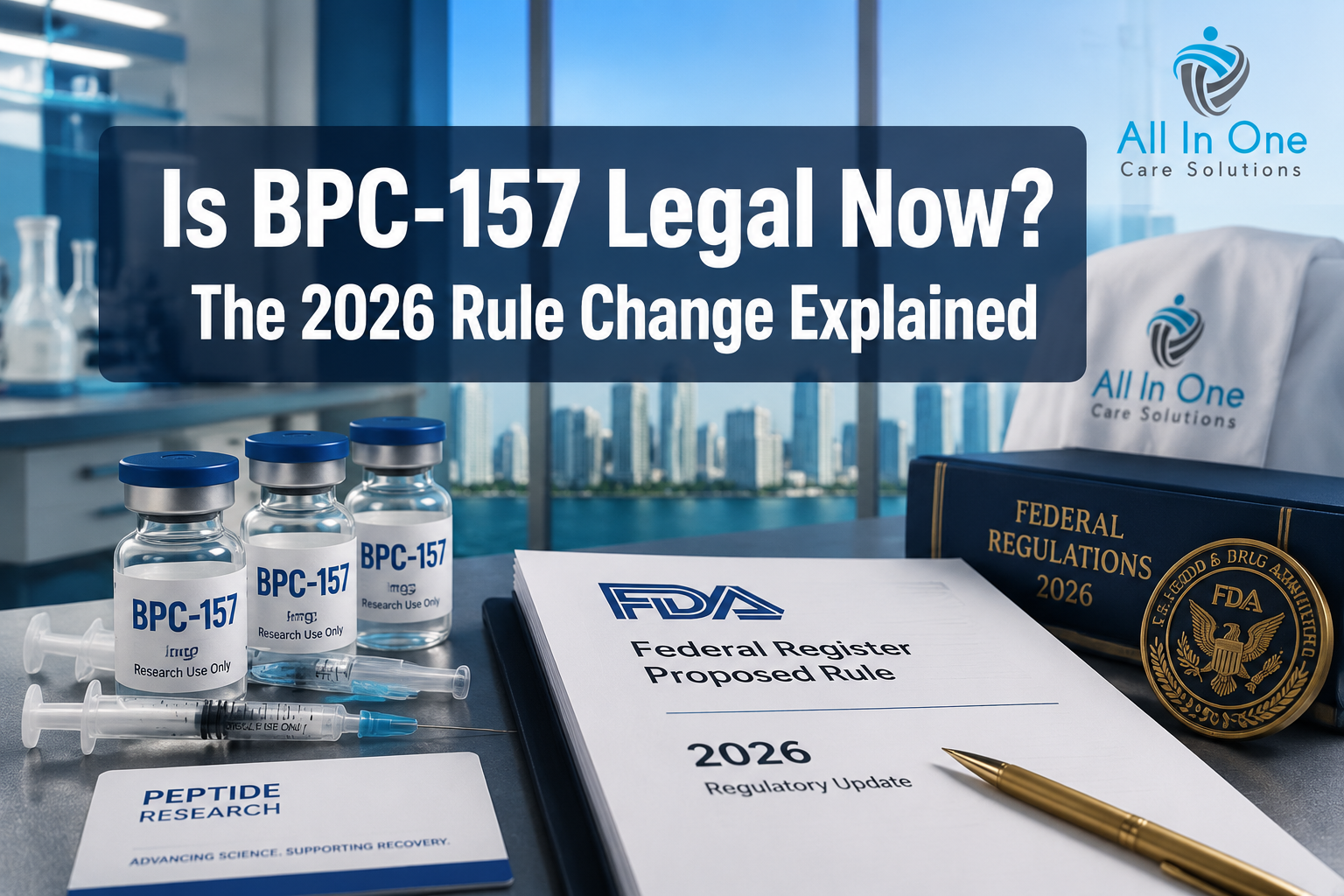
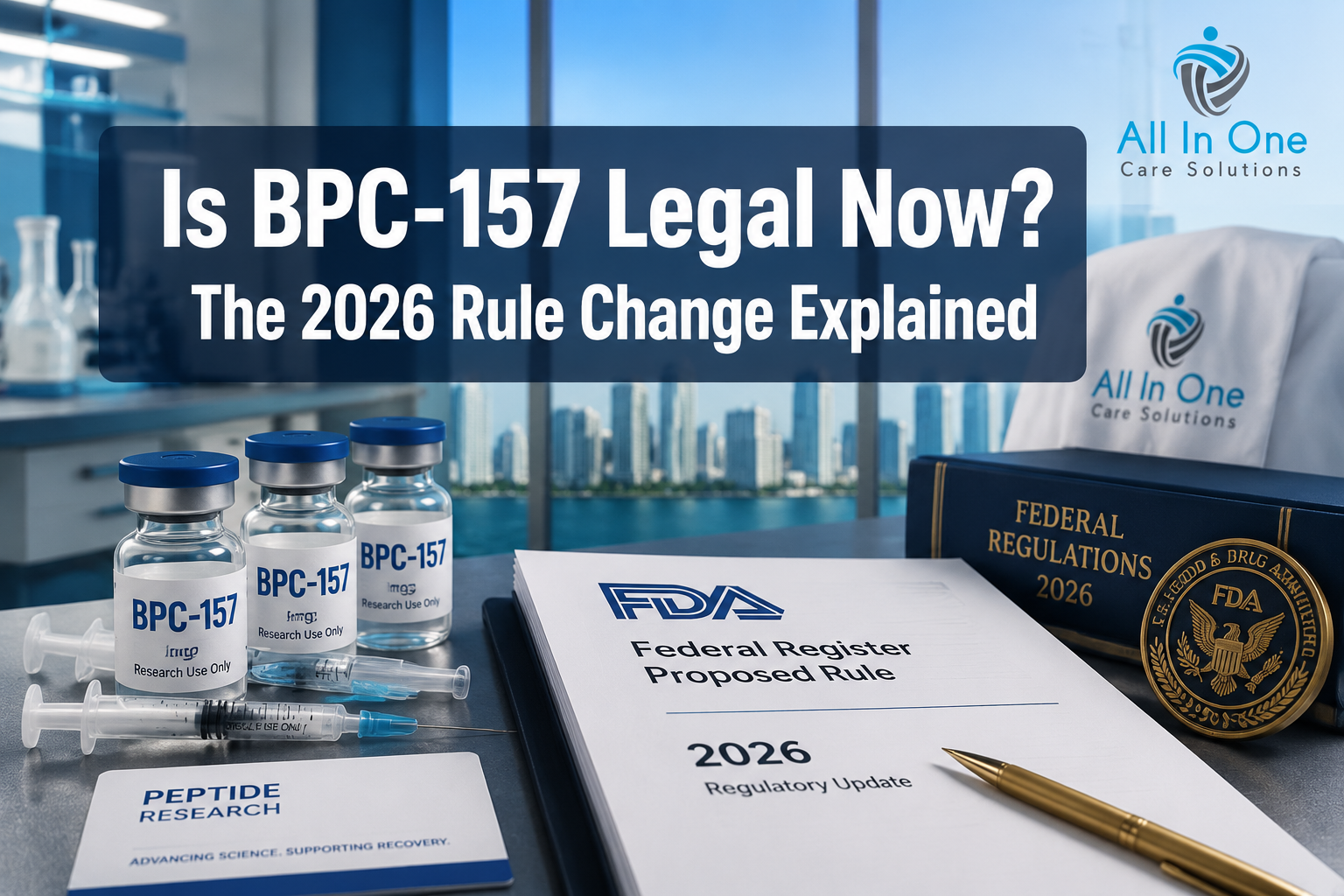
Is BPC-157 Legal Now? The 2026 Rule Change Explained
Last updated: June 10, 2026
Quick Answer
BPC-157 is not fully legal for compounding or general sale in the United States as of mid-2026, despite significant regulatory movement. The FDA removed BPC-157 from its “Category 2 significant safety concerns” list in April 2026, which is a meaningful step forward, but the compound has not been authorized for compounding by licensed 503A or 503B pharmacies. If you are searching for peptide therapy in Miami or considering BPC-157 for injury recovery or wellness, understanding exactly where the law stands right now is essential before you purchase anything.
Key Takeaways
- BPC-157 remains an unapproved drug with no completed human clinical trials and no FDA-approved indications as of June 2026.
- The FDA removed BPC-157 from the “Category 2 significant safety concerns” designation in April 2026, signaling a shift in regulatory posture. [4]
- HHS announced a plan to relax peptide compounding restrictions, including for BPC-157, but this policy change is not yet in effect. [1]
- As of mid-2026, BPC-157 is still not legally compoundable by licensed 503A or 503B pharmacies under current federal rules. [2]
- Purchasing BPC-157 labeled “for research use only” from online vendors carries legal and health risks.
- Medical supervision is critical: a licensed physician should evaluate whether any peptide therapy is appropriate for your individual health profile.
- Patients in Miami seeking medically supervised peptide therapy should work with a licensed primary care clinic, not unregulated online sources.
- The regulatory landscape is actively shifting, and further rule changes are expected in late 2026.
- Athletes and bodybuilders should be aware that BPC-157 is on the World Anti-Doping Agency (WADA) prohibited list.
- Natural supportive alternatives exist for tissue repair and recovery that are currently available through licensed medical providers.
What Exactly Is BPC-157 and How Does It Work?
BPC-157, or Body Protection Compound-157, is a synthetic peptide derived from a protein found in human gastric juice. It consists of 15 amino acids and has been studied primarily in animal models for its potential to accelerate tissue repair, reduce inflammation, and support tendon, muscle, and gut healing.
In laboratory and animal studies, BPC-157 appears to work by promoting angiogenesis (new blood vessel formation), modulating nitric oxide pathways, and interacting with growth hormone receptors. Researchers have observed accelerated healing of tendons, ligaments, bones, and intestinal tissue in rodent models. [5]
Important distinction: Animal study results do not automatically translate to human outcomes. No large-scale, peer-reviewed human clinical trials have been completed for BPC-157 as of 2026. This gap between animal data and human evidence is a central reason the FDA has maintained regulatory caution around this compound.
Is BPC-157 Legal Now? The 2026 Rule Change Explained in Plain Terms
The short answer is: not fully, but the regulatory picture changed meaningfully in April 2026. BPC-157 is not an approved drug, and it remains outside the legal compounding framework for licensed pharmacies.
Here is what actually happened in 2026:
- April 2026: The FDA formally removed BPC-157 from its “Category 2” list, which had designated it as a compound with “significant safety concerns” that blocked compounding pharmacies from producing it. [4]
- HHS announcement: The Department of Health and Human Services signaled a broader intent to ease peptide compounding restrictions, including for BPC-157, as part of a policy review. [1]
- What did not change: Removing a compound from Category 2 does not automatically make it legal to compound. BPC-157 must still go through additional regulatory steps before 503A (retail compounding) or 503B (outsourcing facility) pharmacies can legally produce it for patient use. [2]
Think of it this way: the FDA opened a door that was previously locked, but the path through that door is not yet cleared. Regulatory analysts and peptide industry observers agree that further rulemaking is needed before licensed compounding pharmacies can legally fill BPC-157 prescriptions. [3]
How Will the 2026 Rule Change Affect BPC-157 Availability?
The April 2026 FDA action is the most significant regulatory development for BPC-157 in years, and it does create a realistic pathway toward legal compounding access. However, availability will not change overnight.
What to expect in the near term:
- Compounding pharmacies are monitoring the rulemaking process closely but cannot legally produce BPC-157 for patient use until formal authorization is granted.
- The HHS plan to relax restrictions, if finalized, could open compounding access within months to a year. [10]
- Physicians and clinics offering peptide therapy in Miami will be able to prescribe compounded BPC-157 through licensed pharmacies once that authorization is in place.
- Until then, any clinic or online vendor selling BPC-157 as an injectable for human use is operating outside current federal guidelines.
Choose this approach if: You want to be prepared. Establish a relationship with a licensed primary care provider now, get a baseline health evaluation, and position yourself to access BPC-157 through proper medical channels once compounding authorization is finalized. Our primary care services in Miami Gardens include medically supervised wellness consultations where you can discuss peptide therapy options as regulations evolve.
Where Can I Legally Purchase BPC-157 Peptide Right Now?
As of June 2026, there is no legal route for the general public to purchase BPC-157 as a compounded injectable for human use from a licensed U.S. pharmacy. [2]
What currently exists in the market:
| Source | Legal Status | Risk Level |
|---|---|---|
| Licensed 503A compounding pharmacy | Not yet authorized for BPC-157 | N/A (not available) |
| Licensed 503B outsourcing facility | Not yet authorized for BPC-157 | N/A (not available) |
| Online “research chemical” vendors | Legal gray area; labeled “not for human use” | High |
| Overseas online sources | Illegal importation for personal use | Very High |
| Unregulated wellness clinics | Potentially operating outside federal law | High |
Common mistake: Assuming that a product labeled “research use only” is safe or legal for self-injection. These products are not subject to pharmaceutical-grade quality controls, and their purity, sterility, and actual peptide content cannot be verified. [6]
The safest path right now is to consult with a licensed physician at a medical clinic that follows pharmaceutical-grade compounding standards and monitors the regulatory environment actively.
What Conditions Does BPC-157 Help Heal or Treat?
Animal research suggests BPC-157 may support healing in several areas, though human clinical evidence remains limited.
Areas with the most animal-model research support:
- Tendon and ligament repair (Achilles tendon, rotator cuff injuries)
- Muscle tear recovery
- Inflammatory bowel conditions and gut lining integrity
- Bone healing after fractures
- Nerve injury recovery
- Reduction of exercise-induced inflammation
Important clinical note: None of these indications are FDA-approved. The research base, while promising, consists almost entirely of rodent studies. Physicians who discuss BPC-157 with patients do so based on this preclinical data and patient-specific clinical judgment, not on established treatment guidelines. [5]
If you are managing a chronic musculoskeletal condition or recovering from an injury in Miami, a comprehensive evaluation through same-day doctor appointments in Miami Gardens can help you understand all available evidence-based options alongside emerging therapies like peptides.
What Are the Medical Risks and Common Side Effects of BPC-157?
BPC-157 has not been studied in large human trials, so its full safety profile in humans is not established. This is the core of the FDA’s historical caution around this compound.
Reported side effects from anecdotal human use and limited small studies:
- Nausea and dizziness (most commonly reported)
- Fatigue or temporary energy changes
- Injection site irritation or redness
- Headache
- Potential interactions with blood pressure medications (due to nitric oxide pathway activity)
Serious concerns that require medical oversight:
- Unknown long-term effects on cell growth pathways (angiogenesis promotion raises theoretical oncology questions)
- Risk of contamination or incorrect dosing from unregulated sources
- No established safe dosing range validated in human clinical trials [3]
Edge case to know: Individuals with a personal or family history of cancer should discuss BPC-157 with particular caution with their physician, given the compound’s pro-angiogenic mechanisms. This is not a reason to avoid all peptide therapies, but it is a reason to have a thorough medical evaluation first, including appropriate lab testing.
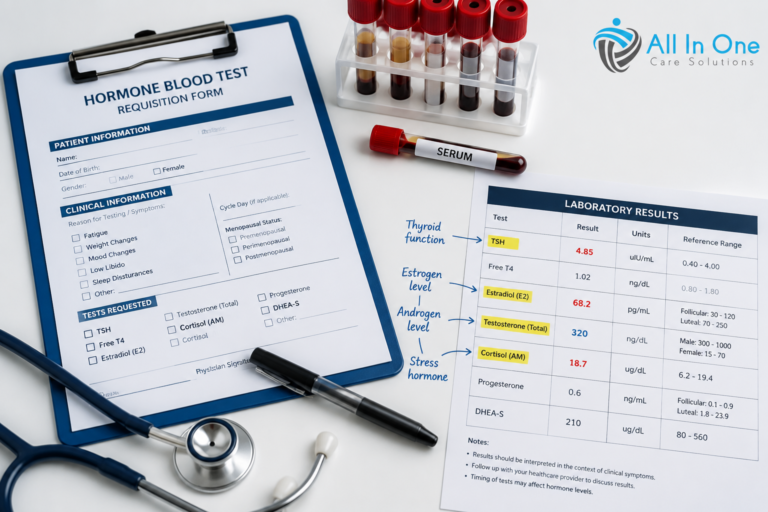
Our clinic offers in-house lab work in Miami Gardens to establish a complete baseline before any advanced wellness protocol.
Is BPC-157 Safe for Athletes and Bodybuilders?
Athletes considering BPC-157 face two distinct issues: safety and eligibility. On the safety side, the same concerns apply as for any patient, compounded by the fact that athletes often seek higher doses for faster recovery.
On the eligibility side, WADA includes BPC-157 on its prohibited list under the category of peptide hormones, growth factors, and related substances. [6] This means:
- Competitive athletes subject to WADA testing risk a positive result and potential ban.
- This applies to professional sports, Olympic competition, and many collegiate athletic programs.
- Even if BPC-157 becomes legally compoundable in the U.S., it will remain prohibited in sport.
For recreational athletes and fitness-focused adults in Miami who are not subject to drug testing, the conversation is different. The focus shifts to medical supervision, product quality, and realistic expectations about what the current evidence actually supports.
What Do Doctors and Researchers Say About BPC-157?
The medical community is divided, and that division reflects the actual state of the evidence. Researchers who study peptides point to compelling animal data and call for properly funded human trials. Regulatory scientists and most mainstream physicians urge caution until human safety and efficacy data exist. [10]
A few points of broad agreement among medical professionals:
- The animal research on BPC-157 is genuinely interesting and warrants human study.
- The absence of completed human trials is a real gap, not a minor technicality.
- Medical supervision is non-negotiable if a patient chooses to use any peptide compound.
- The 2026 FDA Category 2 removal is a sign that the regulatory posture is shifting toward allowing proper research and eventual clinical use. [4]
Physicians at evidence-based primary care clinics, like ours in Miami Gardens, approach peptide therapy the same way we approach any emerging treatment: with careful patient evaluation, honest communication about what is known and unknown, and close monitoring.
Are There Natural Alternatives to BPC-157?
Yes. Several evidence-based options support tissue repair and recovery through established mechanisms, and they are available right now through licensed medical providers.
Clinically supported alternatives for recovery and wellness:
- NAD+ therapy: Supports cellular energy production and has a growing body of human research. Learn more about how NAD+ works and its benefits.
- IV micronutrient therapy: Delivers vitamins, minerals, and amino acids directly into the bloodstream for faster absorption. Our Myers’ Cocktail IV therapy in Miami Gardens is a popular option for recovery support.
- Glutathione IV therapy: A powerful antioxidant that supports tissue health and immune function.
- Vitamin B12 injections: Support nerve health, energy metabolism, and red blood cell production.
- Collagen-supporting nutrition protocols: Vitamin C, zinc, and adequate dietary protein are foundational for tendon and ligament repair.
- Physical therapy combined with anti-inflammatory management: Still the gold standard for most musculoskeletal injuries.
These options do not carry the legal uncertainty or unknown risk profile of BPC-157 in its current regulatory status.
What States Have Different Regulations on BPC-157?
BPC-157 regulation is primarily a federal matter, governed by FDA rules that apply uniformly across all 50 states. Individual states do not have the authority to independently authorize compounding of a substance the FDA has not cleared for that purpose.
What does vary by state:
- State pharmacy boards may have additional oversight requirements for compounding pharmacies operating within their borders.
- State medical boards set standards for how physicians can prescribe and supervise compounded medications.
- Florida, where our clinic operates, has an active state pharmacy board that monitors compounding practices closely.
Bottom line for Miami patients: Florida residents are subject to the same federal BPC-157 rules as everyone else in the country. Any clinic in Miami, Miami Gardens, Hialeah, or Miami Lakes claiming to legally compound and dispense BPC-157 as an injectable for human use right now should be asked to show their regulatory basis for doing so. [1] [3]
FAQ: Is BPC-157 Legal Now? The 2026 Rule Change Explained
Q: Did the FDA approve BPC-157 in 2026?
No. The FDA removed BPC-157 from its Category 2 “significant safety concerns” list in April 2026, but this is not an approval. BPC-157 remains an unapproved drug with no FDA-authorized indications. [4]
Q: Can I get a prescription for BPC-157 from my doctor right now?
Not through a licensed compounding pharmacy. Even if a physician wants to prescribe BPC-157, compounding pharmacies cannot legally fill that prescription under current federal rules as of June 2026. [2]
Q: Is buying BPC-157 online legal?
Products sold online as “research use only” exist in a legal gray area. They are not authorized for human use, and their quality cannot be verified. Importing peptides from overseas for personal use is generally illegal under FDA import rules. [6]
Q: When might BPC-157 become legally compoundable?
If HHS finalizes its plan to relax peptide compounding restrictions, authorized compounding could become available within months to a year. No firm date has been announced as of June 2026. [1] [10]
Q: Is BPC-157 safe?
Its safety profile in humans is not fully established because no large human clinical trials have been completed. Animal studies suggest a favorable safety profile, but this cannot be directly applied to human use without proper clinical data. [5]
Q: Can athletes use BPC-157?
Competitive athletes subject to WADA testing cannot use BPC-157 without risking a ban. It is on the WADA prohibited list regardless of its legal status in any country. [6]
Q: What is the difference between 503A and 503B pharmacies?
503A pharmacies compound medications for individual patients with a valid prescription. 503B outsourcing facilities produce larger batches for healthcare providers. Both categories are currently prohibited from compounding BPC-157. [2]
Q: How much does BPC-157 treatment typically cost?
Because BPC-157 is not currently available through licensed compounding pharmacies, there is no standard market price for a legitimate compounded product. When and if it becomes legally available, costs will depend on dosing protocols, pharmacy pricing, and physician consultation fees. Comparable peptide therapy protocols at supervised clinics typically range from $150 to $400 per month, depending on the compound and protocol.
Q: Where can I find medically supervised peptide therapy in Miami now?
All In One Care Solutions in Miami Gardens offers medically supervised wellness consultations and will provide access to legally available peptide protocols as regulations allow. You can register as a new patient here.
Q: Does All In One Care Solutions offer BPC-157?
We follow all current federal and state regulations. We do not offer BPC-157 compounding while it remains outside the authorized compounding framework. We do offer a full range of medically supervised wellness therapies and will update our protocols as the regulatory landscape changes.
Conclusion
The 2026 regulatory shift around BPC-157 is real and meaningful. The FDA’s April 2026 decision to remove BPC-157 from Category 2 designation, combined with HHS signaling a broader relaxation of peptide compounding restrictions, represents the most significant movement toward legal access in years. But “movement toward” is not the same as “arrived at.” As of June 2026, BPC-157 is still not legally compoundable, and patients in Miami who encounter clinics or online vendors claiming otherwise should ask hard questions.
Your actionable next steps:
- Schedule a comprehensive wellness consultation with a licensed physician to evaluate your health goals and current treatment options.
- Ask about currently available, legally compounded peptides and evidence-based alternatives like NAD+ therapy or IV micronutrient protocols.
- Request baseline lab work so you have a complete health picture before starting any new protocol.
- Stay informed about the HHS rulemaking process, as BPC-157 compounding access could change within the next 6 to 12 months.
- Avoid purchasing BPC-157 from unregulated online sources regardless of the regulatory developments, because product quality and safety cannot be guaranteed outside a licensed pharmacy.
At All In One Care Solutions, we provide medically supervised care for adults throughout Miami Gardens, Miami Lakes, and Hialeah. Our approach to emerging therapies like peptides is grounded in evidence, regulatory compliance, and genuine patient safety. We are committed to offering access to the most current, legally available wellness protocols as the regulatory environment evolves.
Contact us to schedule your consultation and discuss what medically supervised peptide therapy and wellness options are available to you right now.
References
[1] BPC-157 Legal Status in 2026: Where Things Stand – https://rethinkpeptides.com/articles/bpc-157-legal-status-in-2026-where-things-stand
[2] Are Peptides Legal 2026 – https://peptideacademy.io/blog/are-peptides-legal-2026
[3] BPC-157 Legal Status 2026 – https://peptidesrated.com/blog/bpc-157-legal-status-2026
[4] FDA Category 2 Removal April 2026 – https://www.peppal.app/news/fda-category-2-removal-april-2026
[5] BPC-157 Legal Status – https://www.mypeptidematch.com/blog/bpc-157-legal-status
[6] What’s Changing With Peptide Regulation in 2026 – https://www.bscg.org/blogs/single/whats-changing-with-peptide-regulation-in-2026
[10] Peptides Are Coming Back – https://elevatefunctionalmed.com/peptides-are-coming-back/
Tags: BPC-157 legal status, peptide therapy Miami, BPC-157 2026 rule change, FDA peptide regulations, compounded peptides Miami, peptide clinic Miami Gardens, BPC-157 side effects, peptide therapy near me, medically supervised peptide therapy, injury recovery peptides, BPC-157 compounding law, wellness injections Miami