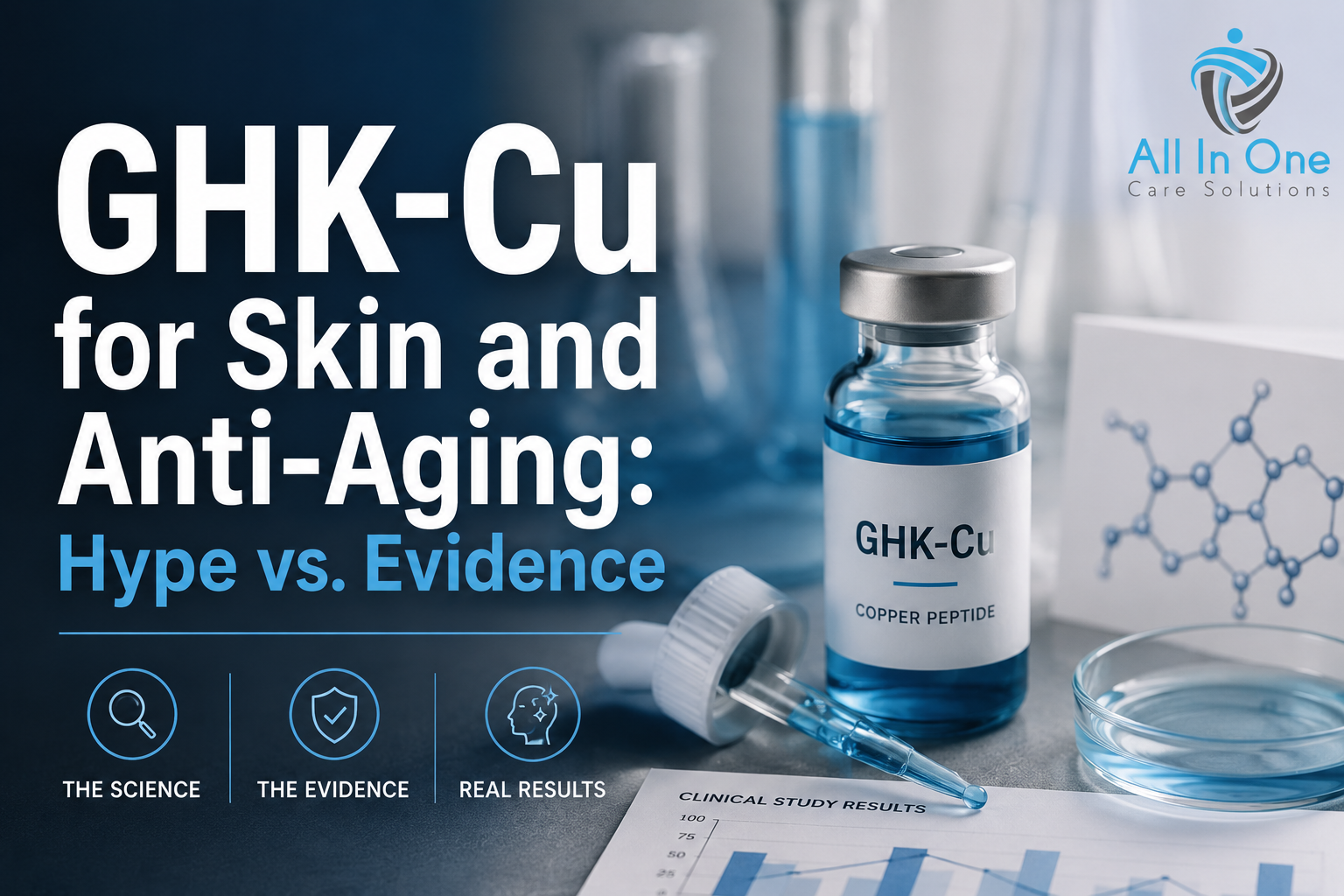
GHK-Cu for Skin and Anti-Aging: Hype vs. Evidence
Last updated: June 10, 2026
Quick Answer: GHK-Cu (copper peptide GHK-Cu) is a naturally occurring tripeptide that declines with age and has demonstrated real, measurable effects on skin repair, collagen production, and inflammation in clinical studies. Topical GHK-Cu products have shown meaningful improvements in skin texture, elasticity, and thickness in controlled trials. However, most supporting studies are small and some are industry-sponsored, so the evidence is promising but not yet definitive. For people in Miami seeking medically supervised anti-aging treatments, GHK-Cu is worth considering as part of a broader skin health plan, not as a standalone miracle solution.
Key Takeaways
- GHK-Cu is a tripeptide naturally found in human plasma that drops significantly between ages 20 and 60, correlating with reduced skin repair capacity [1]
- It stimulates fibroblasts to produce collagen types I, III, and IV while reducing collagen-degrading enzymes, making it mechanistically sound for anti-aging use [6]
- A 12-week placebo-controlled study found a 0.01% GHK-Cu cream improved skin roughness by 35.1%, elasticity by 26.7%, and skin thickness by 24.3% [2]
- GHK-Cu modulates the expression of over 4,000 genes linked to tissue repair and antioxidant defense [3]
- Topical GHK-Cu is generally well-tolerated with a strong safety profile; injectable systemic use lacks sufficient clinical evidence [4][5]
- Product quality varies widely; formulation pH and concentration directly affect how much GHK-Cu actually penetrates the skin barrier [8]
- GHK-Cu is not a replacement for retinol but may complement it, especially for people with retinol sensitivity
- Most clinical studies are small and some are industry-funded, so independent large-scale trials are still needed [7]
- People with copper metabolism disorders or known copper sensitivity should avoid GHK-Cu products
- Medically supervised peptide therapy in Miami, including guidance on topical and injectable peptide protocols, is available at clinics like All In One Care Solutions in Miami Gardens
What Exactly Is GHK-Cu and How Does It Work in Skincare
GHK-Cu is a naturally occurring tripeptide composed of glycine, histidine, and lysine, bound to a copper ion. It is found in human plasma, saliva, and urine, and it plays a key role in wound healing, tissue repair, and cellular signaling.
In the context of skincare, GHK-Cu works through several well-documented pathways:
- Collagen stimulation: It activates fibroblasts to produce more collagen types I, III, and IV, the structural proteins that keep skin firm and smooth [6]
- Collagen protection: It simultaneously reduces matrix metalloproteinase-1 (MMP-1), the enzyme responsible for breaking down existing collagen fibers [6]
- Antioxidant activity: GHK-Cu scavenges free radicals and reduces oxidative stress in skin tissue [1]
- Anti-inflammatory effects: It modulates inflammatory cytokines, which helps calm reactive or damaged skin [1]
- Gene regulation: Research shows GHK-Cu can influence the expression of more than 4,000 human genes, many tied to tissue remodeling and cellular defense [3]
The copper component is not incidental. Copper is a cofactor for lysyl oxidase, the enzyme that crosslinks collagen and elastin fibers. Without adequate copper, collagen formed in skin remains structurally weak.
Plasma levels of GHK-Cu drop from approximately 200 ng/mL at age 20 to about 80 ng/mL by age 60 [1]. This decline tracks closely with the skin’s reduced ability to repair itself, which is why researchers have focused on replenishing it topically or systemically.
What Scientific Studies Actually Prove GHK-Cu Works
The evidence for topical GHK-Cu is real, though it comes with important caveats.
What the studies show:
A 12-week, double-blind, placebo-controlled study of 71 women with photodamaged skin found that a 0.01% GHK-Cu cream produced a 35.1% improvement in skin roughness, a 26.7% increase in skin elasticity, and a 24.3% enhancement in skin thickness [2]. These are clinically meaningful numbers, not marginal changes.
In vitro and in vivo studies consistently confirm GHK-Cu’s ability to promote wound healing, reduce inflammation, and stimulate collagen synthesis [1]. Gene expression research published in peer-reviewed journals demonstrates its broad regulatory effects on aging-related biological pathways [3].
What the studies do not yet confirm:
Most trials are small, short in duration, and some are funded by companies that manufacture GHK-Cu products [7]. Large, independent, multi-center, placebo-controlled trials have not been completed. The field lacks the same depth of evidence that exists for retinoids or sunscreen.
Bottom line: GHK-Cu has a credible mechanism of action and early clinical support. It is not pseudoscience. But it is also not yet at the level of evidence where a dermatologist would call it a first-line treatment.
Can GHK-Cu Actually Reverse Signs of Aging or Is It Just Marketing
GHK-Cu can produce measurable improvements in specific signs of skin aging, particularly texture, elasticity, and thickness. Calling it a reversal agent overstates the evidence; calling it pure marketing understates it.
Here is a more precise way to think about it:
| Claim | Supported by Evidence? |
|---|---|
| Improves skin texture and roughness | Yes, clinical trial data [2] |
| Increases skin elasticity | Yes, clinical trial data [2] |
| Stimulates collagen production | Yes, in vitro and in vivo [1][6] |
| Reduces fine lines and wrinkles | Moderate support, small studies |
| Reverses deep structural aging | Not proven |
| Systemic anti-aging effects (injectable) | Insufficient clinical evidence [5] |
| Safe for most skin types | Yes, strong safety profile [4] |
The honest answer for patients in Miami asking about anti-aging peptide therapy: topical GHK-Cu can improve how your skin looks and functions over 8 to 12 weeks of consistent use. It will not erase decades of sun damage or replace medical-grade treatments. But as part of a supervised skin health plan, it has a legitimate role.
Is GHK-Cu Really Better Than Retinol for Anti-Aging
GHK-Cu is not definitively better than retinol, but it fills a different role and may be preferable for certain patients.
Retinol (and its prescription-strength form, tretinoin) has decades of large-scale clinical evidence behind it. It accelerates cell turnover, reduces fine lines, and addresses hyperpigmentation. It is the gold standard for topical anti-aging.
GHK-Cu works through collagen stimulation and antioxidant activity rather than cell turnover. It does not cause the peeling, dryness, or photosensitivity that retinol commonly triggers.
Choose GHK-Cu if:
- You have retinol sensitivity or rosacea-prone skin
- You are focused on skin firmness and structural repair rather than surface texture
- You want to combine it with retinol as a complementary treatment
Choose retinol if:
- You want the most evidence-backed topical anti-aging option
- You are addressing hyperpigmentation or acne alongside aging concerns
- You can tolerate the adjustment period
Many dermatologists and medical aestheticians recommend using both in a layered protocol, with GHK-Cu applied in the morning and retinol at night. If you are considering a professional facial or aesthetic treatment in Miami Gardens, a clinician can help you determine which combination makes sense for your skin.
How Long Does It Take to See Results from GHK-Cu
Most people using a properly formulated topical GHK-Cu product begin to notice changes in skin texture and hydration within 4 to 6 weeks. More significant improvements in firmness and fine lines typically appear at the 8 to 12 week mark, which aligns with the timeline used in clinical studies [2].
Factors that affect how quickly you see results:
- Concentration: Products with at least 0.01% to 0.1% GHK-Cu are more likely to produce visible effects
- Formulation pH: Higher pH improves skin permeability for copper complexes, meaning a well-formulated product matters as much as the ingredient itself [8]
- Application consistency: Daily use is necessary; skipping applications slows progress
- Skin condition: Photodamaged or thinner skin may respond more noticeably than younger skin with less damage
- Complementary treatments: Pairing GHK-Cu with a HydraFacial or professional skin treatment can enhance absorption and results
Realistic expectation: noticeable texture improvement by week 6, measurable firmness improvement by week 12. Do not expect dramatic changes in the first two weeks.
How Much Does a Good GHK-Cu Serum Cost
Quality GHK-Cu serums typically range from $40 to $150 for a 1 oz (30 mL) bottle. Medical-grade or compounded formulations available through clinics can run higher, often $80 to $200, but come with verified concentrations and formulation standards.
What to look for on the label:
- GHK-Cu listed among the top active ingredients (not buried at the bottom)
- Concentration of at least 0.01% (some products go up to 1%)
- pH-optimized formulation (ideally between 6.5 and 7.5 for better penetration) [8]
- No competing chelating agents that bind copper and reduce its activity
What to avoid:
- Products that list “copper peptide” without specifying GHK-Cu
- Extremely cheap serums (under $20) that likely contain negligible active concentrations
- Brands that make systemic anti-aging claims for a topical product
Consumer-facing GHK-Cu products have grown significantly in the skincare market, with some brands marketing them as alternatives to vitamin C serums [9]. Price alone does not guarantee quality. If you are in the Miami area and want guidance on pharmaceutical-grade options, a consultation at a medical clinic in Miami Gardens can help you identify reliable sources.
How Do Dermatologists Rate GHK-Cu Compared to Other Anti-Aging Treatments
Dermatologists generally view GHK-Cu as a promising but secondary option in the anti-aging toolkit. It ranks below retinoids, sunscreen, and proven procedural treatments in terms of evidence strength, but above most other peptides in terms of mechanistic credibility.
Comparative ranking (evidence-based perspective):
- Broad-spectrum SPF 30+ sunscreen (daily) – highest evidence, most impact
- Prescription tretinoin or retinol – decades of large-scale trial data
- Vitamin C serum (L-ascorbic acid) – strong antioxidant evidence
- GHK-Cu – promising early evidence, strong mechanism, needs larger trials [7]
- Other peptides (Matrixyl, Argireline) – variable evidence, weaker mechanism data
Experts note that GHK-Cu’s ability to modulate thousands of genes simultaneously is biologically unusual and warrants serious research attention [3]. The concern is not that it does not work, but that the clinical trial infrastructure to fully confirm its benefits is still being built.
For patients interested in anti-aging treatments that go beyond topical skincare, options like Botox in Miami Gardens or NAD+ IV Therapy offer complementary approaches that address aging through different mechanisms. A physician-supervised plan that combines multiple modalities tends to produce better outcomes than any single treatment.
Who Should Not Use GHK-Cu Peptides
GHK-Cu is well-tolerated by most people, but certain groups should avoid it or consult a physician first.
Do not use GHK-Cu if you have:
- A diagnosed copper metabolism disorder (such as Wilson’s disease or Menkes disease)
- Known sensitivity or allergy to copper
- Active skin infections or open wounds in the treatment area
- A history of contact dermatitis from metal-based skincare products
Use with caution if you:
- Are pregnant or breastfeeding (insufficient safety data for these populations)
- Are using other active ingredients that may interact with copper chelation
- Have highly reactive or compromised skin barrier conditions
Common mistake: Assuming that “natural” means universally safe. GHK-Cu is naturally occurring, but copper in excess can be pro-oxidant. This is why concentration and formulation matter, and why medically supervised guidance is valuable.
For patients in Miami Gardens, Hialeah, or Miami Lakes who are unsure whether GHK-Cu is appropriate for their health profile, a primary care consultation at All In One Care Solutions can review your full health history before recommending any peptide-based treatment.
What Are the Potential Side Effects of GHK-Cu
GHK-Cu has an exceptional safety profile in both topical and injectable forms based on available research [4]. Serious adverse effects are rare.
Reported side effects (topical):
- Mild skin redness or irritation at the application site, usually transient
- Temporary skin discoloration (bluish tint) if the product is applied too heavily, due to the copper content
- Rare contact dermatitis in copper-sensitive individuals
For injectable or systemic use:
- The safety data for injectable GHK-Cu in humans is limited. Most injectable peptide research has been conducted in animal models or small human studies [5]
- Systemic copper overload is theoretically possible with high-dose injectable use, though no confirmed cases are documented in the current literature
Practical guidance: Start with a patch test on a small area of skin for 48 hours before applying GHK-Cu to the face. If you are considering injectable peptide therapy, this should only be done under physician supervision. Our team at All In One Care Solutions provides medically supervised IV therapy and wellness injections with full clinical oversight.
Why Do Some People Say GHK-Cu Repairs Skin Damage Faster
The perception of faster repair is rooted in GHK-Cu’s direct role in wound healing biology. It does not just stimulate cosmetic collagen production; it activates the same repair pathways the body uses after injury.
Specifically, GHK-Cu:
- Recruits repair cells to damaged tissue
- Reduces inflammation that slows healing
- Promotes angiogenesis (new blood vessel formation), which improves nutrient delivery to skin
- Stimulates the production of decorin, a proteoglycan that organizes collagen fibers properly [1]
People who use GHK-Cu after procedures like microdermabrasion, laser resurfacing, or chemical peels often report faster recovery and reduced redness. This is consistent with the peptide’s mechanism. If you are considering microdermabrasion in Miami Gardens, adding a GHK-Cu serum to your post-procedure routine may support faster skin recovery.
The “faster repair” claim is not marketing language in this context. It reflects real biology, though the magnitude of the effect varies by individual and product quality.
Are There Any Natural Alternatives to GHK-Cu for Skin Regeneration
Several evidence-supported alternatives can support skin regeneration, though none replicate GHK-Cu’s exact mechanism.
Clinically supported alternatives:
- Retinol / Tretinoin: The most evidence-backed topical anti-aging option for collagen stimulation and cell turnover
- Vitamin C (L-ascorbic acid): Essential cofactor for collagen synthesis; strong antioxidant evidence
- Niacinamide: Reduces inflammation, improves barrier function, and addresses hyperpigmentation
- Hyaluronic acid: Supports skin hydration and plumpness, though it does not stimulate collagen directly
- Glutathione: A master antioxidant that supports skin brightness and cellular repair. Glutathione IV therapy is available for patients seeking systemic antioxidant support
Lifestyle-based skin regeneration support:
- Adequate sleep (collagen synthesis peaks during deep sleep)
- Protein-rich diet providing glycine, proline, and lysine (collagen precursors)
- Daily SPF use to prevent ongoing photodamage
- Hydration and micronutrient sufficiency, including zinc and copper from diet
For patients interested in a comprehensive anti-aging approach that includes both topical and systemic support, our Miami Gardens IV therapy services offer nutrient infusions that complement topical peptide protocols.
Where Can I Buy a Reliable GHK-Cu Skincare Product
Reliable GHK-Cu products are available through medical clinics, licensed aestheticians, and select online retailers. The key is verifying that the product contains a meaningful concentration of GHK-Cu and is formulated for actual skin penetration.
Reliable purchasing channels:
- Physician-dispensed medical-grade skincare (highest quality control)
- Licensed medical spas and aesthetic clinics
- Established skincare brands with published formulation data
- Compounding pharmacies (for clinical-grade topical or injectable formulations)
Channels to approach with caution:
- General e-commerce marketplaces without third-party testing
- Products with no listed concentration of GHK-Cu
- Brands that make systemic or injectable anti-aging claims for an OTC topical product [9]
If you are in the Miami area and want access to pharmaceutical-grade peptide products with clinical guidance, All In One Care Solutions offers physician-supervised peptide therapy consultations. Our team serves patients across Miami Gardens, Miami Lakes, and Hialeah with evidence-based wellness protocols. Contact us to schedule a consultation and discuss whether GHK-Cu or other peptide treatments are appropriate for your goals.
Conclusion
GHK-Cu for skin and anti-aging sits at a credible intersection of real biology and early clinical evidence. It is not hype, but it is also not fully proven at the scale that retinoids or sunscreen are. What the research shows is consistent: GHK-Cu stimulates collagen, reduces inflammation, supports skin repair, and declines with age in a way that correlates with skin deterioration. A well-formulated topical product at an appropriate concentration can produce meaningful improvements in skin texture, elasticity, and thickness over 8 to 12 weeks.
Actionable next steps for Miami residents:
- If you are considering GHK-Cu, start with a topical product from a verified source at a concentration of at least 0.01%
- Pair it with daily broad-spectrum SPF and a core skincare routine for best results
- If you have a copper sensitivity, metabolic condition, or are pregnant, consult a physician before use
- For injectable peptide protocols or medical-grade formulations, seek physician supervision
- Schedule a consultation at All In One Care Solutions in Miami Gardens to discuss a personalized anti-aging plan that may include GHK-Cu, NAD+ therapy, aesthetic treatments, or other medically supervised options
Our clinic provides preventive care Miami residents can trust, with evidence-based treatment plans tailored to your health history, goals, and budget. Whether you are a self-pay wellness client or an insured patient, we offer transparent, medically supervised care in a professional environment.
Frequently Asked Questions
Q: Is GHK-Cu FDA-approved for anti-aging?
No. GHK-Cu is not FDA-approved as a drug for anti-aging. It is used as a cosmetic ingredient in topical products and as a compounded peptide in clinical settings. Compounded formulations are not FDA-approved drugs; results vary.
Q: Can I use GHK-Cu every day?
Yes, daily use is appropriate for most people. Apply it consistently, morning or evening, as directed by the product or your clinician. Start with once daily and monitor for any skin sensitivity.
Q: Does GHK-Cu work for hair loss?
Some early research suggests GHK-Cu may support hair follicle health and reduce hair loss, but the evidence is much weaker than for skin applications. Speak with a physician before using it specifically for hair concerns.
Q: Is GHK-Cu safe to use with retinol?
Generally yes. Many clinicians recommend GHK-Cu in the morning and retinol at night to avoid potential interaction and to provide complementary benefits. Confirm with your skincare provider based on your specific products.
Q: How is GHK-Cu different from other copper peptides?
GHK-Cu is the most studied copper peptide in skin science. Other copper peptides exist, but GHK-Cu has the most clinical and mechanistic data supporting its use for collagen stimulation and skin repair.
Q: Can I get GHK-Cu injections in Miami?
Injectable GHK-Cu is available through compounding pharmacies under physician supervision. Systemic evidence is limited, so this should only be pursued with a licensed provider who can assess your health profile and monitor for any adverse effects.
Q: Does GHK-Cu help with acne scars?
GHK-Cu’s ability to stimulate collagen and support tissue remodeling makes it theoretically useful for atrophic acne scars, but clinical evidence specifically for acne scarring is limited. It is often used post-procedure to support healing.
Q: What concentration of GHK-Cu should I look for in a serum?
Look for products with at least 0.01% GHK-Cu. Some formulations go up to 1%. Higher concentration does not automatically mean better results; formulation quality and skin penetration matter equally.
Q: Is peptide therapy available in Miami Gardens?
Yes. All In One Care Solutions in Miami Gardens offers physician-supervised peptide therapy consultations. We serve patients from Miami Gardens, Miami Lakes, Hialeah, and surrounding communities with medically supervised wellness protocols.
Q: Can GHK-Cu replace Botox?
No. GHK-Cu and Botox work through entirely different mechanisms. Botox temporarily relaxes muscles to reduce dynamic wrinkles. GHK-Cu supports collagen production and skin repair. They can be used together as part of a comprehensive anti-aging plan.
References
[1] Pmc8789089 – https://pmc.ncbi.nlm.nih.gov/articles/PMC8789089/
[2] Ghk Cu For Skin And Hair – https://www.middlewaynutrition.com/peptides/ghk-cu-for-skin-and-hair
[3] mdpi – https://www.mdpi.com/2079-9284/2/3/236
[4] Ghk Cu Review – https://www.peptidepilot.me/reviews/ghk-cu-review
[5] Ghk Cu – https://peptidesciencethailand.com/research/ghk-cu
[6] Skin Peptides – https://compoundguide.org/en/guides/skin-peptides/
[7] Ghk Cu For Skin What The Clinical Evidence Actually Shows – https://rethinkpeptides.com/articles/ghk-cu-for-skin-what-the-clinical-evidence-actually-shows
[8] Pmc4508379 – https://pmc.ncbi.nlm.nih.gov/articles/PMC4508379/
[9] Ghk Cu Skincare Discovery Outsells Vitamin C Serums – https://hlbenefits.com/ghk-cu-skincare-discovery-outsells-vitamin-c-serums
Tags: GHK-Cu peptide, copper peptide skincare, anti-aging peptides Miami, peptide therapy Miami Gardens, collagen stimulation, skin repair peptides, GHK-Cu vs retinol, peptide injections Miami, preventive care Miami, medical aesthetics Miami Gardens, topical peptides, skin anti-aging evidence