FDA Peptide Reclassification 2026: What It Means for Patients in Miami (Patient Guide Edition)
Last updated: June 10, 2026
Quick Answer: The FDA’s 2026 peptide reclassification removes several widely used compounded peptides from the category of bulk drug substances that compounding pharmacies can legally use. For patients in Miami currently receiving peptide therapy, this means some treatments may become harder to access, more expensive, or require a switch to FDA-approved alternatives. Knowing exactly which peptides are affected, and what your clinical options are, is the most important step you can take right now.
Key Takeaways
- The FDA has moved several popular compounded peptides, including BPC-157 and certain growth hormone secretagogues, off the list of substances approved for pharmacy compounding.
- Patients in Miami receiving compounded peptide therapy should contact their provider immediately to review their current protocol.
- Some peptide treatments will remain available through licensed compounding pharmacies that meet updated federal standards.
- Costs are likely to rise for treatments that require reformulation or sourcing from new accredited pharmacies.
- Clinics that already operate under physician supervision with pharmaceutical-grade compounding partners are best positioned to continue care with minimal disruption.
- Insurance rarely covered compounded peptides before 2026, and that is unlikely to change after reclassification.
- Alternatives such as semaglutide and tirzepatide weight loss programs and NAD+ IV therapy remain fully available under current regulations.
- Patients should avoid purchasing peptides online from unregulated sources, a practice that carries serious health risks and is now under increased federal scrutiny.
- A consultation with a licensed primary care provider is the safest first step for any patient whose peptide protocol is affected.
What Exactly Are Peptides and Why Is the FDA Changing Their Classification
Peptides are short chains of amino acids, the building blocks of proteins, that act as signaling molecules in the body. They regulate everything from tissue repair and inflammation to hormone release and metabolism. The FDA is changing their classification because many compounded peptides have been sold and administered without the safety, efficacy, and manufacturing oversight required of approved drugs.
The FDA classifies drugs and biological substances under different regulatory categories. For years, certain peptides existed in a gray zone: they were not FDA-approved drugs, but compounding pharmacies could legally prepare them using bulk drug substances. The 2026 reclassification tightens that gray zone significantly. The FDA has determined that several of these peptides do not meet the criteria to remain on the 503A or 503B bulk drug substance lists, which are the legal frameworks that allow compounding pharmacies to produce customized medications.
Key peptides affected by the reclassification include:
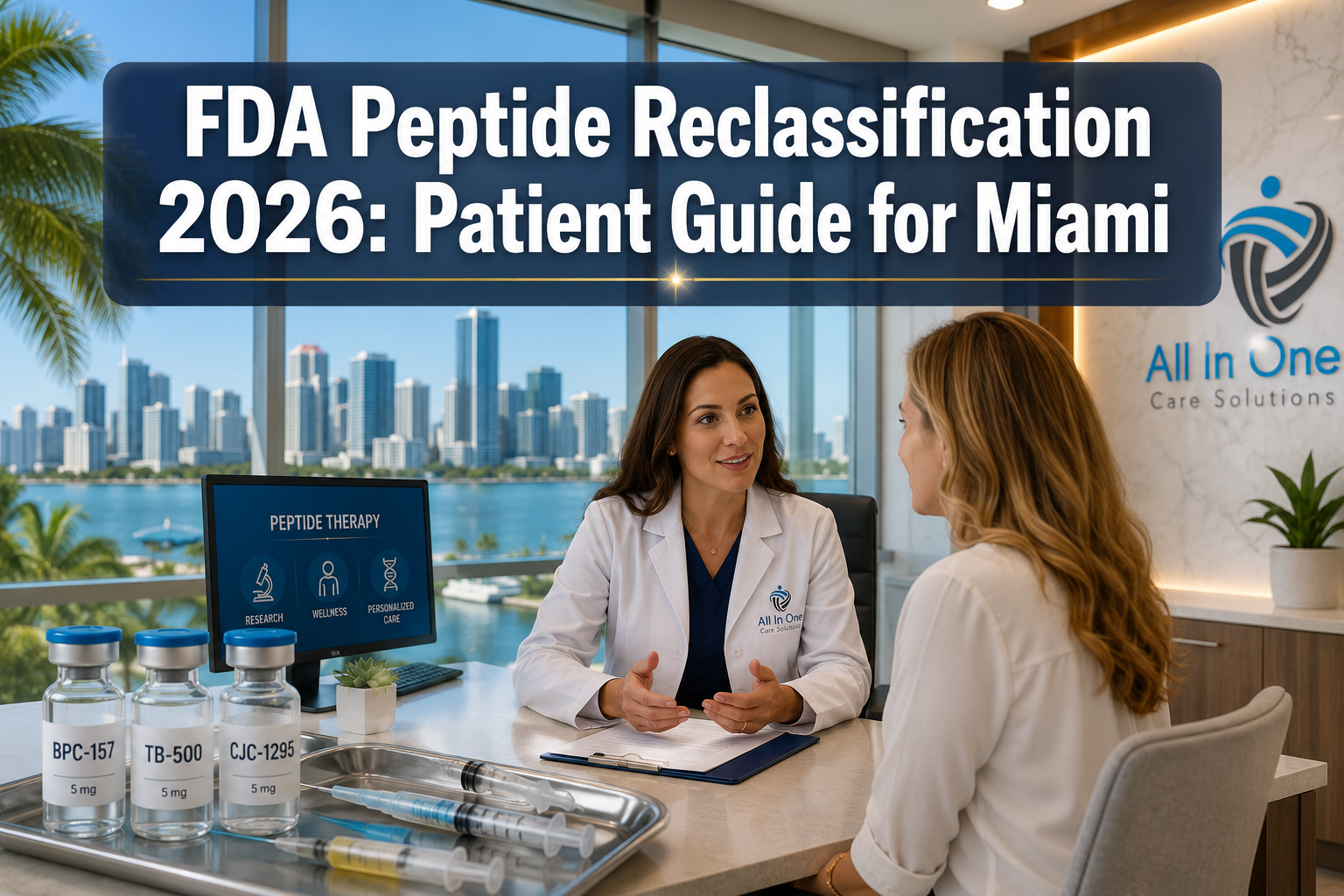
- BPC-157 (Body Protection Compound-157), widely used for tissue healing and gut health
- CJC-1295 and Ipamorelin, used together as growth hormone secretagogues
- TB-500 (Thymosin Beta-4 fragment), used for recovery and inflammation
- Selank and Semax, used for cognitive support and anxiety
The FDA’s concern centers on the lack of clinical trial data supporting safety and efficacy for human use at the doses commonly prescribed. This is a regulatory and public health decision, not a statement that these compounds have no therapeutic value.
How Will the 2026 Reclassification Impact My Current Peptide Treatments in Miami
If you are currently receiving peptide therapy in Miami, the impact depends on which peptides you use and whether your clinic sources them from a 503A or 503B accredited compounding pharmacy.
Patients using peptides that are now off the approved bulk substance list will face one of three outcomes:
- Discontinuation if the clinic cannot source a compliant formulation.
- Reformulation to a closely related peptide or analog that remains on the approved list.
- Transition to an FDA-approved drug that addresses the same clinical goal.
Clinics in Miami that operate under physician supervision and partner with accredited pharmacies are already working through these transitions. If your provider has not contacted you yet about your protocol, that is a signal to call them proactively. Our primary care clinic in Miami Gardens is actively reviewing all patient peptide protocols and reaching out to schedule consultations.
Are Peptide Therapies Going to Be More Expensive After the New FDA Rules
Yes, in most cases, costs will increase. The reclassification adds compliance requirements for compounding pharmacies, which raises their operating costs. Those costs are passed on to patients.
Compounded peptides were already self-pay for most patients, since insurance does not cover them. After reclassification, expect:
- Higher per-vial costs as pharmacies absorb new testing and documentation requirements.
- Longer lead times for some formulations, which may require ordering in advance.
- Possible shortages of specific peptides if fewer pharmacies choose to maintain compliance for low-volume compounds.
For context, BPC-157 injections that previously cost $150 to $250 per month may increase by 20 to 40 percent at compliant pharmacies, based on early estimates from compounding industry groups. Patients should ask their clinic for updated pricing before assuming their current cost holds.
Are Compounded Peptide Treatments Going to Be Restricted
Yes, but not eliminated. The reclassification restricts which peptides compounding pharmacies can legally prepare, not whether compounding itself is legal.
Compounding pharmacies operating under 503A (for patient-specific prescriptions) and 503B (for larger-scale outsourcing facilities) can still prepare peptides that remain on the approved bulk substance list. The restriction applies specifically to peptides the FDA has removed from those lists.
What this means practically:
- Peptides still on the approved list, such as certain amino acid-based formulations and some growth factors, remain accessible.
- Peptides removed from the list cannot be legally compounded for human use by U.S. pharmacies after the compliance deadline.
- Clinics that source from overseas or unregulated domestic suppliers are operating outside federal law, and patients using those sources face both legal and health risks.
Which Miami Clinics Are Already Prepared for the Peptide Classification Changes
Clinics that were already operating under strict physician supervision and using accredited compounding pharmacies are the most prepared. The key markers to look for in a Miami peptide clinic include:
- A licensed physician or advanced practice provider oversees every prescription.
- Peptides are sourced from a pharmacy holding 503A or 503B accreditation.
- The clinic conducts baseline lab work before starting any peptide protocol.
- Informed consent documents clearly state that compounded medications are not FDA-approved drugs.
All In One Care Solutions in Miami Gardens meets each of these standards. Our team is already in contact with our compounding pharmacy partners to identify which formulations remain compliant and which require patient protocol reviews. If you are looking for a primary care doctor in Miami Gardens who can supervise your peptide therapy under the new rules, we are accepting new patients.
What Medical Conditions Will Be Most Affected by This Peptide Reclassification
The conditions most affected are those where compounded peptides were the primary treatment option, rather than a supplement to an FDA-approved therapy.
Most affected conditions and use cases:
| Condition or Goal | Commonly Used Peptide | Regulatory Status After 2026 |
|---|---|---|
| Gut healing, leaky gut | BPC-157 | Removed from approved list |
| Growth hormone deficiency support | CJC-1295 / Ipamorelin | Removed from approved list |
| Tissue and tendon recovery | TB-500 | Removed from approved list |
| Cognitive function, anxiety | Selank, Semax | Removed from approved list |
| Medical weight loss | Semaglutide, Tirzepatide | FDA-approved, unaffected |
| Anti-aging, cellular energy | NAD+ | Remains available via IV therapy |
Patients using peptides for medical weight loss are largely unaffected, since semaglutide and tirzepatide are FDA-approved medications. Our tirzepatide weight loss program in Miami Gardens continues without interruption.
Can I Still Get My Existing Peptide Prescriptions After 2026
It depends on the specific peptide. Prescriptions for peptides that remain on the FDA’s approved bulk substance list can continue with no change. Prescriptions for peptides that have been removed cannot be legally filled by U.S. compounding pharmacies after the compliance deadline.
If your current prescription is for an affected peptide, your provider has three options:
- Transition you to a compliant analog with a similar mechanism.
- Address your underlying condition with an FDA-approved drug.
- Document a clinical rationale for an alternative approach, such as IV therapy or a different treatment modality.
Do not attempt to continue an affected peptide by ordering it online. Unregulated online sources carry risks of contamination, incorrect dosing, and counterfeit products. The FDA has increased enforcement actions in 2026 specifically targeting online peptide sellers.
What Are the Potential Risks of the New FDA Peptide Guidelines
The primary risk for patients is a gap in care if they do not act quickly to review their protocol with a licensed provider.
Secondary risks include:
- Seeking unregulated sources out of frustration, which exposes patients to contaminated or mislabeled products.
- Stopping treatment abruptly without a physician-guided transition, which can affect conditions being managed with peptide support.
- Misinformation from online forums claiming certain peptides are still legal when they are not, or vice versa.
From a public health standpoint, the reclassification also carries a risk of pushing patients toward less supervised care environments. This is why working with a medically supervised clinic matters more now than it did before 2026.
What Common Mistakes Are Patients Making About These Upcoming FDA Changes
Several patterns of misinformation are circulating among patients in Miami and nationally. The most common mistakes include:
- Assuming nothing will change. Some patients believe their clinic will find a workaround. Reputable clinics will not violate federal compounding law.
- Stockpiling peptides. Purchasing large quantities before the compliance deadline does not make those peptides legal to use after it. It also creates storage and sterility risks.
- Confusing research peptides with clinical peptides. Peptides labeled “for research use only” are not legal for human injection, regardless of what a seller claims.
- Delaying a provider conversation. The earlier you discuss your protocol with a physician, the more transition options are available to you.
- Assuming insurance will step in. Insurance did not cover compounded peptides before, and it will not cover them after reclassification.
How Do Miami Healthcare Providers Plan to Adapt to These New FDA Regulations
Prepared Miami clinics are taking a structured approach. At All In One Care Solutions, our response includes four steps:
- Protocol audit: Every patient on a peptide protocol is being reviewed to identify which compounds are affected.
- Pharmacy partner review: We are confirming which of our compounding pharmacy partners hold current 503A or 503B accreditation and which formulations they can still legally provide.
- Clinical alternatives mapping: For each affected peptide, our physicians are identifying the closest compliant alternative, whether that is a different peptide, an FDA-approved drug, or a supportive therapy like IV therapy in Miami Gardens.
- Patient communication: We are scheduling consultations proactively rather than waiting for patients to call.
Clinics that do not have a physician on staff, or that source peptides from non-accredited pharmacies, will have a much harder time adapting. This is one reason why choosing a medically supervised clinic from the start matters.
Will My Insurance Cover Peptide Treatments After the 2026 Changes
No. Insurance coverage for compounded peptides was not available before 2026, and the reclassification does not create a path to coverage. In fact, removing peptides from the approved compounding list makes insurance reimbursement even less likely.
What insurance may cover, depending on your plan, are the underlying conditions being treated. For example:
- If you were using a peptide to support growth hormone deficiency, your insurance may cover lab testing and an FDA-approved hormone therapy.
- If you were using peptides for weight management, your insurance may now cover semaglutide or tirzepatide under GLP-1 drug benefits, depending on your plan.
We recommend scheduling an annual physical exam in Miami to review your lab work and discuss which FDA-approved treatments your insurance will support as part of a transition plan.
What Alternative Treatments Should I Consider If Peptides Become Harder to Access
Several evidence-supported alternatives remain fully available and are not affected by the 2026 reclassification.
For weight management:
- Semaglutide and tirzepatide (GLP-1 and dual GIP/GLP-1 agonists) are FDA-approved and widely available. See our semaglutide weight loss program in Miami Gardens for details.
For energy, recovery, and cellular health:
- NAD+ IV therapy in Miami Gardens supports mitochondrial function and is not subject to the peptide reclassification.
- Glutathione IV therapy supports antioxidant defense and remains fully available.
- Myers’ Cocktail IV therapy provides a broad spectrum of vitamins and minerals for general wellness.
For hormone support:
- Physician-supervised hormone therapy using FDA-approved formulations remains an option for patients whose peptide use was aimed at hormone optimization.
For inflammation and recovery:
- Physical therapy, anti-inflammatory nutrition protocols, and supervised exercise programming can address some of the goals previously supported by BPC-157 and TB-500.
Who Should Be Most Concerned About the Peptide Reclassification
Patients in four groups should prioritize a provider conversation as soon as possible.
- Active peptide therapy patients using any of the compounds removed from the approved list.
- Patients who self-manage their peptide use without a supervising physician, since they have no clinical point of contact to guide a transition.
- Patients sourcing peptides online from unregulated vendors, who face the highest risk of receiving non-compliant or unsafe products.
- Patients with complex conditions where the peptide was playing a meaningful clinical role, such as gut repair or hormone support, and where stopping abruptly could affect their health.
If you fall into any of these groups and are in the Miami area, our team is available for same-day appointments in Miami Gardens to review your situation and build a compliant, supervised plan.
Frequently Asked Questions
Is BPC-157 still legal in Miami in 2026?
BPC-157 has been removed from the FDA’s approved bulk drug substance list for compounding. U.S. compounding pharmacies can no longer legally prepare it for human use. Patients currently using BPC-157 should consult their provider immediately about compliant alternatives.
Can I still get CJC-1295 and Ipamorelin from a Miami clinic?
These growth hormone secretagogues are among the peptides affected by the 2026 reclassification. Compliant clinics in Miami can no longer prescribe them through compounding pharmacies. Your provider can discuss FDA-approved alternatives for hormone optimization.
Will peptide therapy clinics in Miami close because of this?
No. Clinics that operate under physician supervision and adapt their protocols to compliant formulations will continue to offer peptide-adjacent and alternative therapies. Only clinics that relied exclusively on now-restricted compounds without a transition plan will face significant disruption.
Is it safe to buy peptides online after the reclassification?
No. Peptides sold online as “research chemicals” or “for research use only” are not legal for human injection and carry serious contamination and dosing risks. The FDA has increased enforcement in 2026 specifically targeting these sales channels.
Does the reclassification affect NAD+ therapy?
No. NAD+ (nicotinamide adenine dinucleotide) IV therapy is not classified as a peptide under the reclassification framework and remains fully available at licensed clinics.
Will tirzepatide and semaglutide be affected?
No. Both are FDA-approved medications and are not subject to the compounded peptide reclassification. These weight loss treatments continue without interruption.
How do I know if my Miami clinic is compliant?
Ask your provider directly whether they source peptides from a 503A or 503B accredited pharmacy, whether a licensed physician oversees your prescription, and whether they have reviewed your protocol against the 2026 reclassification list.
Can I get a telemedicine consultation to review my peptide protocol?
Yes. Our telemedicine services in Miami Gardens allow you to speak with a licensed physician from home to review your current protocol and discuss compliant next steps.
What lab tests should I get before transitioning off a peptide?
Your provider will determine the appropriate panel based on your condition. Common tests include IGF-1 levels (for growth hormone-related peptides), comprehensive metabolic panel, and inflammation markers. Our clinic offers comprehensive medical exams in Miami Gardens that include relevant lab work.
How long do I have before the compliance deadline takes effect?
The FDA’s enforcement timeline has been phased, with full compliance expected by late 2026 for most affected compounds. However, many accredited pharmacies have already stopped producing restricted peptides. Do not wait for a hard deadline to act.
Conclusion
The FDA Peptide Reclassification 2026 is a real and immediate change that affects patients across Miami, Miami Gardens, Miami Lakes, and Hialeah who rely on compounded peptide therapy. The most important action you can take is to schedule a consultation with a licensed physician before your current supply runs out or your clinic makes a unilateral change to your protocol.
At All In One Care Solutions, we are committed to providing medically supervised, evidence-based care that stays within federal regulatory standards. That means we will not prescribe restricted peptides through non-compliant sources, and we will work with each patient individually to find the best available alternative under current law.
Your next steps:
- Call or book online to schedule a peptide protocol review with one of our physicians.
- Bring a list of your current peptides, doses, and the pharmacy you use.
- Ask about compliant alternatives, including NAD+ IV therapy, GLP-1 weight loss programs, and hormone therapy.
- Request updated lab work to establish a baseline before any transition.
Our team provides bilingual care in English and Spanish, accepts most major insurance for primary care visits, and offers self-pay wellness pricing for treatments like IV therapy and weight loss programs. We serve patients from Miami Gardens, Miami Lakes, Hialeah, and surrounding communities.
Contact All In One Care Solutions today to protect your health and your treatment plan under the new FDA guidelines.
References
- U.S. Food and Drug Administration. “Bulk Drug Substances That May Be Used in Compounding Under Section 503A of the Federal Food, Drug, and Cosmetic Act.” FDA.gov, 2023.
- U.S. Food and Drug Administration. “Outsourcing Facility Regulations Under Section 503B.” FDA.gov, 2022.
- Alliance for Pharmacy Compounding. “Category 2 Bulk Drug Substance Nominations.” A4PC.org, 2023.
- International Journal of Molecular Sciences. “BPC-157: A Review of Its Mechanisms and Potential Clinical Applications.” MDPI, 2022.
- National Academies of Sciences, Engineering, and Medicine. “The Clinical Utility of Compounded Bioidentical Hormone Preparations.” NAP.edu, 2020.
Tags: FDA peptide reclassification 2026, peptide therapy Miami, compounded peptides Miami, BPC-157 Miami, CJC-1295 Ipamorelin, peptide clinic Miami Gardens, medical weight loss Miami Gardens, NAD+ therapy Miami, primary care Miami, peptide reclassification patient guide