Family Medicine vs Internal Medicine
Last updated: July 2, 2026
Quick Answer: Family medicine and internal medicine are both primary care specialties, but they serve different patient populations. Family medicine doctors treat patients of all ages, from newborns to seniors, while internists (internal medicine physicians) focus exclusively on adult patients. For most families and individuals in Miami Gardens seeking a single doctor to manage their health across all life stages, a family medicine physician is typically the right first choice.
Key Takeaways
- Family medicine covers all ages; internal medicine covers adults only (generally 18 and older).
- Both specialties can serve as a primary care physician for adults with chronic conditions such as diabetes, hypertension, and high cholesterol.
- Internal medicine residency is three years; family medicine residency is also three years but includes pediatric and obstetric training.
- Family medicine doctors routinely perform minor procedures; internists may have deeper training in complex adult disease management.
- For families with children, a family medicine doctor is the more practical choice since one provider can care for every household member.
- Seniors on Medicare can see either a family medicine doctor or an internist as their primary care physician.
- Salary differences between the two specialties are modest at the primary care level, though subspecialty internal medicine typically pays more.
- Switching between the two specialties is possible but requires additional training or a new residency match.
What Is the Difference Between Family Medicine and Internal Medicine?
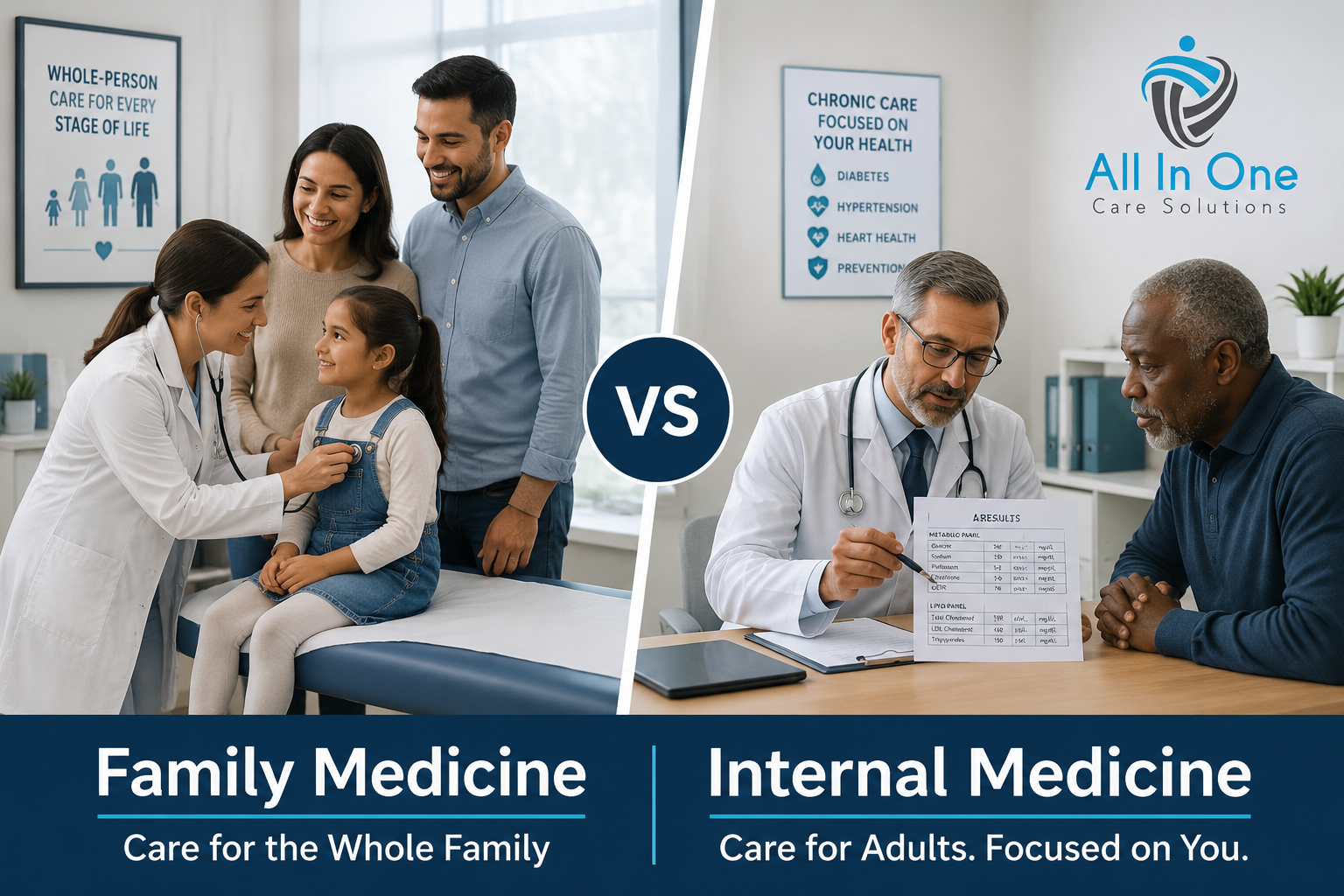
Family medicine and internal medicine are both primary care disciplines, but they differ in scope and patient age range. A family medicine physician is trained to care for patients at every stage of life, including children, adolescents, adults, and seniors. An internal medicine physician, often called an internist, is trained specifically in adult medicine and does not typically provide care for pediatric patients.
Both types of physicians diagnose and treat common illnesses, manage chronic conditions, order lab work, and coordinate specialist referrals. The distinction becomes most relevant when you are choosing a primary care doctor for your household.
Key structural differences:
| Feature | Family Medicine | Internal Medicine |
|---|---|---|
| Patient age range | All ages (birth through end of life) | Adults (typically 18+) |
| Residency length | 3 years | 3 years |
| Pediatric training | Yes, included in residency | No (separate pediatrics specialty) |
| Obstetrics training | Basic OB included in some programs | Not included |
| Subspecialties available | Sports medicine, geriatrics, others | Cardiology, nephrology, endocrinology, and many others |
| Typical practice setting | Outpatient clinic, community health | Outpatient clinic, hospital medicine |
Who Should See a Family Medicine Doctor vs. an Internal Medicine Doctor?
For most adults, either specialty works well for routine primary care. The choice depends primarily on whether you have children in your household and the complexity of your medical conditions.
Choose a family medicine doctor if:
- You have children or teenagers who also need a primary care physician.
- You want one doctor who can see every member of your family.
- You are an adult with common chronic conditions such as diabetes, high blood pressure, or high cholesterol.
- You want comprehensive preventive care, including annual physical exams and routine screenings.
- You are located in Miami Gardens or surrounding communities and prefer a bilingual, community-based practice.
Choose an internal medicine doctor if:
- You are an adult with multiple complex medical conditions requiring in-depth management.
- You do not have children who need primary care.
- You have been referred to an internist by a specialist for coordinated adult care.
- You are a senior patient whose care involves several organ systems simultaneously.
For patients in Miami Gardens, Miami Lakes, and Hialeah, family practice primary care services that accept patients ages 12 and up offer a practical solution for most households.
Do Family Medicine Doctors See Kids and Adults?
Yes. Family medicine physicians are specifically trained to care for patients across all age groups, including infants, children, adolescents, adults, and elderly patients. This is one of the defining characteristics of the specialty.
This breadth of training makes family medicine doctors well suited for community-based primary care, where a single provider can follow a patient from childhood through retirement. In contrast, an internist would refer a child to a pediatrician.
For families in South Florida seeking a single point of care, a primary care physician in Miami Gardens who practices family medicine can manage routine wellness visits, vaccinations, chronic disease monitoring, and sick visits for every member of the household.
Can an Internal Medicine Doctor Treat the Whole Family?
No, not typically. Internists are trained exclusively in adult medicine and are not equipped to provide pediatric care. If you have children under 18, an internist would not be the appropriate primary care provider for them.
That said, for households where all members are adults, an internist can function as a full-service primary care physician, managing preventive care, chronic disease management, and acute illness.
Common mistake: Some patients assume “internal medicine” means the doctor handles everything internally, like a general surgeon. In fact, the name refers to the specialty’s focus on internal organ systems in adults, not a broader scope than family medicine.
What Conditions Do Family Medicine Doctors Treat?
Family medicine doctors manage a wide range of acute and chronic conditions across all age groups. Their training prepares them for both the breadth of everyday primary care and the longitudinal management of long-term health conditions.
Commonly managed conditions include:
- Type 2 diabetes and prediabetes
- Hypertension (high blood pressure)
- High cholesterol and lipid disorders
- Asthma and COPD
- Thyroid disorders
- Obesity and weight management
- Urinary tract infections and respiratory infections
- Anxiety and depression (initial management)
- Skin conditions
- Musculoskeletal pain and minor injuries
For patients managing diabetes or high blood pressure in Miami Gardens, a chronic disease management program through a family medicine practice provides structured, ongoing care rather than episodic treatment.
Preventive care is also central to family medicine. Annual physical exams, blood panels, EKGs, cancer screenings, and immunizations are all standard components of a family medicine practice. Patients can schedule an annual physical exam in Miami Gardens as a starting point for establishing care.
Do Family Medicine Doctors Do Procedures?
Yes. Family medicine physicians are trained to perform a variety of in-office procedures, though the scope varies by practice setting and individual physician training.
Procedures commonly performed in family medicine:
- Skin biopsies and lesion removal
- Joint injections
- Laceration repair
- Ear irrigation and cerumen removal
- Pap smears and pelvic exams
- EKGs (electrocardiograms)
- Spirometry (lung function testing)
- In-office laboratory testing and blood draws
Internists also perform procedures, but their procedural training tends to focus more on hospital-based or subspecialty contexts, such as thoracentesis, lumbar puncture, or central line placement in inpatient settings.
For patients who want on-site lab testing without a separate appointment, in-house laboratory services in Miami Gardens allow for same-day results alongside a clinical visit.
How Long Does It Take to Become a Family Medicine Doctor vs. an Internal Medicine Doctor?
Both specialties require the same total training time at the residency level: four years of medical school followed by a three-year residency program. The content of that residency, however, differs substantially.
Family medicine residency:
- Three years of training covering pediatrics, adult medicine, obstetrics, gynecology, surgery, behavioral health, and geriatrics.
- Graduates are eligible for board certification through the American Board of Family Medicine (ABFM).
- Optional fellowship training available in sports medicine, geriatrics, hospice and palliative care, and other areas.
Internal medicine residency:
- Three years of training focused exclusively on adult medicine across multiple organ systems.
- Graduates are eligible for board certification through the American Board of Internal Medicine (ABIM).
- Fellowship training (an additional two to three years) is required to subspecialize in fields such as cardiology, gastroenterology, nephrology, or endocrinology.
Total training timeline (both specialties):
- Bachelor’s degree: 4 years
- Medical school: 4 years
- Residency: 3 years
- Total minimum: 11 years before independent practice
Internal Medicine Residency Requirements vs. Family Medicine: What Are the Key Differences?
Both residencies are three years and are accredited by the Accreditation Council for Graduate Medical Education (ACGME). The core difference lies in the patient population and rotation structure.
Internal medicine residency programs are heavily inpatient-focused during the first year (internship year), with significant time spent in hospital settings managing complex adult patients. Family medicine residency programs distribute time across inpatient and outpatient settings and include mandatory rotations in pediatrics, obstetrics, and behavioral health.
Applicants to both programs apply through the National Resident Matching Program (NRMP). Internal medicine is generally more competitive for subspecialty fellowship positions, while family medicine has a broader geographic distribution of training programs.
Family Medicine vs. Internal Medicine Salary Comparison
At the primary care level, salary differences between family medicine and internal medicine are relatively modest. Both specialties earn comparable compensation as general outpatient physicians.
According to data from the Medical Group Management Association (MGMA) and Medscape physician compensation surveys, family medicine physicians and general internists in outpatient primary care settings typically earn within a similar range. The more significant salary differences emerge when internal medicine physicians pursue subspecialty fellowships.
General salary context (U.S. estimates, subject to regional variation):
- Family medicine physician (outpatient): Typically in the range of $230,000 to $280,000 annually.
- General internist (outpatient): Typically in the range of $240,000 to $290,000 annually.
- Internal medicine subspecialist (e.g., cardiologist, gastroenterologist): Substantially higher, often $400,000 or more.
For patients, this distinction is less relevant than understanding which physician type best fits their care needs. From a career perspective, internal medicine offers a broader subspecialty pathway, while family medicine offers greater practice flexibility and community impact.
Can You Switch from Family Medicine to Internal Medicine?
Switching between these specialties after completing residency is uncommon but not impossible. A physician who completed a family medicine residency and wants to practice internal medicine would typically need to complete an internal medicine residency, as board certification requirements are specialty-specific.
In practice, many family medicine physicians who want to focus exclusively on adult patients simply narrow their practice scope without formally switching specialties. Conversely, some internists complete additional training to expand into geriatrics or palliative care, which overlaps with family medicine competencies.
For patients, this means a physician’s board certification is a reliable indicator of their formal training, but their actual clinical experience and practice focus may extend beyond or differ from that baseline.
Is Internal Medicine Better for Career Prospects?
Internal medicine offers more subspecialty pathways, which can lead to higher earning potential and more specialized roles. However, family medicine offers strong career stability, broad scope of practice, and high demand across both urban and rural communities.
Neither specialty is objectively “better.” The right choice depends on a physician’s clinical interests, desired lifestyle, and practice goals. For patients, the more practical question is which type of physician best serves their health needs, not which specialty has better career metrics.
From a community health perspective, family medicine physicians play a critical role in underserved areas where access to subspecialists is limited. In communities like Miami Gardens and Hialeah, a skilled family medicine physician providing comprehensive preventive care in Miami can address the majority of a patient’s health needs without requiring multiple specialist visits.
Which Specialty Is Right for You: Family Medicine Doctor vs. Internist?
The decision comes down to your household composition, age, and health complexity.
- If you have children or teenagers: a family medicine doctor is the practical choice.
- If you are an adult with complex, multi-system chronic conditions: either specialty works, though an internist with subspecialty training may be appropriate for specific conditions.
- If you are a senior on Medicare: both specialties can serve as your primary care physician; the key is finding a physician who accepts Medicare and has experience in geriatric care.
- If you are uninsured or self-pay: a family medicine clinic that offers transparent pricing for annual exams and chronic disease management is often the most accessible option.
Patients in the Miami Gardens area can explore primary care services that accommodate both insured and self-pay patients, including bilingual care for Spanish-speaking communities.
For patients managing blood pressure specifically, a dedicated blood pressure care program through a primary care clinic provides structured monitoring and treatment adjustments over time.
Frequently Asked Questions
Q: Can a family medicine doctor be my primary care physician as an adult? Yes. Family medicine physicians are fully qualified to serve as primary care doctors for adults of any age, including seniors. They manage chronic conditions, order lab work, provide preventive care, and coordinate specialist referrals.
Q: What is the difference between a family medicine doctor and a general practitioner? In the United States, these terms are often used interchangeably. Technically, a family medicine physician has completed a formal three-year residency and is board-certified, while “general practitioner” is a broader term that may or may not indicate residency training. Board-certified family medicine physicians have standardized, verified training.
Q: Do internists see patients for annual physical exams? Yes. Internists perform annual wellness exams, preventive screenings, and routine blood work for adult patients. The structure of an annual exam is similar whether performed by a family medicine doctor or an internist.
Q: Can a family medicine doctor manage my diabetes and high blood pressure? Yes. Chronic disease management, including diabetes, hypertension, and high cholesterol, falls squarely within the scope of family medicine. Most patients with these conditions do not need a specialist unless their condition is poorly controlled or involves complications.
Q: Which doctor should a Medicare patient choose? Medicare patients can see either a family medicine physician or an internist as their primary care provider. The most important factors are whether the physician accepts Medicare, has availability for new patients, and can provide the preventive services covered under Medicare wellness visits.
Q: Is telehealth available for family medicine or internal medicine visits? Yes. Both specialties can provide many services via telehealth, including medication management, follow-up visits, and chronic disease monitoring. Telemedicine services in Miami Gardens allow patients to connect with a primary care physician without traveling to the clinic for every visit.
Q: What age does a family medicine doctor start seeing patients? Family medicine physicians can see patients from birth through the end of life. Some family medicine practices set a minimum age, such as 12 years old, based on their clinical setup. It is always worth confirming the age range a specific practice accepts when scheduling.
Q: Do I need a referral to see an internal medicine doctor? Not always. Many patients self-refer to an internist for primary care. However, if you have insurance, your plan may require a referral from a primary care physician to see a specialist. Confirm your plan’s requirements before scheduling.
Conclusion
The family medicine vs. internal medicine distinction matters most when selecting a primary care physician for the first time or when your health needs change. Family medicine offers the broadest scope, covering patients of all ages and a wide range of conditions, making it the most practical choice for most households. Internal medicine provides focused adult care and serves as the gateway to subspecialty training for physicians who want to pursue cardiology, nephrology, gastroenterology, and other fields.
For patients in Miami Gardens, Miami Lakes, and Hialeah, the most important step is establishing care with a qualified primary care physician, regardless of specialty. Regular preventive care, annual physical exams, and consistent chronic disease management are the foundations of long-term health.
All In One Care Solutions, located at 16191 NW 57 Ave in Miami Gardens, provides family medicine and primary care services for patients ages 12 and up. The clinic accepts most major insurance plans and offers self-pay options for uninsured patients. Services include annual physical exams, chronic disease management, in-house lab testing, medical weight loss, and IV therapy, all under one roof.
To schedule an appointment or learn more about primary care services in Miami Gardens, call (786) 446-9414 or visit allinonecaresolutions.com.
References
- American Board of Family Medicine (ABFM). About Family Medicine. abfm.org. (Accessed 2024)
- American Board of Internal Medicine (ABIM). About Internal Medicine. abim.org. (Accessed 2024)
- Accreditation Council for Graduate Medical Education (ACGME). Program Requirements for Graduate Medical Education in Family Medicine and Internal Medicine. acgme.org. (2022)
- Medscape. Physician Compensation Report. medscape.com. (2023)
- American Academy of Family Physicians (AAFP). What Is a Family Physician? aafp.org. (Accessed 2024)
- Medical Group Management Association (MGMA). Physician Compensation and Production Survey. mgma.com. (2023)
Tags: family medicine vs internal medicine, primary care Miami Gardens, family doctor Miami Gardens, internal medicine doctor, chronic disease management Miami, annual physical exam Miami, preventive care Miami, family medicine residency, internist vs family physician, primary care physician, medical clinic Miami Gardens, lab testing Miami