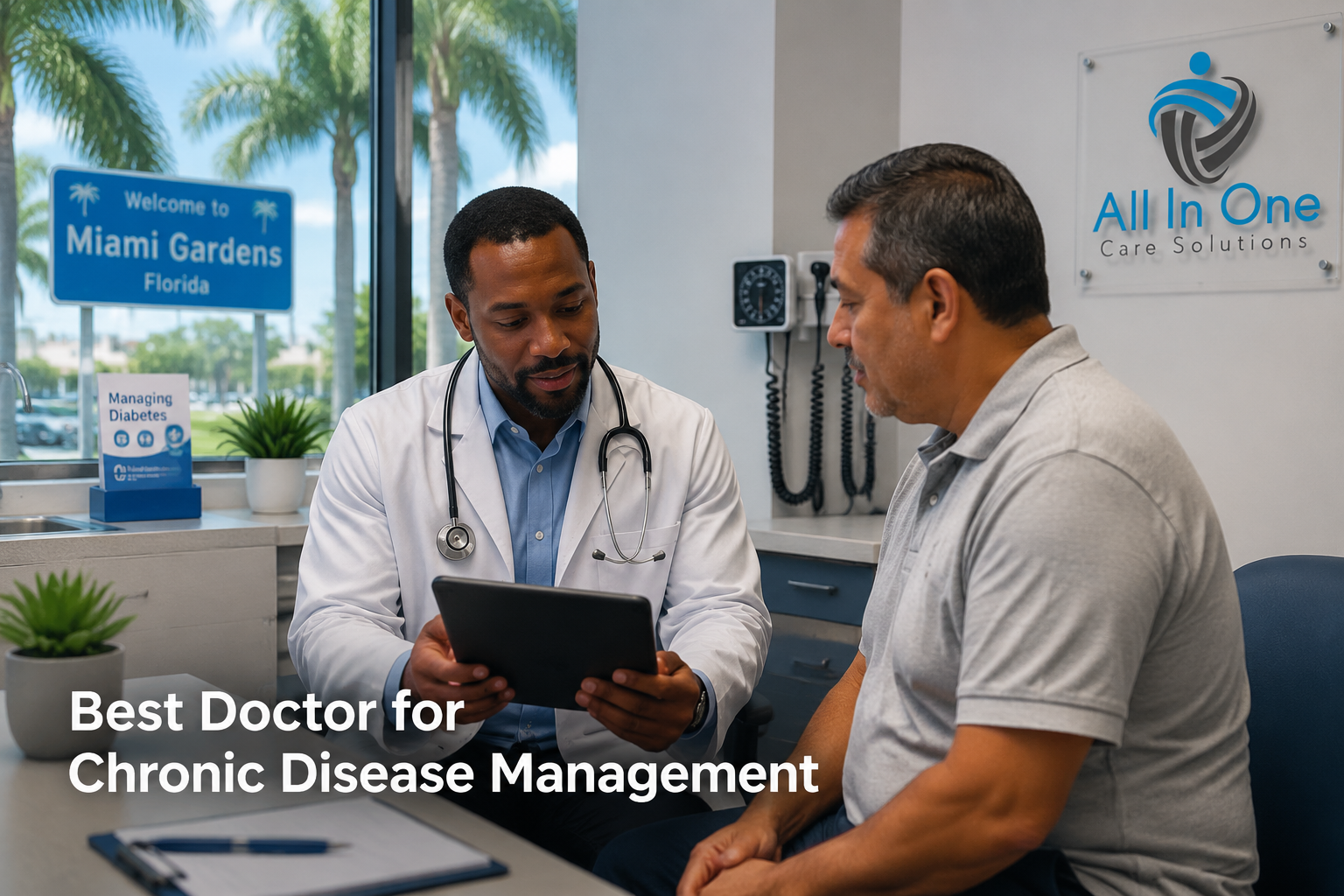
Best Doctor for Chronic Disease Management
Last updated: July 2, 2026
Quick Answer: The best doctor for chronic disease management is typically a primary care physician or family medicine doctor who coordinates your overall health, monitors multiple conditions simultaneously, and builds a long-term relationship with you. For patients in Miami Gardens and surrounding South Florida communities, finding a local primary care provider who offers in-house lab testing, bilingual services, and same-day appointments makes consistent chronic disease management significantly more accessible.
Key Takeaways
- A primary care physician (PCP) is the most effective first point of contact for managing chronic conditions such as diabetes, hypertension, and high cholesterol.
- Chronic diseases are conditions lasting one year or more that require ongoing medical attention or limit daily activities, according to the CDC.
- The best chronic disease doctor listens carefully, adjusts treatment plans based on lab results, and coordinates care with specialists when needed.
- Patients with multiple chronic conditions benefit most from a single provider who can see the full clinical picture rather than managing each condition in isolation.
- Insurance typically covers chronic disease management visits, and self-pay options are available at clinics like All In One Care Solutions in Miami Gardens.
- Seeing your doctor every three to six months is standard for most chronic conditions, though frequency depends on disease severity and stability.
- Nurse practitioners can effectively manage many chronic diseases, particularly in primary care settings, under appropriate clinical protocols.
- Red flags that your current doctor is not managing your chronic disease well include consistently uncontrolled lab values, no treatment plan adjustments, and poor communication.
- Telemedicine is a valid option for stable chronic disease follow-ups, though in-person visits remain important for physical exams and lab work.
- Patients in Miami Gardens, Miami Lakes, and Hialeah have access to comprehensive chronic disease management through local primary care clinics.
What Qualifies as a Chronic Disease
A chronic disease is any condition that lasts 12 months or longer and requires either ongoing medical care or limits a person’s normal daily activities, or both. The Centers for Disease Control and Prevention (CDC) identifies chronic diseases as the leading cause of death and disability in the United States, with six in ten adults living with at least one chronic condition.
Common chronic diseases managed in primary care include:
- Type 2 diabetes — requires blood sugar monitoring, medication management, and lifestyle counseling
- Hypertension (high blood pressure) — often called a “silent” condition because it rarely causes symptoms until serious damage has occurred
- High cholesterol (hyperlipidemia) — a major risk factor for heart disease and stroke
- Asthma and COPD — chronic respiratory conditions requiring ongoing medication and monitoring
- Obesity — increasingly recognized as a chronic disease with metabolic consequences
- Chronic kidney disease — often a downstream result of poorly controlled diabetes or hypertension
- Hypothyroidism — requires lifelong hormone replacement and regular lab monitoring
- Arthritis — includes osteoarthritis and rheumatoid arthritis, both requiring long-term management
For patients in South Florida, conditions like diabetes and hypertension are particularly prevalent. If you are managing one or more of these conditions, consistent care from a qualified physician is not optional — it is essential for preventing serious complications.
Primary Care Doctor vs. Specialist: Who Should Manage Your Chronic Disease
For most patients with chronic conditions, a primary care physician is the right first choice and often the best ongoing manager of their care. A specialist may be needed for complex or severe cases, but the PCP remains the coordinator.
Here is how the two roles differ in practice:
| Role | Primary Care Physician (PCP) | Specialist |
|---|---|---|
| Scope | Manages overall health and multiple conditions | Focused on one organ system or disease |
| Relationship | Long-term, continuous | Often episodic or consultative |
| Coordination | Coordinates all your care | Advises on specific condition |
| Best for | Diabetes, hypertension, cholesterol, preventive care | Severe heart failure, advanced kidney disease, complex endocrine disorders |
| Cost | Generally lower co-pays | Often higher cost per visit |
Choose a PCP if your chronic condition is newly diagnosed, moderately controlled, or part of a broader health picture involving multiple conditions. Choose a specialist if your PCP has referred you for a specific complication, your condition is not responding to standard treatment, or you need a procedure only a specialist performs.
For most patients managing diabetes, high blood pressure, or high cholesterol in Miami Gardens, a well-equipped primary care clinic handles the full scope of ongoing management without requiring specialist referrals for routine care. You can learn more about what comprehensive chronic disease management in Miami looks like at a dedicated primary care clinic.
How to Find a Good Chronic Disease Management Doctor
Finding the right doctor for chronic disease management comes down to three practical steps: verifying credentials, confirming services, and assessing fit.
Step 1: Confirm the doctor is accepting new patients. Many primary care practices in South Florida have limited availability. Call ahead or check online to confirm new patient slots are open. All In One Care Solutions is currently accepting new patients at its Miami Gardens location.
Step 2: Verify they offer in-house lab testing. Chronic disease management depends heavily on regular blood work — A1C levels for diabetes, lipid panels for cholesterol, and metabolic panels for kidney function. A clinic with in-house laboratory services means faster results and fewer trips to separate facilities.
Step 3: Check insurance and self-pay options. Confirm the clinic accepts your insurance plan. If you are uninsured, ask about self-pay rates for office visits and lab work.
Step 4: Assess communication and language. For patients in Miami Gardens, Hialeah, and surrounding communities, finding a bilingual clinic that offers services in both English and Spanish removes a significant barrier to consistent care.
Step 5: Look for same-day or next-day availability. Chronic disease flare-ups and medication questions do not always wait for a scheduled appointment. A clinic that offers same-day doctor appointments in Miami Gardens provides an important safety net.
What to Look for in the Best Doctor for Chronic Disease Management
The best doctor for chronic disease management combines clinical competence with consistent follow-through and clear communication. Here are the specific qualities that matter most:
- Evidence-based treatment protocols: Your doctor should follow current clinical guidelines for conditions like diabetes (ADA guidelines) and hypertension (ACC/AHA guidelines), not outdated or arbitrary targets.
- Regular lab monitoring: A good chronic disease doctor orders labs on a schedule — not just when something seems wrong. For diabetes, that typically means A1C testing every three months until stable, then every six months.
- Medication management: They should review your medications at every visit, check for interactions, and adjust doses based on your lab results and how you feel.
- Preventive care integration: The best chronic disease doctors do not just treat what is already wrong — they screen for what could go wrong next. Annual physical exams, EKGs, and wellness panels are part of this picture.
- Patient education: You should leave every appointment understanding what your numbers mean and what you need to do before your next visit.
- Referral network: When specialist input is needed, a good PCP has established referral relationships and communicates with those specialists on your behalf.
Best Type of Doctor for Managing Multiple Chronic Conditions
When a patient has two or more chronic conditions simultaneously — a situation called “multimorbidity” — a primary care physician or family medicine doctor is the most effective single provider. Managing multiple conditions in isolation, with separate specialists for each, often leads to conflicting medications, redundant testing, and gaps in care coordination.
A family medicine doctor sees the full picture. For example, a patient with both diabetes and hypertension needs a provider who understands how blood pressure medications affect kidney function in the context of diabetic nephropathy — not two separate doctors treating each condition without awareness of the other.
At All In One Care Solutions, the primary care team in Miami Gardens manages diabetes, hypertension, high cholesterol, and other chronic conditions together under one roof, with in-house labs and same-day availability.
How Much Does Chronic Disease Management Cost
The cost of chronic disease management visits varies depending on insurance status, visit complexity, and what services are included.
With insurance: Most insurance plans, including Medicare and Medicaid, cover chronic disease management visits as part of primary care benefits. Co-pays typically range from $0 to $50 per visit depending on the plan. Medicare patients are entitled to an Annual Wellness Visit at no cost, which is separate from a standard office visit.
Without insurance (self-pay): Self-pay rates for primary care visits in South Florida typically range from $75 to $200 per visit. All In One Care Solutions offers a comprehensive annual physical exam — including a doctor visit, EKG, and basic blood panel — for $150, making preventive and chronic disease care accessible for uninsured patients.
Lab work costs: In-house lab testing is often more affordable than hospital-based labs. Patients without insurance should ask about bundled pricing for common panels like the comprehensive metabolic panel (CMP), lipid panel, and A1C.
Medication costs: Prescription costs vary widely. Generic medications for diabetes, hypertension, and cholesterol are often available at low cost through pharmacy discount programs.
Does Insurance Cover Chronic Disease Management Visits
Yes, most major insurance plans cover chronic disease management visits as standard primary care services. This includes Medicare, Medicaid, and most private insurance plans accepted in Florida.
All In One Care Solutions accepts most major insurance providers in South Florida. Patients are encouraged to call (786) 446-9414 to verify their specific coverage before scheduling. For those without insurance, self-pay options are available and clearly priced.
Medicare patients specifically benefit from:
- Annual Wellness Visit (covered at 100%, no co-pay)
- Chronic Care Management (CCM) services for patients with two or more chronic conditions
- Diabetes self-management training
- Cardiovascular disease risk reduction visits
What Questions Should You Ask a Chronic Disease Doctor
Asking the right questions at your appointment helps you get more out of every visit. Here are the most useful questions to bring:
- What are my target numbers for blood sugar, blood pressure, and cholesterol — and where do I stand right now?
- How often should I have labs done, and what specifically are you monitoring?
- Are there any medication interactions I should know about?
- What lifestyle changes would have the most impact on my specific condition?
- When should I call the office versus wait for my next appointment?
- What complications should I be watching for, and what are the early warning signs?
- Do I need any specialist referrals, and if so, why?
- Is there a patient portal where I can access my lab results and send messages?
These questions apply whether you are newly diagnosed or have been managing a chronic condition for years. A good doctor welcomes them.
How Often Should You See Your Doctor for Chronic Disease Management
For most stable chronic conditions, a visit every three to six months is appropriate. The exact frequency depends on how well controlled the condition is and whether medications are being adjusted.
General guidelines by condition:
- Diabetes (uncontrolled): Every three months until A1C is at target
- Diabetes (well-controlled): Every six months
- Hypertension (newly diagnosed or adjusting medications): Every one to three months
- Hypertension (stable): Every six months
- High cholesterol: Every six to twelve months once on stable therapy
- Multiple chronic conditions: More frequent visits are often warranted, typically every three months
Between scheduled visits, patients should monitor blood pressure at home if hypertensive, check blood glucose as directed if diabetic, and contact the clinic promptly if readings are consistently outside target ranges.
Signs Your Current Doctor Is Not Managing Your Chronic Disease Well
Not every primary care provider is equally equipped or attentive when it comes to chronic disease management. These are specific red flags worth paying attention to:
- Lab values are consistently out of range with no change in treatment plan
- Appointments are rushed and you leave without understanding your results or next steps
- Medications have not been reviewed or adjusted in over a year despite uncontrolled numbers
- No preventive screenings have been ordered (eye exams for diabetics, foot exams, EKGs)
- You cannot reach the office with questions between appointments
- Language barriers prevent you from fully understanding your diagnosis or treatment
- No care plan exists in writing — you are managing by memory alone
If several of these apply, it may be time to find a new provider. Patients in Miami Gardens and Miami Lakes can explore primary care services near Hialeah or schedule a new patient visit at All In One Care Solutions.
Can a Nurse Practitioner Manage Chronic Diseases as Well as an MD
Yes, in most primary care settings, a nurse practitioner (NP) can effectively manage common chronic conditions such as diabetes, hypertension, and high cholesterol. Multiple peer-reviewed studies have found comparable outcomes between NPs and physicians for primary care management of stable chronic conditions.
In Florida, nurse practitioners practice under a collaborative agreement with a physician. This means a physician is available for consultation on complex cases, while the NP handles routine management, medication refills, and follow-up visits.
When an MD is specifically preferable:
- Complex or rare presentations of a chronic disease
- Multiple medications with significant interaction risks
- Conditions that have not responded to standard treatment protocols
- Cases requiring specialist coordination for advanced complications
For the majority of patients managing well-controlled diabetes, blood pressure, or cholesterol, an NP-led primary care visit delivers equivalent quality of care to an MD visit — particularly in a well-supervised clinical environment.
Telemedicine vs. In-Person Visits for Chronic Disease Management
Telemedicine is appropriate for stable chronic disease follow-ups, medication refills, and reviewing lab results. In-person visits remain necessary for physical examinations, new symptom evaluation, and lab draws.
Telemedicine works well for:
- Reviewing recent lab results and adjusting medication doses
- Discussing symptom changes that do not require a physical exam
- Routine follow-ups when the condition is stable and well-controlled
- Patients with transportation limitations in areas like Opa-Locka or North Miami
In-person visits are necessary for:
- Annual physical exams, including EKG and blood draw
- Blood pressure measurement (home monitors can be inaccurate)
- Foot exams for diabetic patients
- Any new or worsening symptom requiring physical assessment
All In One Care Solutions offers telemedicine services in Miami Gardens as a complement to in-person care, not a replacement. The most effective chronic disease management combines both — telehealth for convenience between visits and in-person appointments for comprehensive evaluation.
What to Do If Your Chronic Disease Is Not Improving With Your Current Doctor
If your condition has been uncontrolled for six months or more despite treatment, take these steps:
- Request a full medication review. Ask your doctor to go through every medication, its purpose, and whether the current dose is appropriate.
- Ask for updated lab work. Sometimes outdated data drives outdated treatment decisions.
- Request a specialist referral. If your PCP has not suggested one and your condition is not improving, ask directly.
- Seek a second opinion. This is your right as a patient and is not considered disrespectful in a clinical setting.
- Consider changing providers. If communication has broken down or you do not feel heard, finding a new primary care doctor is a reasonable and sometimes necessary step.
For patients in South Florida, diabetes management and prevention resources in Miami Gardens are available, along with dedicated support for hypertension through a primary care doctor for blood pressure management.
Frequently Asked Questions
What is the best type of doctor for managing diabetes long-term? A primary care physician or family medicine doctor is the best long-term manager for most diabetes patients. An endocrinologist may be needed for complex or insulin-dependent cases, but routine Type 2 diabetes management is well within the scope of primary care.
Can I see a primary care doctor for high blood pressure without a referral? Yes. Hypertension is a primary care condition. No referral is needed to see a PCP for blood pressure management.
How do I know if my A1C is being monitored often enough? For patients with uncontrolled diabetes, A1C should be checked every three months. For well-controlled diabetes, every six months is appropriate. If your doctor has not ordered an A1C in over six months and your diabetes is not fully controlled, ask for one.
Does All In One Care Solutions accept Medicare for chronic disease management? Yes. All In One Care Solutions accepts most major insurance plans. Medicare patients should call (786) 446-9414 to confirm coverage for their specific plan.
What is the difference between a chronic disease management visit and a regular sick visit? A chronic disease management visit is a planned, scheduled appointment focused on monitoring and adjusting treatment for a known ongoing condition. A sick visit addresses a new or acute problem. Both are important, and they are billed differently by insurance.
Is it possible to manage multiple chronic conditions at one clinic? Yes. A comprehensive primary care clinic like All In One Care Solutions manages diabetes, hypertension, high cholesterol, and other conditions together, with in-house labs and coordinated care.
How long does a chronic disease management appointment typically last? Most follow-up visits for chronic disease management last 15 to 30 minutes. New patient appointments or complex cases may take 45 to 60 minutes.
What should I bring to my first chronic disease management appointment? Bring a list of all current medications (including supplements), recent lab results if available, your insurance card, a list of current symptoms or concerns, and any home monitoring logs (blood pressure readings, blood glucose logs).
Can chronic diseases be reversed or only managed? Some chronic conditions, particularly Type 2 diabetes and hypertension, can go into remission with significant lifestyle changes and weight loss. However, most require ongoing monitoring even when well-controlled. Medical weight loss programs using medications like semaglutide have shown meaningful impact on blood sugar and blood pressure in clinical studies.
Is bilingual chronic disease management available in Miami Gardens? Yes. All In One Care Solutions provides bilingual services in English and Spanish, serving the Hispanic and multilingual communities of Miami Gardens, Hialeah, and surrounding areas.
Conclusion
Choosing the best doctor for chronic disease management is one of the most consequential health decisions a patient can make. A qualified primary care physician who monitors your labs consistently, adjusts your treatment plan based on results, communicates clearly, and coordinates your care across providers is the foundation of effective long-term management for conditions like diabetes, hypertension, and high cholesterol.
For patients in Miami Gardens, Miami Lakes, Hialeah, and surrounding South Florida communities, All In One Care Solutions offers comprehensive chronic disease management under one roof — with in-house lab testing, bilingual services, same-day appointments, and affordable options for both insured and self-pay patients.
Next steps:
- Schedule a new patient appointment by calling (786) 446-9414
- Book online at allinonecaresolutions.com
- Visit the clinic at 16191 NW 57 Ave, Miami Gardens, FL 33014
- Ask about the $150 annual physical exam, which includes a doctor visit, EKG, and basic blood panel
Consistent, proactive care is the most effective tool available for living well with a chronic condition. The right doctor makes that possible.
Medical Disclaimer: The information in this article is for educational purposes only and does not constitute medical advice. Always consult a qualified healthcare provider regarding your specific medical condition and treatment options.
Tags: chronic disease management, primary care Miami Gardens, best doctor for chronic disease, diabetes management Miami, hypertension treatment Miami Gardens, family medicine Miami, chronic disease doctor, preventive care Miami, primary care physician, high blood pressure doctor Miami Gardens