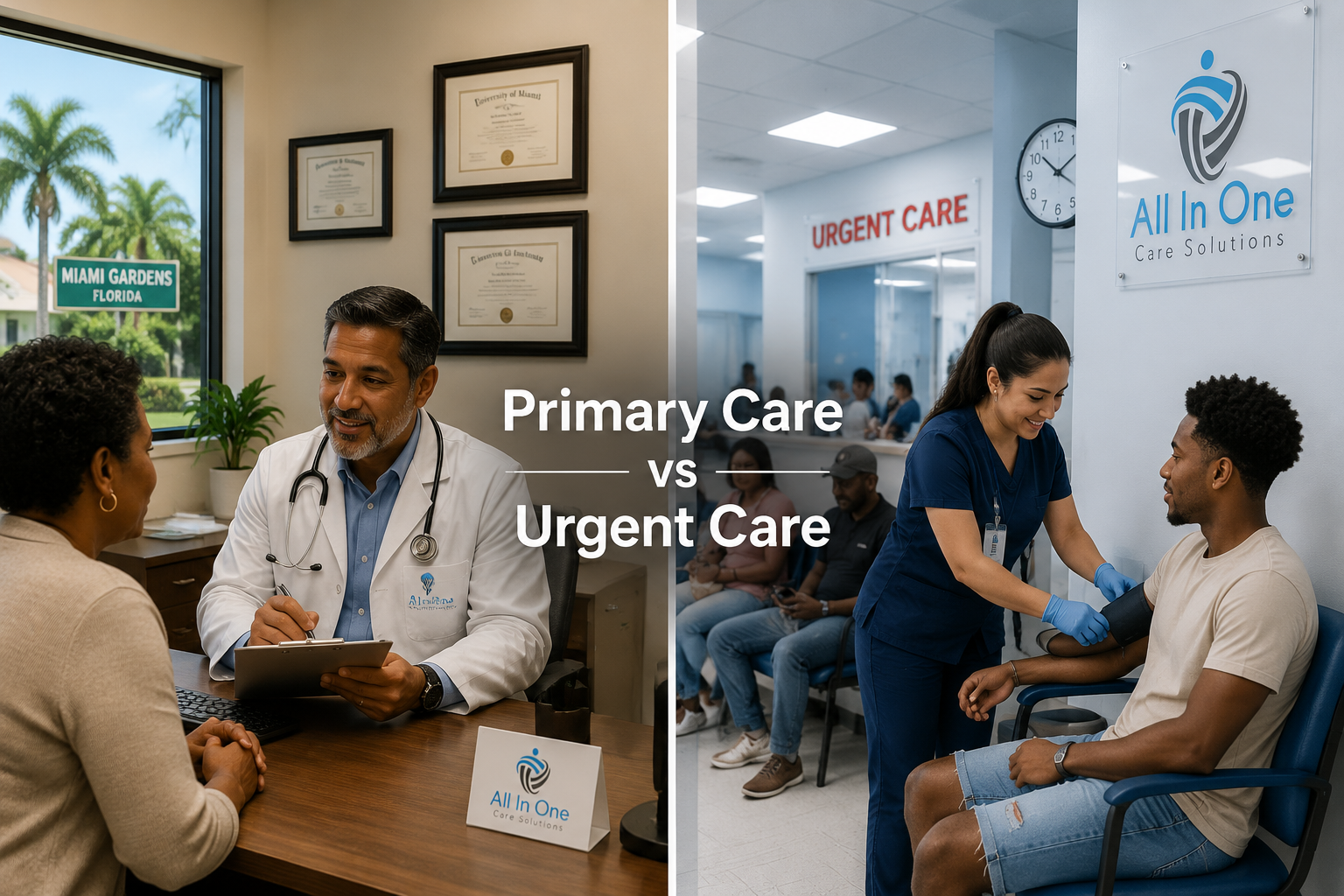
Primary Care vs Urgent Care
Last updated: July 2, 2026
Quick Answer: Primary care and urgent care serve different purposes. Primary care is your long-term medical home — a physician who knows your history, manages chronic conditions, and guides your preventive health. Urgent care handles unexpected, non-emergency illnesses or injuries when your regular doctor is unavailable. Knowing the difference between primary care vs urgent care helps you get the right care at the right time, often at a lower cost.
Key Takeaways
- Primary care provides ongoing, relationship-based medicine including annual exams, chronic disease management, and preventive screenings.
- Urgent care is designed for acute, non-life-threatening conditions that need same-day attention but are not emergencies.
- Primary care is almost always less expensive over time and produces better long-term health outcomes for patients with chronic conditions.
- Urgent care cannot replace a primary care doctor for managing diabetes, hypertension, high cholesterol, or other ongoing conditions.
- Most urgent care centers can order basic lab work and X-rays, but they do not maintain your longitudinal medical record the way a primary care physician does.
- Patients who rely exclusively on urgent care tend to receive fragmented, reactive care rather than coordinated, preventive care.
- For residents of Miami Gardens, Miami Lakes, and Hialeah, same-day primary care appointments are available at All In One Care Solutions — offering the speed of urgent care with the continuity of a primary care relationship.
What Is the Difference Between Primary Care and Urgent Care?
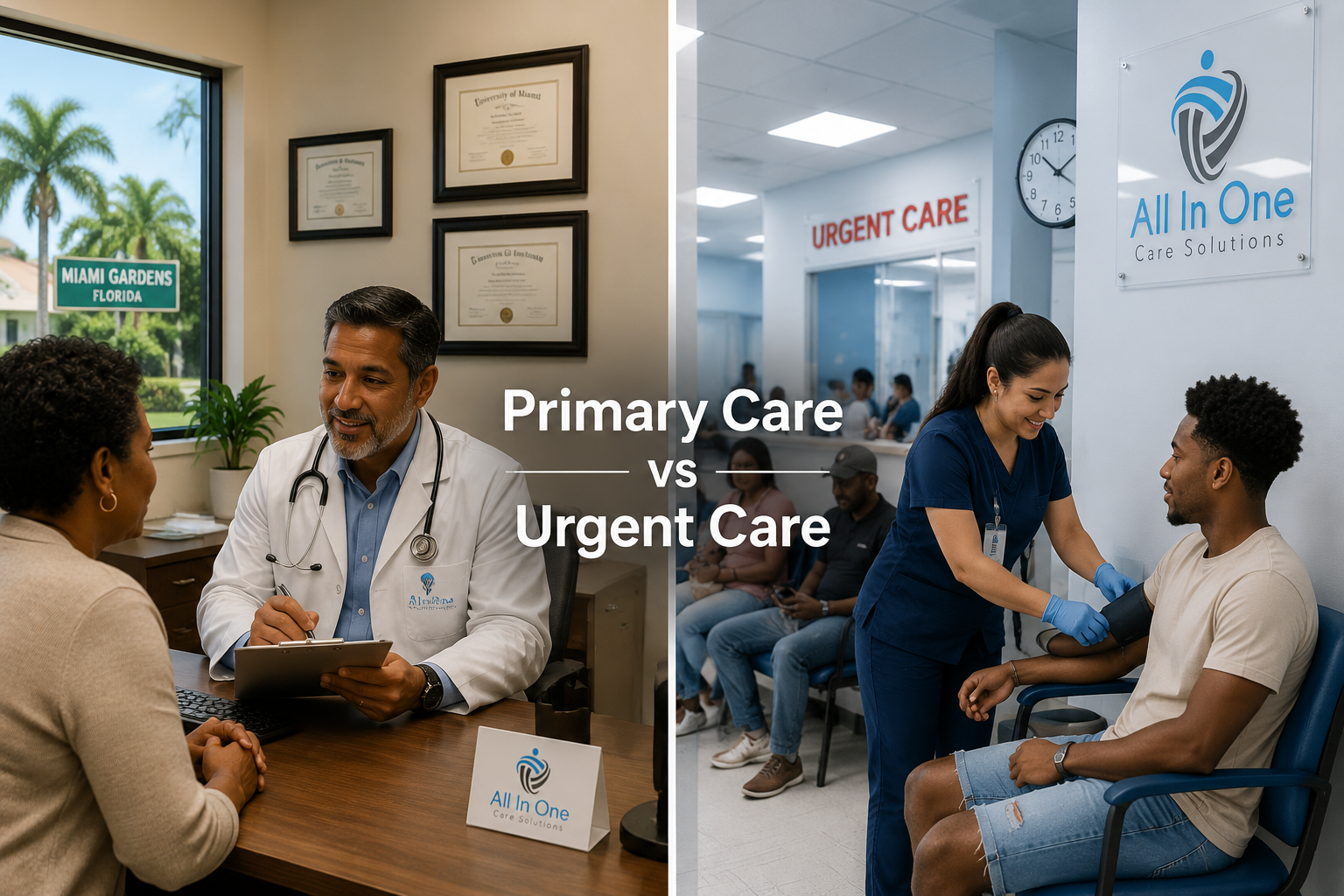
Primary care is a long-term, relationship-based form of medicine. A primary care physician (PCP) serves as your main point of contact for all health concerns — from routine checkups and preventive screenings to managing chronic conditions like diabetes, high blood pressure, and high cholesterol. Your PCP maintains a complete medical record, tracks your health over years, and coordinates referrals to specialists when needed.
Urgent care is a walk-in or same-day service designed for conditions that are not medical emergencies but cannot wait several days for a scheduled appointment. Think of it as a bridge between your regular doctor and the emergency room.
Primary care is best for:
- Annual physical exams and wellness visits
- Chronic disease management (diabetes, hypertension, high cholesterol)
- Preventive screenings and vaccinations
- Medication management and prescription refills
- Follow-up care after illness or hospitalization
- Mental health referrals and ongoing support
- Lab work and diagnostic monitoring over time
Urgent care is best for:
- Minor cuts or injuries requiring stitches
- Sprains and strains
- Fever, flu, or cold symptoms when your doctor is unavailable
- Urinary tract infections
- Minor allergic reactions
- Ear infections
When Should You Go to Urgent Care vs Primary Care?
The deciding factor is usually urgency combined with the nature of the problem. Go to urgent care when you have a new, time-sensitive issue that is not life-threatening and your primary care office is closed or fully booked. Go to your primary care doctor for anything that involves your ongoing health, medication, or a condition that has been building over time.
Choose primary care when:
- You need a prescription refill or medication adjustment
- You are managing a chronic condition like diabetes or hypertension
- You want an annual physical exam or preventive blood work
- You have a concern that has lasted more than a few days
- You need a referral to a specialist
- You are a Medicare patient needing a wellness visit
Choose urgent care when:
- You have a sudden illness on a weekend or after hours
- You need a rapid strep test or flu test and cannot reach your doctor
- You have a minor injury that needs immediate evaluation
- You need a work or school physical on short notice (though primary care is preferred)
Go to the emergency room when:
- You have chest pain, difficulty breathing, or signs of stroke
- You have a severe allergic reaction
- You have a serious injury with heavy bleeding or broken bones
One important note: if you live in Miami Gardens or surrounding communities, same-day primary care appointments are available at All In One Care Solutions, which eliminates one of the main reasons patients default to urgent care.
Is Urgent Care Cheaper Than Primary Care?
For a single visit, urgent care may appear comparable in cost to a primary care visit, but the comparison is more nuanced over time. A typical urgent care visit costs between $100 and $200 out of pocket, depending on the services provided. A primary care visit with insurance is often covered at a lower copay, and preventive visits are frequently covered at no cost under most insurance plans, including Medicare.
More importantly, primary care is significantly more cost-effective for patients with chronic conditions. When diabetes, hypertension, or high cholesterol goes unmanaged because a patient lacks a primary care physician, the long-term costs — hospitalizations, specialist visits, emergency care — increase substantially.
For patients without insurance, affordable primary care options exist in Miami Gardens. All In One Care Solutions offers a comprehensive annual physical exam including an EKG and basic blood panel for $150, with no insurance required.
Can You Use Urgent Care Instead of a Primary Care Doctor?
Urgent care can handle isolated, acute problems, but it cannot replace a primary care doctor. Urgent care providers do not maintain your full medical history, cannot prescribe long-term medications for chronic conditions in most cases, and are not structured to coordinate your care across specialists or track changes in your health over time.
Patients who rely solely on urgent care for their healthcare needs tend to:
- Receive inconsistent diagnoses because each provider sees them without context
- Miss preventive screenings that catch conditions like cancer, diabetes, or heart disease early
- Lack a physician who can advocate for them with insurance companies or specialists
- Pay more in the long run due to missed preventive care
Urgent care is a supplement to primary care, not a substitute for it.
What Can Urgent Care Treat That Primary Care Cannot?
In practice, urgent care does not treat conditions that primary care cannot. The difference is timing and context, not clinical capability. Urgent care centers are designed to see patients immediately without an appointment, which makes them useful for sudden, unexpected issues outside of regular office hours.
However, many primary care clinics now offer same-day sick visits that match the accessibility of urgent care. At All In One Care Solutions, patients can access same-day primary care services for acute illnesses, which means there is rarely a reason to choose urgent care over an established primary care relationship.
Do You Need a Primary Care Doctor If You Have Urgent Care Nearby?
Yes. Having urgent care nearby does not eliminate the need for a primary care physician. Urgent care centers are not equipped to manage ongoing health conditions, order and interpret longitudinal lab work, or provide the kind of coordinated care that prevents serious illness.
Adults over 30, seniors on Medicare, and anyone with a chronic condition like diabetes or high blood pressure especially need a dedicated primary care physician. Research consistently shows that patients with a primary care doctor have better health outcomes, lower hospitalization rates, and lower overall healthcare costs than those without one.
For families in Miami Gardens, Miami Lakes, and Hialeah, establishing care with a local primary care doctor is one of the most impactful health decisions available.
How Long Does It Take to See Someone at Urgent Care vs Primary Care?
Urgent care wait times vary widely. During peak hours or flu season, patients may wait 45 minutes to over two hours before being seen. The visit itself is typically brief because urgent care providers are focused on the immediate complaint, not a comprehensive review of your health.
Primary care appointments, when scheduled in advance, often have shorter actual wait times in the exam room. For patients concerned about wait times, clinics that offer same-day primary care appointments provide the best of both worlds: the speed of urgent care with the depth of a primary care relationship.
At All In One Care Solutions, same-day appointments are available Monday through Friday, 8 a.m. to 5 p.m., and Saturday mornings — making it practical for working adults and families to access primary care without long delays.
What Conditions Should Only Be Treated by Primary Care?
Several health conditions require the continuity and clinical depth that only a primary care physician can provide. These include:
- Type 2 diabetes: Requires ongoing A1C monitoring, medication management, and lifestyle counseling. Urgent care cannot safely manage this long-term. See diabetes care in Miami Gardens for more information.
- Hypertension (high blood pressure): Blood pressure management requires regular monitoring, medication titration, and assessment of cardiovascular risk. Blood pressure treatment through a primary care physician is far more effective than episodic urgent care visits.
- High cholesterol: Statin therapy and dietary counseling require follow-up lab work over months and years.
- Chronic disease management: Any condition requiring regular monitoring, prescription management, or specialist coordination belongs in primary care. Learn more about chronic disease management.
- Preventive care and annual physicals: Screenings for cancer, heart disease, and metabolic conditions are scheduled, evidence-based, and require a physician who knows your baseline.
- Women’s health: Annual well-woman exams, hormone management, and reproductive health require a trusted, ongoing provider relationship. All In One Care Solutions offers comprehensive women’s health primary care in Miami Gardens.
Can Urgent Care Do Blood Tests and X-Rays Like Primary Care?
Most urgent care centers can perform basic blood tests and X-rays on-site. They can check for strep throat, influenza, urinary tract infections, and some basic metabolic values. However, their lab capabilities are generally limited to acute diagnostic needs.
Primary care clinics with in-house laboratories offer a broader range of testing, including:
- Complete blood count (CBC)
- Comprehensive metabolic panels
- Lipid panels and A1C for diabetes monitoring
- Hormone panels
- STD and STI testing
- Thyroid function tests
Critically, primary care lab results are interpreted within the context of your full medical history and tracked over time. A single blood glucose reading at urgent care tells a very different story than a series of A1C results reviewed by your primary care physician over two years.
Is Urgent Care Good for Ongoing Health Issues?
No. Urgent care is not designed for ongoing or chronic health issues. It is structured for episodic, acute care. Patients who use urgent care to manage conditions like high blood pressure, diabetes, or recurring infections often receive inconsistent treatment because each visit involves a different provider with no access to prior records.
For patients in South Florida managing chronic conditions, the right approach is to establish care with a primary care physician who can build a treatment plan, monitor progress, and adjust medications as needed. This is especially important for Medicare patients, who benefit from annual wellness visits and coordinated preventive care.
Primary Care vs Urgent Care for Strep Throat
For strep throat specifically, either setting can diagnose and treat the condition. Both urgent care and primary care can perform a rapid strep test and prescribe antibiotics if the result is positive.
The practical difference: if you already have a primary care physician and can reach the office, calling them first is the better choice. They can review your allergy history, check for antibiotic interactions with other medications you take, and document the illness in your medical record. If your primary care office is closed and you have a high fever with severe throat pain, urgent care is a reasonable option.
Do Urgent Care Visits Go on Your Medical Record Like Primary Care?
Urgent care visits are documented in the urgent care center’s own electronic health record system. Whether that information transfers to your primary care physician depends on whether the two systems are connected and whether you authorize the exchange of records.
In contrast, every visit to your primary care physician is part of a continuous, longitudinal record that informs every future clinical decision. Your PCP can see patterns — a gradual rise in blood pressure, a trending increase in blood sugar, a recurring respiratory illness — that an urgent care provider seeing you for the first time cannot.
What Happens If You Only Use Urgent Care and Never Have a Primary Doctor?
Patients who rely exclusively on urgent care tend to receive reactive, fragmented healthcare. Without a primary care physician, there is no one ordering preventive screenings, managing medications consistently, or tracking changes in health over time.
The consequences can include:
- Undiagnosed hypertension, diabetes, or high cholesterol until a crisis occurs
- Missed cancer screenings (colonoscopy, mammogram, cervical cancer screening)
- No coordinated care when seeing multiple specialists
- Higher emergency room utilization and hospitalization rates
- Difficulty getting referrals or specialist appointments without a PCP
For adults in Miami Gardens, Miami Lakes, and Hialeah who do not currently have a primary care doctor, establishing care at All In One Care Solutions is a straightforward first step.
Can Urgent Care Prescribe Medications the Same Way Primary Care Does?
Urgent care providers can prescribe medications for acute conditions — antibiotics for infections, short-course steroids for inflammation, or antivirals for flu. However, they generally cannot and should not prescribe long-term medications for chronic conditions such as antihypertensives, diabetes medications, or controlled substances.
Primary care physicians manage ongoing prescriptions, adjust dosages based on lab results and clinical response, and ensure that all medications work safely together. This level of medication management requires continuity of care that urgent care simply cannot provide.
Comparison: Primary Care vs Urgent Care at a Glance
| Feature | Primary Care | Urgent Care |
|---|---|---|
| Appointment required | Usually (same-day often available) | No |
| Ongoing medical record | Yes | No (visit-specific only) |
| Chronic disease management | Yes | No |
| Preventive screenings | Yes | No |
| Annual physical exams | Yes | Limited |
| Prescription management | Yes (long-term) | Yes (acute only) |
| Lab testing | Comprehensive | Basic/acute |
| X-rays | Often available | Usually available |
| Insurance billing | Yes | Yes |
| Cost for uninsured | Varies; affordable options exist | $100–$200+ per visit |
| Best for | Ongoing health, prevention, chronic care | Sudden illness, after-hours needs |
Frequently Asked Questions
Can urgent care refill my blood pressure medication?
Generally, no. Most urgent care providers will not refill long-term medications for chronic conditions like hypertension. You need a primary care physician for ongoing prescription management. If you have run out of medication, contact your primary care office directly.
Does urgent care accept Medicare?
Most urgent care centers accept Medicare, but Medicare wellness visits and annual physicals must be completed by a primary care physician to qualify for full coverage benefits.
Can I get an annual physical at urgent care?
Some urgent care centers offer basic physicals, but they are not equivalent to a comprehensive annual physical exam performed by a primary care physician who knows your history. For a complete annual exam in Miami Gardens, including EKG and blood panel, visit All In One Care Solutions.
Is urgent care open on weekends?
Most urgent care centers are open on weekends, which is one of their main advantages. All In One Care Solutions also offers Saturday morning appointments from 8 a.m. to 12 p.m. for patients who need primary care outside of the standard weekday schedule.
Can urgent care treat a UTI?
Yes. A urinary tract infection is one of the most common conditions treated at urgent care. However, if you experience recurrent UTIs, a primary care physician should evaluate the underlying cause.
Is it better to go to urgent care or primary care for the flu?
If your primary care office is open and can see you the same day, go there. Your PCP can prescribe antivirals, review your vaccination history, and monitor for complications. If your PCP is unavailable, urgent care is a reasonable alternative for flu evaluation.
What if I do not have insurance — can I still see a primary care doctor?
Yes. All In One Care Solutions offers self-pay options for uninsured patients, including a comprehensive annual physical exam for $150. Call (786) 446-9414 to discuss pricing for other services.
Can urgent care diagnose diabetes or high blood pressure?
Urgent care can identify elevated blood sugar or blood pressure readings, but they cannot diagnose, manage, or treat these conditions on an ongoing basis. A primary care physician is required for proper diagnosis, treatment planning, and long-term management.
How do I find a primary care doctor in Miami Gardens?
All In One Care Solutions is currently accepting new patients at 16191 NW 57 Ave, Miami Gardens, FL 33014. The clinic serves patients from Miami Gardens, Miami Lakes, Hialeah, and surrounding communities. Call (786) 446-9414 or book online.
Does primary care cost more than urgent care per visit?
Not necessarily. With insurance, primary care copays are often lower than urgent care copays, and preventive visits are frequently covered at no cost. For uninsured patients, self-pay primary care can be comparably priced to urgent care, especially at clinics with transparent flat-fee options.
Conclusion
The primary care vs urgent care decision comes down to one core question: is this a new, isolated problem or part of your ongoing health picture? Urgent care fills a genuine gap for acute, after-hours needs. But it cannot replace the value of a trusted primary care physician who knows your history, manages your chronic conditions, orders your preventive labs, and coordinates your care over years.
For adults in Miami Gardens, Miami Lakes, and Hialeah, the most important health decision in 2026 is establishing care with a primary care physician before a health crisis makes that choice urgent. All In One Care Solutions offers comprehensive primary care services in Miami Gardens for patients of all ages, including those with Medicare, those without insurance, and those managing chronic conditions like diabetes, hypertension, and high cholesterol.
Take the next step: Call All In One Care Solutions at (786) 446-9414 or book your appointment online at allinonecaresolutions.com. Same-day appointments are available. The clinic is located at 16191 NW 57 Ave, Miami Gardens, FL 33014, and proudly serves bilingual English and Spanish-speaking patients throughout South Florida.
References
- Agency for Healthcare Research and Quality. The Number of Practicing Primary Care Physicians in the United States. AHRQ, 2018. https://www.ahrq.gov
- American Academy of Family Physicians. Primary Care’s Role in the U.S. Health Care System. AAFP, 2022. https://www.aafp.org
- Starfield, B., Shi, L., & Macinko, J. Contribution of Primary Care to Health Systems and Health. Milbank Quarterly, 2005. https://doi.org/10.1111/j.1468-0009.2005.00409.x
- Centers for Medicare & Medicaid Services. Medicare Preventive Services. CMS, 2023. https://www.cms.gov
- Urgent Care Association. Benchmarking Report: Urgent Care Industry. UCA, 2022. https://www.ucaoa.org
Tags: primary care vs urgent care, primary care Miami, urgent care differences, family medicine Miami Gardens, chronic disease management Miami, annual physical exam Miami, preventive care Miami, when to see a doctor, medical clinic Miami Gardens, lab testing Miami, primary care doctor, urgent care alternatives