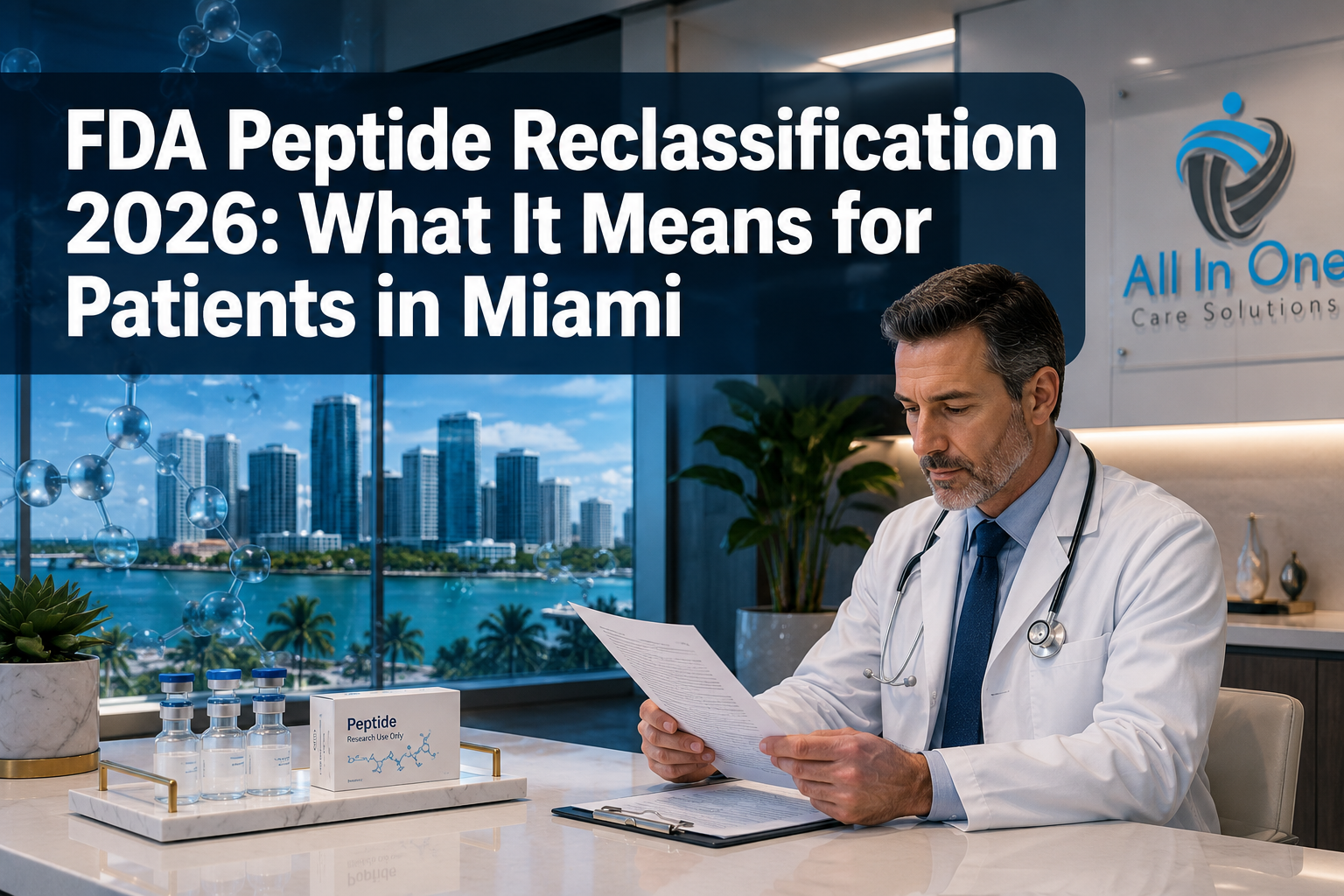
FDA Peptide Reclassification 2026: What It Means for Patients in Miami
Last updated: June 10, 2026
Quick Answer
On April 15, 2026, the FDA removed 12 peptides from Category 2, a classification that had previously restricted their compounding due to safety concerns. This does not mean these peptides are immediately available for compounding, but it is a significant step toward restoring access for patients in Miami who rely on these therapies. A formal FDA advisory committee review is scheduled for July 23-24, 2026, and final decisions on legal compounding are expected in late 2026 or early 2027.
Key Takeaways
- The FDA removed 12 peptides from Category 2 on April 15, 2026, ending their classification as posing significant safety risks [1]
- The 12 peptides include BPC-157, TB-500, Semax, MOTS-c, GHK-Cu (injectable), Epitalon, LL-37, Dihexa, DSIP, KPV, PEG-MGF, and Melanotan II
- These peptides are not yet legally available for compounding; the FDA’s Pharmacy Compounding Advisory Committee (PCAC) meets July 23-24, 2026 to complete its review [2]
- Semaglutide and tirzepatide remain in Category 2 and are still banned from compounding [3]
- The public comment period for the PCAC review closes July 9, 2026
- Miami patients currently using these therapies should consult their provider before making any changes to their treatment plan
- If the PCAC review goes favorably, compounding could legally resume in late 2026 or early 2027 [2]
- Medically supervised peptide therapy at a licensed primary care clinic remains the safest path forward for patients in Miami Gardens, Miami Lakes, and Hialeah
What Exactly Are Peptides and Why Is the FDA Changing Their Classification
Peptides are short chains of amino acids, the building blocks of proteins, that act as signaling molecules in the body. They regulate functions like tissue repair, immune response, metabolism, and hormone production. The FDA is changing their classification because the original Category 2 restrictions, which blocked compounding pharmacies from preparing these substances, were found to lack sufficient safety evidence to justify the ban [3].
Why this matters:
- Peptides like BPC-157 and TB-500 have been used in clinical settings for tissue healing and recovery
- GHK-Cu and Epitalon have been studied for their roles in cellular repair and aging
- MOTS-c and DSIP are linked to metabolic regulation and sleep support
- The FDA’s own review found the original restrictions were not well-supported by clinical evidence [3]
The reclassification also followed sustained pressure from the medical industry and Congressional representatives who argued that the bans limited patient access to potentially beneficial treatments without adequate scientific justification.
How Will the FDA Peptide Reclassification 2026 Impact My Current Peptide Treatments in Miami
For Miami patients currently receiving peptide therapy, the reclassification signals a positive shift, but it does not change your treatment options immediately. Until the PCAC review concludes and the FDA makes a final determination on adding these peptides to the 503A bulk drug substances list, compounding pharmacies cannot legally prepare them [2].
What this means in practical terms:
- If you were receiving one of the 12 reclassified peptides before restrictions took effect, your provider may be preparing to resume those protocols pending final FDA approval
- If you are currently on a treatment plan, do not stop or change your protocol without speaking to your physician
- Patients at our primary care clinic in Miami Gardens are being monitored closely as the regulatory situation evolves
The most important step right now is staying in contact with a licensed medical provider who follows these regulatory updates in real time.
What Specific Health Risks Is the FDA Trying to Address With This Reclassification
The FDA’s original Category 2 placement was intended to flag peptides where safety data was considered insufficient or where concerns about compounding quality existed. The reclassification does not mean these peptides are risk-free; it means the FDA no longer considers the evidence sufficient to justify an outright compounding ban [1].
Remaining areas of caution:
- Dosing accuracy in compounded formulations requires strict pharmacy standards
- Some peptides have limited long-term human clinical trial data
- Individual patient factors, including existing conditions and other medications, still require physician oversight
- The PCAC review will specifically assess safety, efficacy, and compounding suitability for each of the 12 peptides
The FDA’s approach here is measured. Removing a peptide from Category 2 is not the same as approving it as a drug. The July 2026 committee review will determine whether each peptide meets the standards required for the 503A list.
Are Peptide Therapies Going to Become More Expensive After This Change
Pricing for peptide therapies in Miami may fluctuate during the transition period, but the reclassification is generally expected to stabilize or reduce costs over time. When compounding restrictions are in place, patients often turn to less regulated sources, which can be both more expensive and less safe. Legal compounding through licensed pharmacies typically offers more predictable pricing.
Factors that will influence cost:
- Whether your provider works with an accredited 503A compounding pharmacy
- The specific peptide protocol and dosing frequency
- Whether the treatment is part of a broader supervised wellness program
- Insurance coverage, which is discussed in detail below
For patients seeking cost-effective options, our clinic offers flexible medical payment plans that can make medically supervised treatments more accessible.
Will My Insurance Still Cover Peptide Treatments After 2026
Most peptide therapies are not covered by standard health insurance because they are compounded medications rather than FDA-approved drugs. This was true before the 2026 reclassification and remains true now. The reclassification does not automatically trigger insurance coverage.
What patients should know:
- Compounded peptides are prescribed and dispensed under a different regulatory framework than FDA-approved pharmaceuticals
- Some supplemental or wellness-focused plans may offer partial reimbursement; check with your insurer directly
- Self-pay options are common for peptide therapy patients in Miami, Miami Gardens, and Miami Lakes
- Our clinic works with both insured patients and self-pay wellness clients to find appropriate care pathways
If cost is a concern, a comprehensive medical exam in Miami Gardens can help identify which treatments are covered under your existing plan and which fall under self-pay wellness services.
What Medical Conditions Might Be Affected by This FDA Decision
The 12 reclassified peptides have been used to address a range of conditions and wellness goals. Patients pursuing these therapies typically fall into several clinical categories.
| Peptide | Common Clinical Use |
|---|---|
| BPC-157 | Tissue repair, gut health, joint recovery |
| TB-500 | Muscle healing, inflammation reduction |
| Semax | Cognitive support, neuroprotection |
| MOTS-c | Metabolic regulation, insulin sensitivity |
| GHK-Cu (injectable) | Skin repair, anti-aging, wound healing |
| Epitalon | Cellular aging, sleep regulation |
| LL-37 | Immune modulation, antimicrobial support |
| DSIP | Sleep quality, stress response |
| KPV | Gut inflammation, skin conditions |
| PEG-MGF | Muscle growth, recovery |
| Melanotan II | Pigmentation, libido (limited clinical use) |
| Dihexa | Cognitive function (early-stage research) |
Patients managing chronic conditions should note that peptide therapy is typically used as a complement to primary care, not a replacement. If you are managing a chronic condition in Miami, our team provides chronic disease management and preventive care alongside any wellness protocols.
Who Shouldn’t Consider Peptide Therapies Based on the New Guidelines
Peptide therapy is not appropriate for everyone, and the 2026 reclassification does not change the underlying medical criteria for patient selection. Certain individuals face elevated risks and should proceed only with careful physician oversight, or not at all.
Peptide therapy is generally not recommended for:
- Patients with active cancer or a history of hormone-sensitive cancers, as some peptides may influence growth factors
- Pregnant or breastfeeding individuals
- Patients with uncontrolled autoimmune conditions, where immune-modulating peptides could worsen symptoms
- Individuals with severe kidney or liver impairment, given altered metabolism of compounded substances
- Anyone who has not had a baseline medical evaluation, including lab work
Edge case to be aware of: Some patients assume that because a peptide is “natural” or amino-acid-based, it carries no risk. This is incorrect. Dosing, purity, and individual health status all determine safety outcomes. A thorough medical consultation and lab testing in Miami before starting any peptide protocol is standard practice at our clinic.
What Common Mistakes Do Patients Make When Starting Peptide Treatments
The most common mistake is sourcing peptides outside of a licensed medical setting. Before the 2026 reclassification, some patients turned to online vendors or gray-market suppliers when compounding access was restricted. This carries serious risks including incorrect dosing, contaminated formulations, and no physician oversight.
Other frequent mistakes:
- Starting a peptide protocol without baseline bloodwork to establish reference values
- Combining multiple peptides without understanding potential interactions
- Stopping a protocol abruptly without physician guidance
- Choosing a clinic based on price alone rather than verifying medical licensure and pharmacy accreditation
- Ignoring state-level pharmacy board regulations, which may add requirements beyond federal FDA rules
The safest approach is a structured consultation with a licensed physician who reviews your health history, orders appropriate lab work, and prescribes through an accredited compounding pharmacy. Our team at All In One Care Solutions in Miami Gardens follows this protocol for every patient.
Are There Alternative Treatments If Peptides Remain Restricted
Yes. If the PCAC review in July 2026 does not result in full approval for compounding, or if specific peptides remain restricted, there are clinically supported alternatives for many of the conditions these peptides address.
Alternatives by treatment goal:
- Weight management: Supervised programs using tirzepatide or semaglutide, where medically appropriate, remain available through prescription. Our medical weight loss programs in Miami Gardens offer physician-supervised protocols.
- Energy and cellular health: NAD+ therapy has a well-established safety profile and is available now. Our NAD+ IV therapy in Miami Gardens is a popular option for patients focused on energy and anti-aging.
- Recovery and inflammation: Physical therapy, anti-inflammatory nutrition protocols, and IV nutrient therapy can support recovery goals.
- Cognitive and sleep support: Lifestyle medicine, targeted supplementation, and mental health support through our mental health services in Miami Gardens address many of the same concerns.
No single treatment is right for every patient. The goal is a personalized plan built on your specific lab results, health history, and wellness objectives.
Can I Still Get Personalized Peptide Treatments After 2026
Yes, personalized peptide therapy will remain available for patients in Miami after 2026, provided the PCAC review proceeds favorably and the FDA adds the 12 reclassified peptides to the 503A list. Even during the current transition period, licensed providers can work with patients to prepare for treatment resumption and ensure all prerequisites, including medical evaluations and lab work, are completed.
Steps to prepare now:
- Schedule a consultation with a licensed physician who specializes in peptide therapy
- Complete baseline lab work to establish your health status
- Review your health history for any contraindications
- Discuss your treatment goals and which specific peptides align with those goals
- Confirm that your provider uses an accredited 503A compounding pharmacy
Personalized care is the standard at our clinic. Every peptide protocol begins with a full medical review, not a one-size-fits-all approach. This is what distinguishes medically supervised peptide therapy from unregulated alternatives.
How Do Miami Healthcare Providers Plan to Adapt to These New Regulations
Licensed medical clinics in Miami are taking a measured, compliance-first approach to the 2026 reclassification. Reputable providers are monitoring the PCAC review closely, maintaining relationships with accredited compounding pharmacies, and updating patient protocols as the regulatory landscape clarifies.
What responsible adaptation looks like:
- Staying current with FDA guidance and PCAC outcomes
- Educating patients on what the reclassification does and does not mean
- Not resuming compounding of the 12 peptides until the FDA issues a final determination
- Offering alternative supervised therapies in the interim
- Participating in the public comment period, which closes July 9, 2026, to represent patient interests
At All In One Care Solutions, our approach to peptide therapy in Miami Gardens is grounded in medical supervision, regulatory compliance, and patient safety. We do not offer treatments outside of approved clinical frameworks, and we update our protocols as federal and state guidelines evolve.
Frequently Asked Questions
Q: Is BPC-157 legal to use in Miami right now?
BPC-157 was removed from FDA Category 2 on April 15, 2026, meaning it is no longer classified as posing significant safety risks for compounding. However, it is not yet fully approved for compounding until the PCAC review concludes, expected after July 24, 2026. Consult your physician for current availability [1].
Q: What is the FDA’s Category 2 list?
Category 2 is an FDA classification for bulk drug substances that compounding pharmacies are not permitted to use due to safety concerns or insufficient evidence of clinical benefit. Removal from this list means the FDA no longer considers those concerns sufficient to maintain the ban [3].
Q: Will semaglutide compounding become legal again in 2026?
No. Semaglutide and tirzepatide remain in Category 2 and are still banned from compounding as of 2026. The 2026 reclassification applies only to the 12 specific peptides listed above [3].
Q: When will the 12 reclassified peptides be available at compounding pharmacies?
The PCAC meets July 23-24, 2026. If the committee recommends adding these peptides to the 503A bulk drug substances list and the FDA agrees, compounding could resume in late 2026 or early 2027 [2].
Q: Do I need a prescription to receive peptide therapy in Miami?
Yes. Compounded peptides require a valid prescription from a licensed physician. Any provider offering these treatments without a prescription is operating outside of legal and medical standards.
Q: What lab tests should I get before starting peptide therapy?
A comprehensive metabolic panel, complete blood count, hormone panel, and thyroid function tests are standard starting points. Your physician may order additional tests based on your specific treatment goals and health history.
Q: Can I get a same-day consultation about peptide therapy in Miami Gardens?
Yes. Our clinic offers same-day doctor appointments in Miami Gardens for new and existing patients, including consultations about peptide therapy and wellness programs.
Q: Are peptide therapies safe for older adults?
Some peptides, such as Epitalon and GHK-Cu, are specifically studied in the context of aging. Safety depends on individual health status, existing conditions, and current medications. A physician evaluation is required before starting any protocol.
Q: Is there a difference between peptide therapy and hormone therapy?
Yes. Peptides are signaling molecules that influence various biological processes, while hormone therapy directly replaces or supplements hormones like testosterone or estrogen. Some peptides influence hormone pathways indirectly, which is why physician oversight is essential.
Q: How do I know if a Miami clinic is using a legitimate compounding pharmacy?
Ask whether the pharmacy is accredited by the Pharmacy Compounding Accreditation Board (PCAB) and registered with the FDA as a 503A or 503B facility. A reputable clinic will provide this information without hesitation.
Conclusion
The FDA Peptide Reclassification 2026 represents a meaningful shift in how these therapies will be regulated and accessed in Miami. Twelve peptides, including BPC-157, TB-500, and Epitalon, have been removed from the restrictive Category 2 classification, and a formal advisory committee review in late July 2026 will determine whether they can be legally compounded again. For patients in Miami Gardens, Miami Lakes, and Hialeah, this is an encouraging development, but it requires patience and informed guidance.
Your next steps:
- Do not source peptides from unregulated vendors while the review is pending
- Schedule a medical consultation to review your health baseline and treatment goals
- Ask your provider about interim options, including NAD+ therapy and medically supervised weight loss
- Stay informed as the PCAC review concludes and the FDA issues its final determination
At All In One Care Solutions, we provide medically supervised, evidence-based care for patients across Miami. Whether you are interested in peptide therapy, preventive wellness, or chronic disease management, our team is here to guide you through every step with clinical precision and genuine care for your health.
Schedule a consultation at our primary care clinic in Miami Gardens or call us directly to speak with a provider about your options in 2026.
References
[1] FDA Removes 12 Peptides Category 2 April 2026 – https://www.peptidemark.com/news/fda-removes-12-peptides-category-2-april-2026?utm_source=openai
[2] FDA Peptide Reclassification 2026 – https://peptide.law/news/fda-peptide-reclassification-2026?utm_source=openai
[3] FDA Peptide Reclassification March 2026 Update – https://www.peptidemark.com/news/fda-peptide-reclassification-march-2026-update?utm_source=openai
Tags: FDA peptide reclassification 2026, peptide therapy Miami, BPC-157 Miami, compounded peptides Miami, peptide clinic Miami Gardens, primary care Miami, medical weight loss Miami Gardens, anti-aging clinic Miami, preventive care Miami, peptide injections Miami, wellness injections Hialeah, NAD+ therapy Miami Gardens