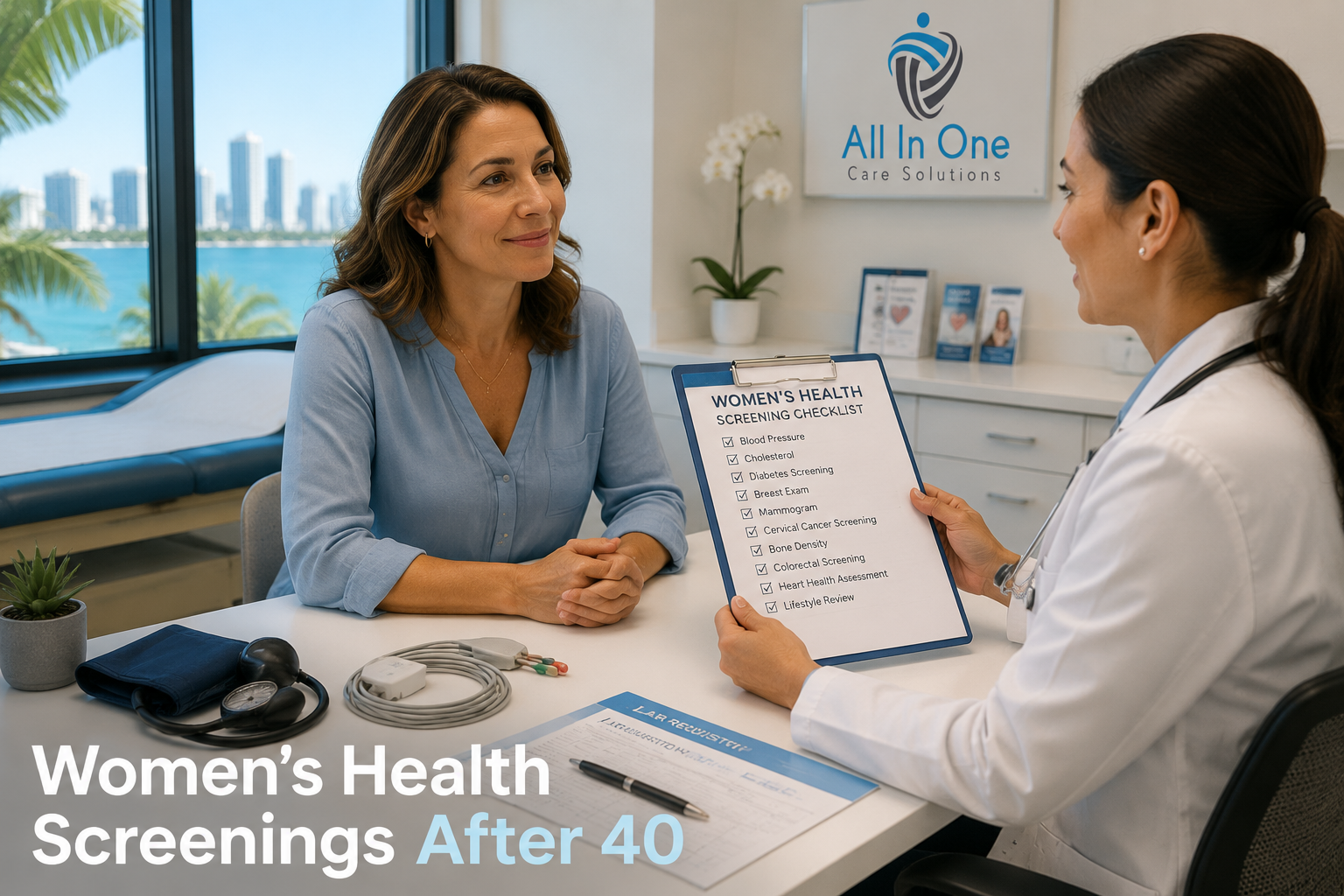
Women’s Health Screenings After 40

Last updated: July 2, 2026
Quick Answer
Women’s health screenings after 40 include mammograms, cervical cancer screening (Pap smear), blood pressure and cholesterol checks, diabetes testing, colorectal cancer screening, and bone density evaluation. The exact schedule depends on personal and family health history, current health status, and whether a woman has entered menopause. Skipping these screenings is one of the most common — and preventable — reasons serious conditions go undetected until they are harder to treat.
Key Takeaways
- Mammograms are recommended annually or every two years starting at age 40, depending on individual risk and the guidelines your provider follows.
- Pap smears remain necessary after 40; most women need one every three years, or every five years when combined with an HPV test.
- Colorectal cancer screening typically begins at age 45, not 40, for average-risk individuals.
- A basic blood panel at 40 should include fasting glucose, lipid panel, complete blood count, and thyroid function.
- Bone density screening (DEXA scan) is generally recommended at menopause onset or age 65, but earlier for women with risk factors.
- Women with a family history of breast or ovarian cancer may need earlier and more frequent screenings.
- Abnormal screening results do not mean a diagnosis — they trigger follow-up testing to clarify findings.
- Self-pay annual exams in Miami Gardens start at $150 at All In One Care Solutions, making preventive care accessible without insurance.
- Menopause introduces new screening priorities, including cardiovascular risk assessment and hormone evaluation.
- Skipping low-risk screenings is sometimes appropriate — a primary care provider can help prioritize based on individual needs.
What Health Screenings Do Women Need After 40?
Women over 40 need a core set of screenings that address the conditions most likely to affect their health during this life stage. These include cancer screenings (breast, cervical, colorectal, and skin), cardiovascular risk assessments, metabolic panels, and reproductive health evaluations.
The following table outlines the standard screening schedule for women in their 40s and 50s:
| Screening | Starting Age | Frequency |
|---|---|---|
| Mammogram | 40 (discuss with provider) | Annually or every 2 years |
| Pap smear | 21 (continues after 40) | Every 3 years, or every 5 with HPV co-test |
| Blood pressure check | Any age | At least annually |
| Fasting blood glucose | 35-45 | Every 3 years if normal |
| Lipid panel (cholesterol) | 40 | Every 4-6 years if normal; more often if elevated |
| Colorectal cancer screening | 45 | Every 10 years (colonoscopy) or annually (stool test) |
| Bone density (DEXA scan) | Menopause or age 65 | Every 2 years if normal |
| Thyroid function (TSH) | 40-50 | Every 5 years or as indicated |
| Skin cancer screening | 40+ | Annually with dermatologist |
| Eye exam | 40 | Every 2 years |
These are general guidelines based on recommendations from the U.S. Preventive Services Task Force (USPSTF) and the American Cancer Society. Individual schedules should be confirmed with a primary care provider.
How Often Should You Get a Mammogram After 40?
The current evidence supports starting annual mammograms at age 40, though some guidelines suggest every two years for average-risk women. The USPSTF updated its guidance in 2024 to recommend biennial (every two years) mammograms starting at age 40 for women at average risk. The American Cancer Society recommends annual screening starting at 45, with the option to begin at 40.
In practice, many primary care providers in Miami and across South Florida recommend annual mammograms starting at 40, particularly for women with dense breast tissue, which is more common in Hispanic women and can make tumors harder to detect.
Decision rule: Choose annual mammograms if you have dense breast tissue, a first-degree relative with breast cancer, or personal anxiety about missed detection. Every-two-years screening is reasonable if you are at average risk and your provider confirms it.
What Is the Difference Between a Mammogram and a Breast Ultrasound?
A mammogram uses low-dose X-ray to detect abnormalities in breast tissue and is the standard screening tool for breast cancer. A breast ultrasound uses sound waves to examine specific areas of concern and is often used as a follow-up when a mammogram finds something unclear or when a woman has dense breast tissue.
Ultrasound does not replace mammography as a primary screening tool. However, it adds useful information for women with dense breasts or those who have a palpable lump. Some facilities also offer 3D mammography (tomosynthesis), which provides more detailed images than standard 2D mammograms and is increasingly available at South Florida clinics.
At All In One Care Solutions, in-house ultrasound services are available for pelvic and abdominal imaging, supporting comprehensive women’s health care in Miami Gardens.
Do You Need a Colonoscopy at 40 or Wait Until 45?
For average-risk individuals, colorectal cancer screening begins at age 45, not 40. This recommendation was updated by the USPSTF in 2021 after evidence showed increasing rates of colorectal cancer in younger adults.
However, women with the following risk factors should discuss earlier screening with their provider:
- A first-degree relative diagnosed with colorectal cancer before age 60
- Personal history of inflammatory bowel disease (Crohn’s or ulcerative colitis)
- Known or suspected hereditary colorectal cancer syndromes (Lynch syndrome, familial adenomatous polyposis)
- Prior colorectal polyps
Common mistake: Assuming a clean colonoscopy at 45 means no follow-up is needed for 10 years. The follow-up interval depends on what was found. If polyps were removed, the next colonoscopy may be scheduled in 3 to 5 years.
Stool-based tests such as the FIT (fecal immunochemical test) are an alternative to colonoscopy for average-risk women and should be done annually. A positive stool test always requires follow-up colonoscopy.
What Blood Tests Should Women Get at 40?
A standard blood panel for women at 40 should include fasting glucose, a complete lipid panel, complete blood count (CBC), comprehensive metabolic panel (CMP), thyroid-stimulating hormone (TSH), and a vitamin D level.
Here is what each test evaluates:
- Fasting glucose / HbA1c: Screens for prediabetes and type 2 diabetes. Diabetes risk increases significantly after 40, especially in Hispanic women, who have higher prevalence rates than the national average.
- Lipid panel: Measures total cholesterol, LDL, HDL, and triglycerides. Elevated LDL is a major risk factor for heart disease.
- CBC: Checks for anemia, infection, and other blood disorders. Iron-deficiency anemia is common in women with heavy menstrual cycles approaching perimenopause.
- CMP: Assesses kidney and liver function, electrolytes, and blood sugar.
- TSH: Thyroid disorders — both hypothyroidism and hyperthyroidism — are significantly more common in women and often emerge in the 40s.
- Vitamin D: Deficiency is widespread in South Florida despite the sunshine, particularly in women who work indoors.
- Hormone panel: Estrogen, progesterone, and FSH levels help identify perimenopause. This is especially relevant for women experiencing irregular periods, hot flashes, or mood changes.
All of these tests are available through in-house lab services at All In One Care Solutions’ medical laboratory in Miami Gardens, often with same-day results.
Why Do You Still Need a Pap Smear After 40?
Pap smears remain an essential part of women’s health screenings after 40 because cervical cancer risk does not disappear with age. In fact, the average age of cervical cancer diagnosis in the U.S. is 50, according to the American Cancer Society.
Current guidelines recommend:
- Ages 30-65: Pap smear every 3 years, OR a combined Pap smear and HPV co-test every 5 years.
- After 65: Screening may be discontinued if a woman has had three consecutive normal Pap smears and no history of high-grade abnormalities. This decision should be made with a provider.
Women who have had a hysterectomy with removal of the cervix for non-cancerous reasons generally do not need continued Pap smears. However, women who had a hysterectomy due to cervical cancer or pre-cancer still need vaginal vault screening.
For more information on cervical screening options, see the Pap smear services available in Miami Gardens.
Can You Skip Some Screenings If You Are Low Risk?
Yes, some screenings are genuinely not indicated for low-risk women in their 40s. Avoiding unnecessary tests reduces cost, anxiety, and the risk of false positives that lead to further invasive procedures.
Screenings that are generally not recommended for average-risk women in their 40s include:
- Ovarian cancer screening (CA-125 blood test or transvaginal ultrasound): Not recommended for average-risk women because evidence shows it does not reduce mortality and leads to unnecessary surgeries.
- Lung cancer screening (low-dose CT): Only recommended for current or former heavy smokers ages 50-80 with a 20 pack-year history.
- Routine EKG: Not recommended as a screening tool for women without cardiac symptoms or known risk factors.
Edge case: If a woman has a strong family history of ovarian cancer or carries a BRCA gene mutation, ovarian cancer surveillance may be appropriate despite the general guideline. This requires a conversation with a provider who knows the full clinical picture.
What If You Have a Family History of Breast Cancer?
Women with a first-degree relative (mother, sister, or daughter) diagnosed with breast cancer should discuss earlier and more frequent screening with their provider. In some cases, genetic testing for BRCA1 and BRCA2 mutations is recommended.
Depending on the level of risk, a provider may recommend:
- Annual mammograms starting at age 30 or earlier
- Supplemental MRI screening in addition to mammography
- Referral to a genetic counselor for BRCA testing
- Chemoprevention (medications that reduce breast cancer risk in high-risk women)
Women of Ashkenazi Jewish descent have a higher carrier rate for BRCA mutations. Hispanic women with a family history of breast or ovarian cancer should also discuss genetic risk with their primary care provider.
For a comprehensive evaluation of breast health and family history risk, the breast exam and women’s health services at All In One Care Solutions provide a starting point for personalized screening plans.
What Happens If a Screening Finds Something Abnormal?
An abnormal screening result is not a diagnosis. It means the test found something that requires further evaluation to determine whether it is clinically significant.
What typically follows an abnormal result:
- Mammogram: A callback for additional imaging (diagnostic mammogram or ultrasound). Most callbacks do not result in a cancer diagnosis.
- Pap smear: Depending on the abnormality, follow-up may include repeat Pap in 1 year, HPV testing, or colposcopy (a closer examination of the cervix).
- Blood glucose: Elevated fasting glucose may prompt an HbA1c test and a conversation about lifestyle changes or medication.
- Cholesterol: Elevated LDL typically leads to dietary counseling, repeat testing in 3 months, and possible statin therapy if lifestyle changes are insufficient.
For guidance on what to expect after an abnormal Pap smear result, see this detailed resource on abnormal Pap smear results and next steps.
The most important step after any abnormal result is timely follow-up. Delays are a leading reason that treatable conditions progress.
What Is the Best Age to Start Bone Density Screening?
Bone density screening (DEXA scan) is recommended at age 65 for average-risk women. However, earlier screening is appropriate for women who enter menopause before age 45 (premature menopause), have a history of fractures, take corticosteroids long-term, or have conditions associated with bone loss such as rheumatoid arthritis or celiac disease.
Osteoporosis develops silently. Many women have no symptoms until a fracture occurs. The DEXA scan is a low-radiation, non-invasive test that takes about 10 to 15 minutes and measures bone mineral density at the hip and spine.
Do You Need Different Screenings During Menopause?
Yes. Menopause — defined as 12 consecutive months without a menstrual period — introduces new health priorities that go beyond standard cancer screenings.
Additional screenings and evaluations relevant during and after menopause:
- Cardiovascular risk assessment: Estrogen has a protective effect on the heart. After menopause, LDL cholesterol often rises and cardiovascular risk increases. Blood pressure, lipid panels, and fasting glucose should be monitored more closely.
- Hormone panel: FSH, estradiol, and progesterone levels help confirm menopausal status and guide decisions about hormone therapy.
- Bone density (DEXA): Should be done at the onset of menopause if risk factors are present, rather than waiting until age 65.
- Mental health screening: Depression and anxiety are more prevalent during perimenopause and menopause due to hormonal fluctuations. Screening for mood disorders is appropriate at annual visits.
- Thyroid function: Hypothyroidism symptoms (fatigue, weight gain, cold intolerance) overlap significantly with menopause symptoms. A TSH test helps distinguish between the two.
Women in Miami Gardens and surrounding communities can access comprehensive women’s health services including well-woman exams that address all of these menopausal health priorities in a single visit.
How Much Does a Women’s Health Screening Cost Without Insurance?
The cost of women’s health screenings without insurance varies widely depending on the type of test and the facility. At All In One Care Solutions in Miami Gardens, the annual physical exam — which includes a complete medical physical, EKG, and basic blood panel — is available for $150 as a self-pay option.
Approximate self-pay costs for common screenings in South Florida:
- Annual physical exam with basic labs: $150 (at All In One Care Solutions)
- Mammogram: $100-$250 depending on facility and whether it is 2D or 3D
- Pap smear (in-office): Often included in a well-woman exam; standalone cost varies
- Colonoscopy: $1,500-$3,500 without insurance at most facilities
- DEXA scan: $150-$300 at imaging centers
- Comprehensive blood panel: Varies by tests ordered; basic panels often $50-$150
Many screenings are covered at no cost under the Affordable Care Act for insured patients. For patients without insurance, community health centers and federally qualified health centers (FQHCs) in Miami-Dade County offer income-based sliding scale fees.
At All In One Care Solutions, the team works with both insured patients and self-pay clients to make preventive care accessible. The clinic accepts most major insurance plans and offers affordable cash-pay options for those without coverage.
FAQ: Women’s Health Screenings After 40
Q: At what age should I get my first mammogram? A: Most guidelines recommend starting at age 40. The USPSTF (2024) recommends every two years starting at 40 for average-risk women. Women with a family history of breast cancer should discuss starting earlier with their provider.
Q: Can I get a Pap smear and mammogram at the same visit? A: Yes. A well-woman exam can include a Pap smear, clinical breast exam, blood pressure check, and referrals for mammography all in one appointment. This is one of the most efficient ways to stay current on multiple screenings.
Q: Is a breast self-exam still recommended? A: Major guidelines no longer formally recommend monthly self-exams due to inconsistent evidence of benefit and risk of unnecessary biopsies. However, women should be familiar with how their breasts normally look and feel, and report any changes to their provider promptly.
Q: Do I need an STD screening after 40? A: Yes, if you are sexually active with new or multiple partners. Chlamydia, gonorrhea, HIV, and syphilis testing may be appropriate depending on risk factors. There is no age cutoff for STD screening.
Q: How do I know if I am in perimenopause? A: Perimenopause typically begins in the mid-to-late 40s and can last several years. Symptoms include irregular periods, hot flashes, night sweats, and mood changes. A hormone panel (FSH, estradiol) ordered by your primary care provider can help confirm the transition.
Q: Does Medicare cover women’s health screenings? A: Medicare Part B covers annual mammograms, Pap smears, pelvic exams, bone density tests, and cardiovascular screenings at no cost to the patient. Medicare Advantage plans may cover additional services. Patients should verify their specific plan benefits.
Q: What is a well-woman exam? A: A well-woman exam is a comprehensive annual visit focused on preventive care. It typically includes a physical exam, blood pressure check, clinical breast exam, Pap smear (if due), discussion of screening schedules, and review of any symptoms or concerns.
Q: I feel fine. Do I still need screenings? A: Yes. Most conditions caught by routine screenings — including early-stage breast cancer, high blood pressure, prediabetes, and high cholesterol — cause no symptoms in their early stages. Feeling well is not a reliable indicator of underlying health status.
Q: Are there screenings specific to Hispanic women? A: Hispanic women have higher rates of type 2 diabetes, cervical cancer, and obesity-related conditions compared to some other demographic groups. This makes diabetes screening, cervical cancer screening, and cardiovascular risk assessment particularly important. Bilingual care, like that offered at All In One Care Solutions, helps ensure these screenings are discussed clearly and acted upon.
Q: Where can I get women’s health screenings in Miami Gardens? A: All In One Care Solutions at 16191 NW 57 Ave, Miami Gardens, FL 33014 offers annual well-woman exams, in-house lab testing, pelvic ultrasound, and comprehensive primary care for women. Call (786) 446-9414 or book an appointment online.
Conclusion
Women’s health screenings after 40 are not optional extras — they are the foundation of long-term health. The conditions most likely to affect women in their 40s, 50s, and beyond are largely detectable before they become serious. Breast cancer, cervical cancer, diabetes, cardiovascular disease, and osteoporosis all have established screening protocols that give women and their providers the information needed to act early.
The right screening schedule depends on individual risk factors, family history, and whether a woman has entered perimenopause or menopause. A primary care provider who knows the full clinical picture is the best resource for building a personalized plan.
For women in Miami Gardens, Miami Lakes, Hialeah, and surrounding South Florida communities, All In One Care Solutions provides comprehensive women’s health primary care services in a bilingual, patient-centered environment. Annual exams start at $150 for self-pay patients, and the clinic accepts most major insurance plans.
Take the next step: Call (786) 446-9414 or visit allinonecaresolutions.com to schedule a well-woman exam or annual physical today. Preventive care Miami women can access close to home — no long waits, no language barriers, no barriers to getting started.
References
- U.S. Preventive Services Task Force. Breast Cancer: Screening. USPSTF, 2024. https://www.uspreventiveservicestaskforce.org
- American Cancer Society. American Cancer Society Guidelines for the Early Detection of Cancer. ACS, 2024. https://www.cancer.org
- U.S. Preventive Services Task Force. Colorectal Cancer: Screening. USPSTF, 2021. https://www.uspreventiveservicestaskforce.org
- U.S. Preventive Services Task Force. Cervical Cancer: Screening. USPSTF, 2018. https://www.uspreventiveservicestaskforce.org
- U.S. Preventive Services Task Force. Osteoporosis to Prevent Fractures: Screening. USPSTF, 2018. https://www.uspreventiveservicestaskforce.org
- Centers for Disease Control and Prevention. Diabetes and Hispanic Americans. CDC, 2023. https://www.cdc.gov/diabetes
Tags: women’s health screenings after 40, preventive care Miami, mammogram guidelines, Pap smear after 40, annual well-woman exam, primary care Miami Gardens, bone density screening, menopause health screenings, blood tests for women, colorectal cancer screening, family medicine Miami Gardens, lab testing Miami